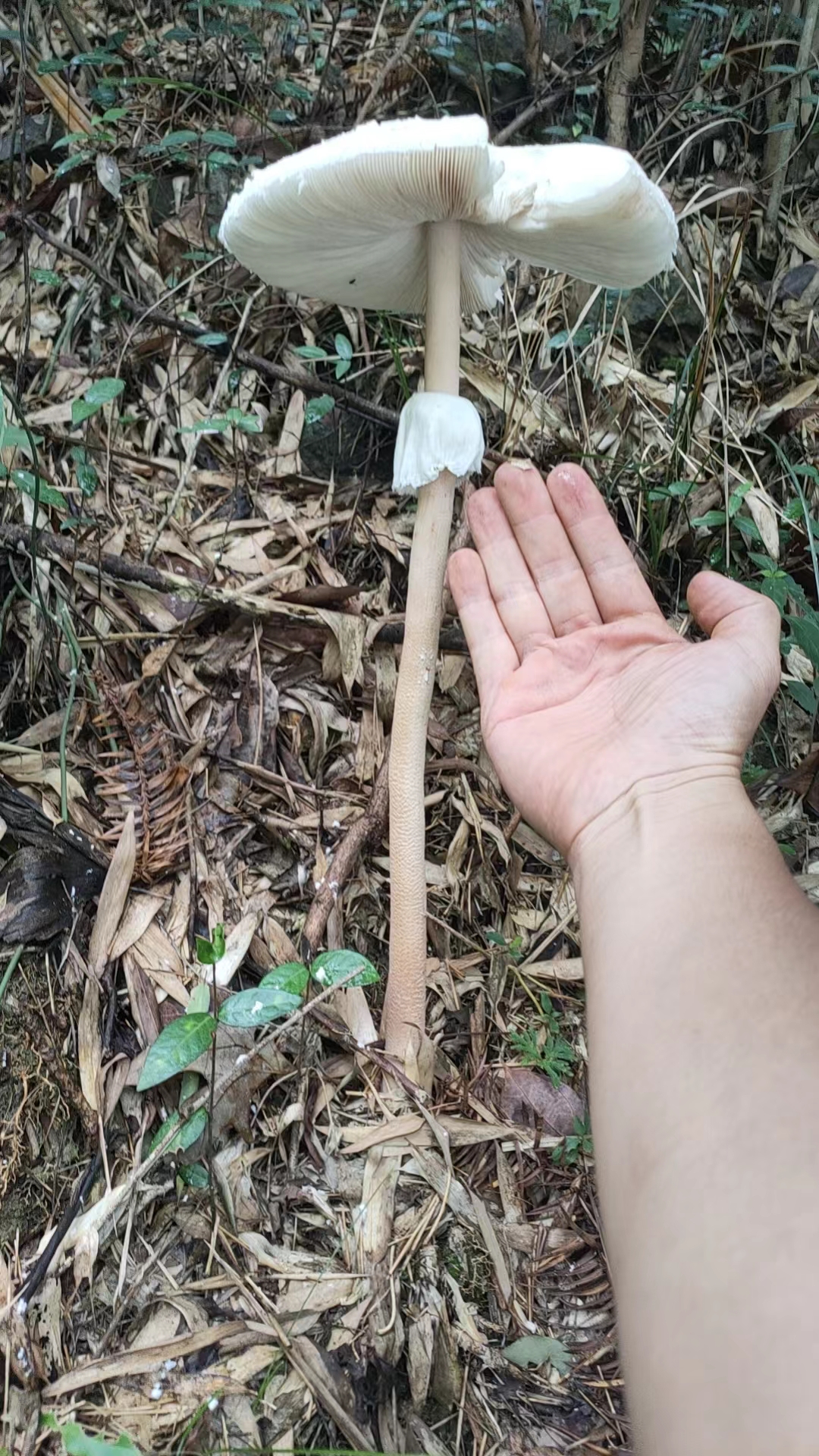
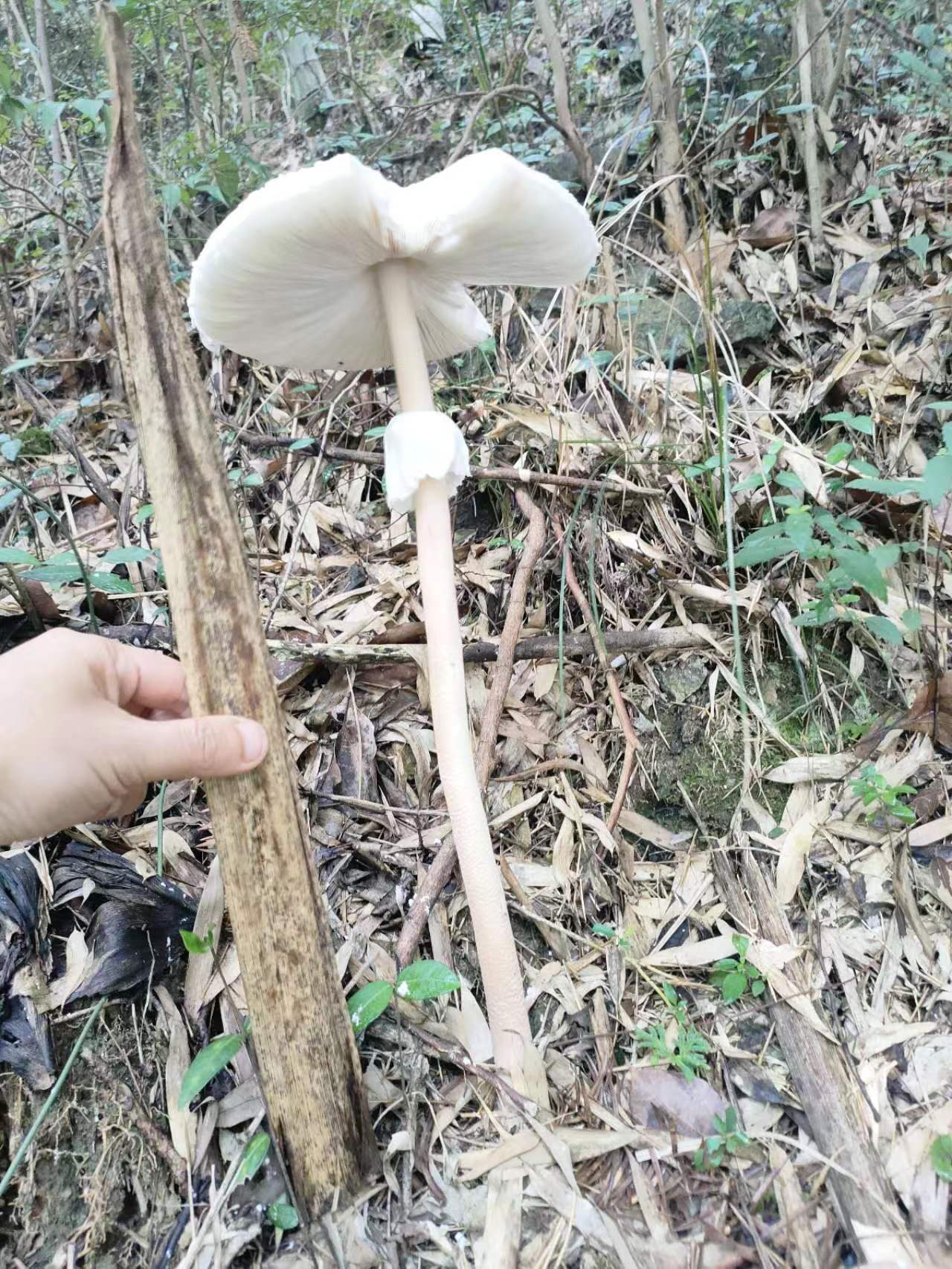
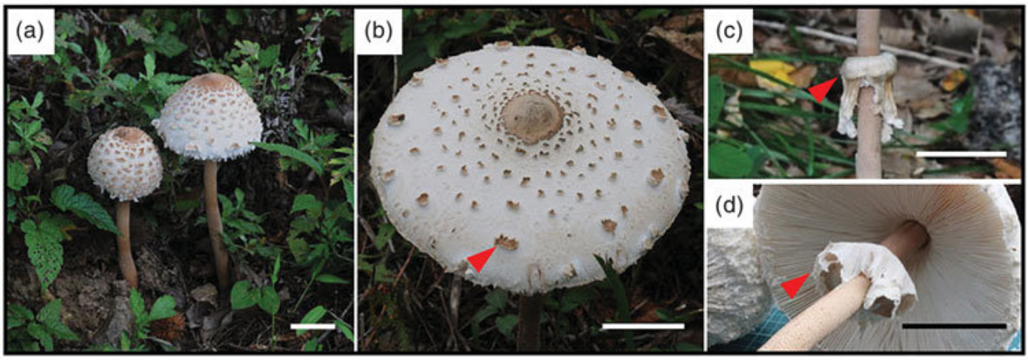
脱皮大环柄菇 图103
Macrolepiota detersa Z.W.Ge, Zhu L.Yang & Vellinga, Fungal Diversity 45: 83, fig. 2, 2010.
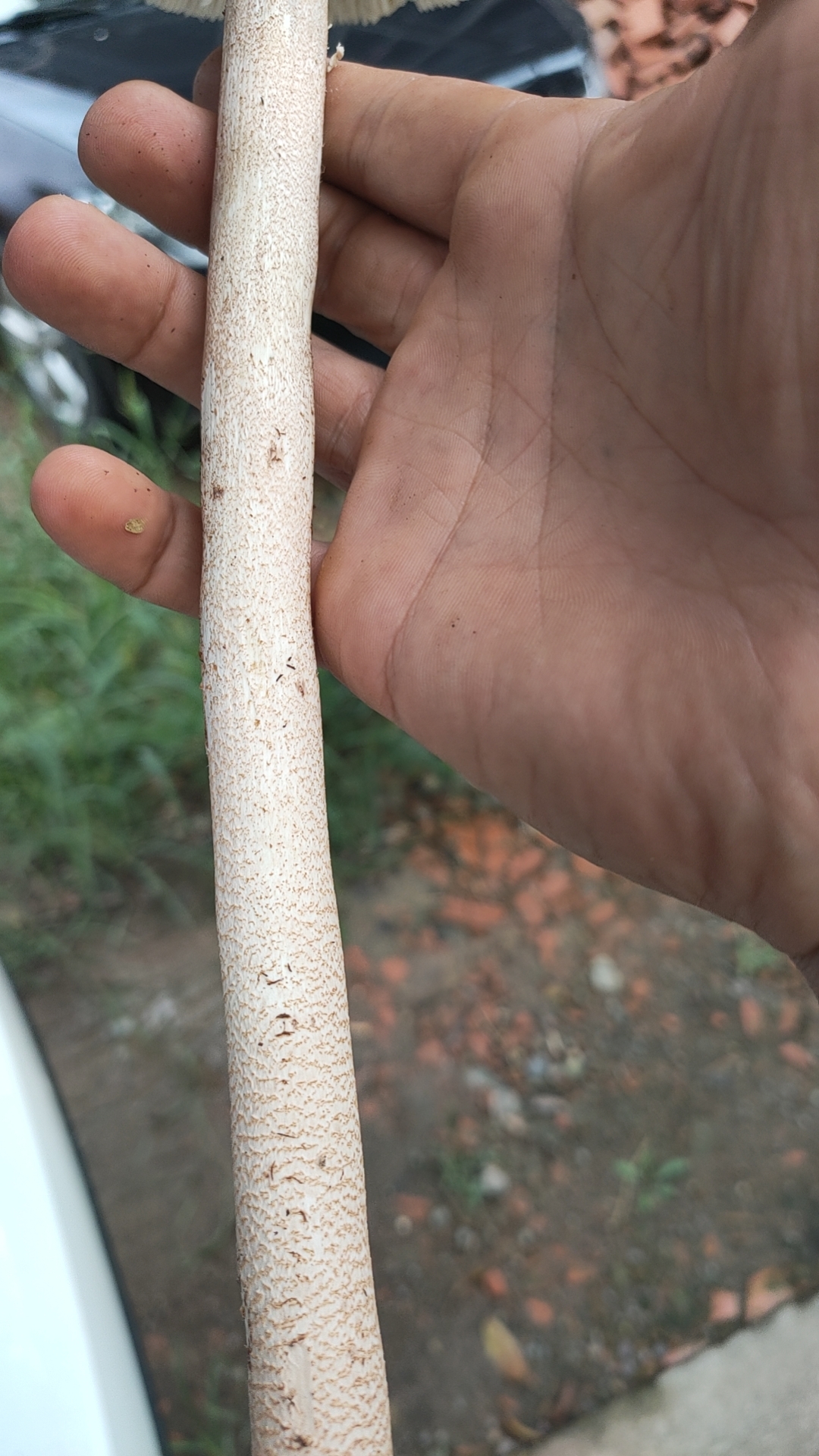
担子果大型。菌盖直径8~12cm;幼时卵球形至半球形,后渐呈平凸形至平展形,白色至近白色,具黄褐色至褐色的片状至壳状、易脱落的鳞片,中央的鳞片不撕裂;菌肉白色至近白色,海绵质,伤不变色;菌褶离生,幼时白色,成熟后呈白色至奶油色,较密,高约1cm,不等长,有时具褐色小斑点。菌柄长13~15cm,直径1.8~2.4cm,近圆柱形,向顶部渐细,基部膨大为近球形,本底近白色,密被褐色细鳞;菌环上位,膜质,较大,近白色,下表面具褐色斑块状细鳞,后期可向上下滑动。无气味,味淡。
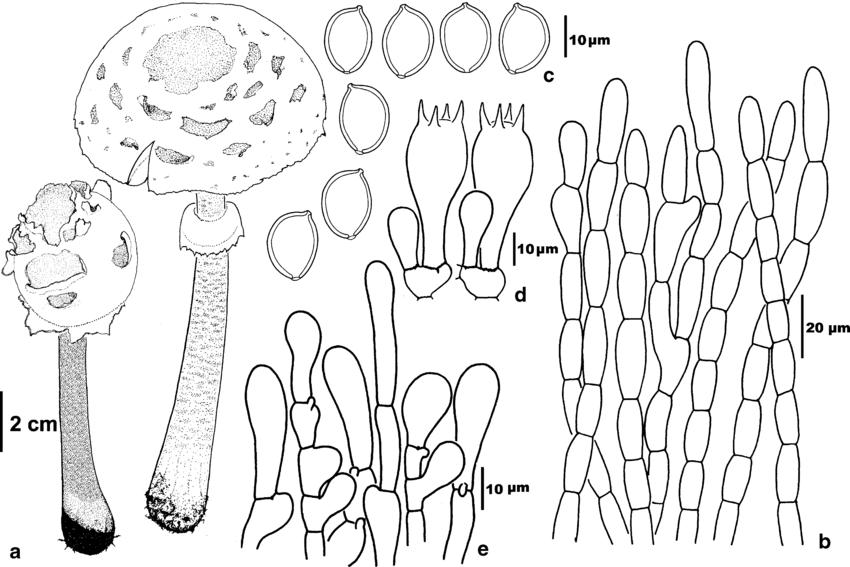
担子30~38x11~15um,棒状,具4孢梗,偶具2孢梗,薄壁,无色,透明;担子基部横隔上常具锁状联合。担孢子14~16(18)x(9)9.5~10.5(11)μm [Q =(1.40)1.43~1.67(1.71),
Q=1.53±0.07],侧面观椭圆形至卵状椭圆形,背腹观椭圆形,壁厚,无色透明,光滑,类糊精质,在刚果红中变红色,内壁遇甲酚蓝变红,孢子顶部具明显的有盖芽孔;小尖长约1μm。褶缘囊状体棒状,宽棒状至梨形,极少数呈近纺锤形,薄壁,无色透明,侧生囊状休阚如,菌盖表面鳞片由呈毛状排列的菌丝组成,菌丝多分隔,但很少分枝,18~40(55)x7~13(15)um,略呈黄褐色,壁稍厚,末端菌丝向顶部渐细;菌丝横隔上无锁状联合。锁状联合见于担子及褶缘囊状体基部。
生境:夏秋单生或散生于竹林中地上。世界分布:亚洲(日本和中国)。模式产地:中国(安徽)。
研究标本:安徽:旌德,云乐,2007年9月27日,侯成林603(HKAS 55306,主模式)。
讨论:脱皮大环柄菇M.detersa的主要特点是担子果大型,白色的菌盖表面上被有易脱落的片状至壳状褐色鳞片,菌柄密被褐色细鳞,菌环较大,褶缘囊状体棒状、宽棒状至梨形。
脱皮大环柄菇与大环柄菇 M.procera极为相似。但是,大环柄菇的菌盖鳞片不易从菌盖表面脱落,菌柄表面的褐色至深褐色的细鳞常形成蛇皮纹状,褶缘囊状体主要呈棒状至囊状,菌盖表面鳞片细胞(25~90x7~14μm)较脱皮大环柄菇的(18~40x7~13μm)长得多。根据ITS 片段的 DNA 序列分析,脱皮大环柄菇的姐妹种为长柄大环柄菇,但是长柄大环柄菇M.dolichaula的菌盖鳞片点状,组成菌盖鳞片的菌丝多分枝,菌柄表面细鳞片为白色。
描述于欧洲的M.prominens(Fr.)M.M.Moser与脱皮大环柄菇也较相似,区别在于 M.prominens菌盖中央具显著凸起,菌褶表面成熟后会变暗(Wasser,1993)。
脱皮大环柄菇可食。
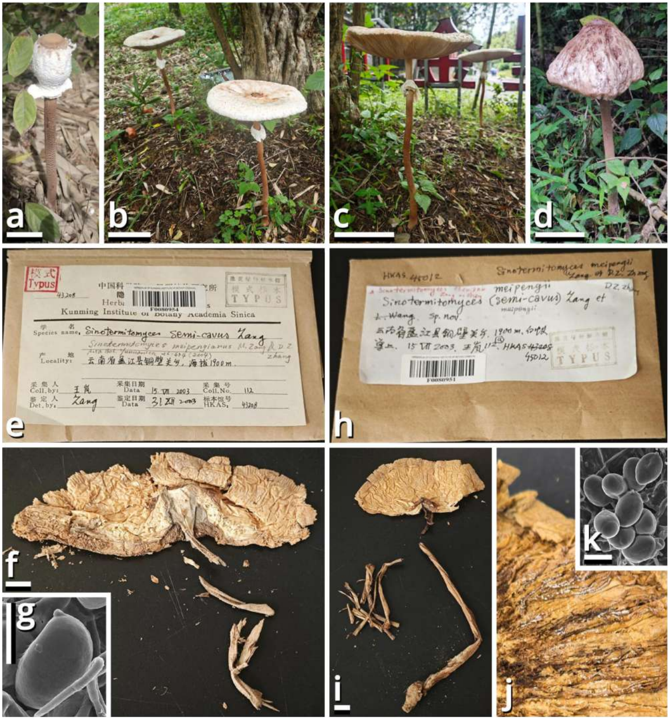
Macrolepiota meipengiana (M. Zang & D.Z. Zhang) Kun L. Yang, J. Y. Tang & Jia Y. Lin, comb. nov. (Fig. 38)
Registration identifier FN573432
Basionym:—Sinotermitomyces meipengianus M. Zang & D.Z. Zhang, Acta Botanica Yunnanica 26 (6): 634 (2004) (≡Termitomyces meipengianus (M. Zang & D.Z. Zhang) P.M. Kirk, Index Fungorum 120: 1 (2014); ≡ Sinotermitomycessemicavus M. Zang, nom. ined.; = Macrolepiota detersa Z.W. Ge, Zhu L. Yang & Vellinga, Fungal Diversity 45: 83(2010))
Holotype examined:—CHINA. Yunnan Province: Dehong Dai and Jingpo Autonomous Prefecture, YingjiangCounty, Tongbiguan Village, exact location unknown, elevation 1,900 m, 15 July 2003, Lan Wang, Lan Wang 112(HKAS43208). It has been contaminated by Aspergillus halophilicus.
Paratype examined:—CHINA. Yunnan Province: Dehong Dai and Jingpo Autonomous Prefecture, YingjiangCounty, Tongbiguan Village, exact location unknown, elevation 1,900 m, 15 July 2003, Lan Wang, Lan Wang 112a(HKAS45012). It has been contaminated by Sarocladium spinificis.
Description based on dried materials from the holotype (HKAS4??0?):—Basidioma large, spotted withmycelia of Aspergillus halophilicus; odour moldy; taste unknown. Pileus about 148 mm broad, plano-concave, creamorange (#FEF3CE) at background, more or less umbonate and covered with a piece of coffee red (#7B5B4E) squamuleat centre, shortly groovily striate at margin. Lamellae free, crowded, dull creamy, with a smooth to serrated edge,interspersed with lamellulae. Stipe fragmented, densely covered with coffee red (#7B5B4E) squamules. Annulus notrecognized among existing materials.
Basidiospores {40/1/1} (12) 12.5–14.5 (15) [13.48 ± 0.78, 13.50] × 8.5–10 [9.28 ± 0.43, 10.00] µm, Q = (1.33)1.35–1.55 (1.65) [1.45 ± 0.08, 1.50], ellipsoid, more or less ovoid to amygdaliform, thick-walled, smooth, palelybrownish, strongly dextrinoid, cyanophilic, with a small apiculus, with an opercular germ pore. Hymenium collapsed.Squamule at pileus centre composed of a palisadoderm to trichoderm by 4–10 µm wide, more or less thick-walled,brownish, moderately compact to compact, frequently septate, rarely branching hyphae. Clamp connections present.
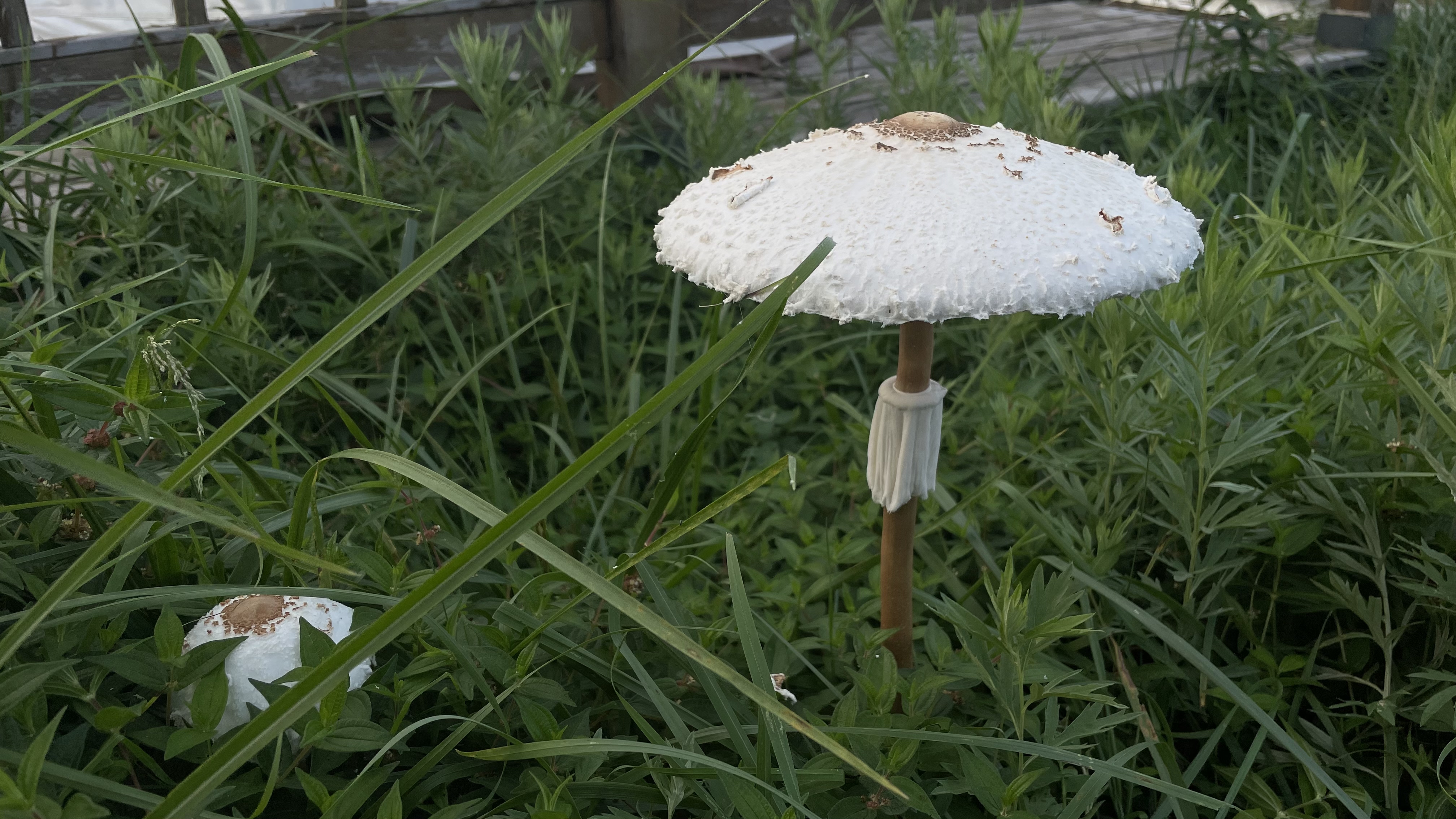
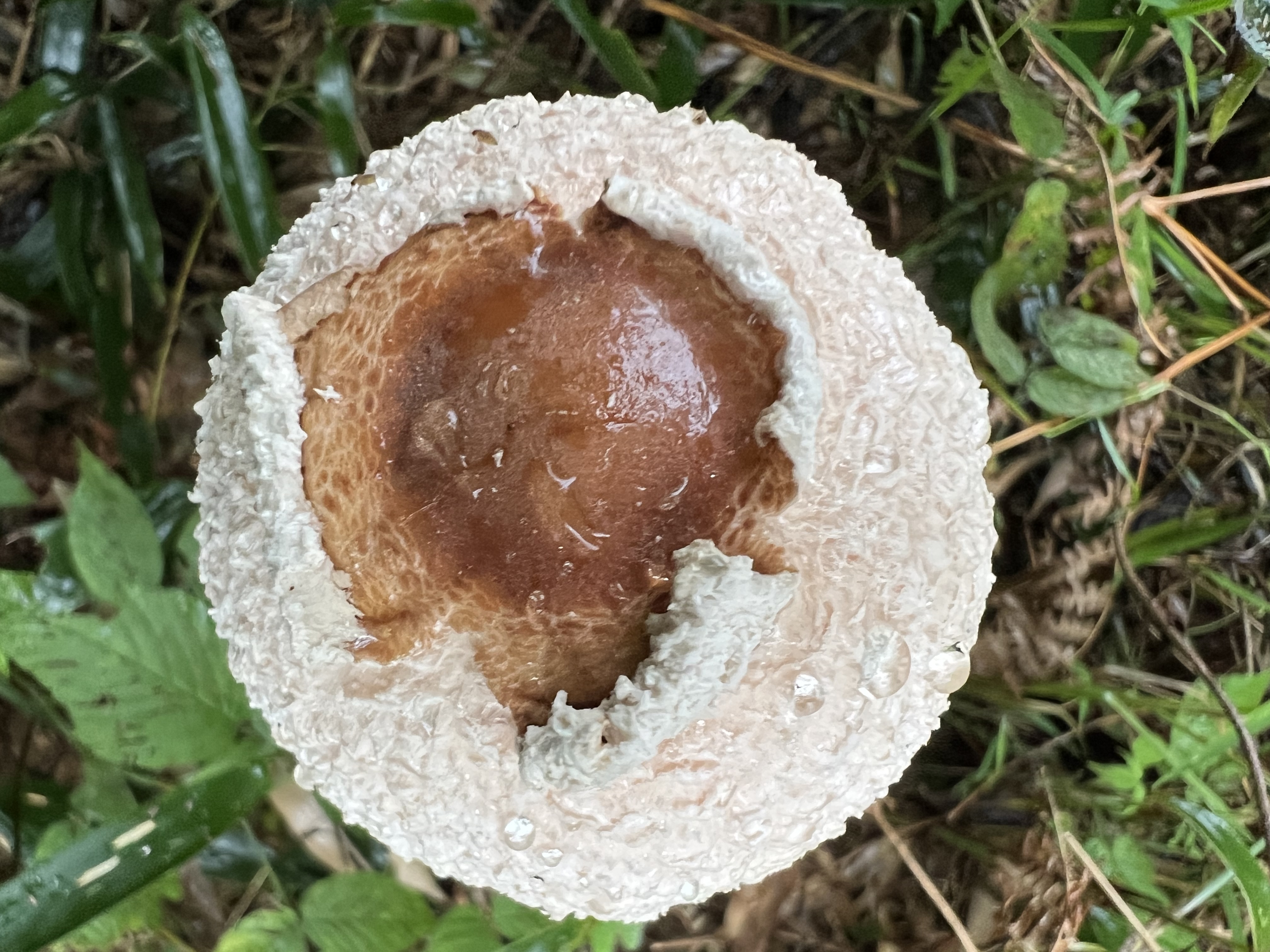
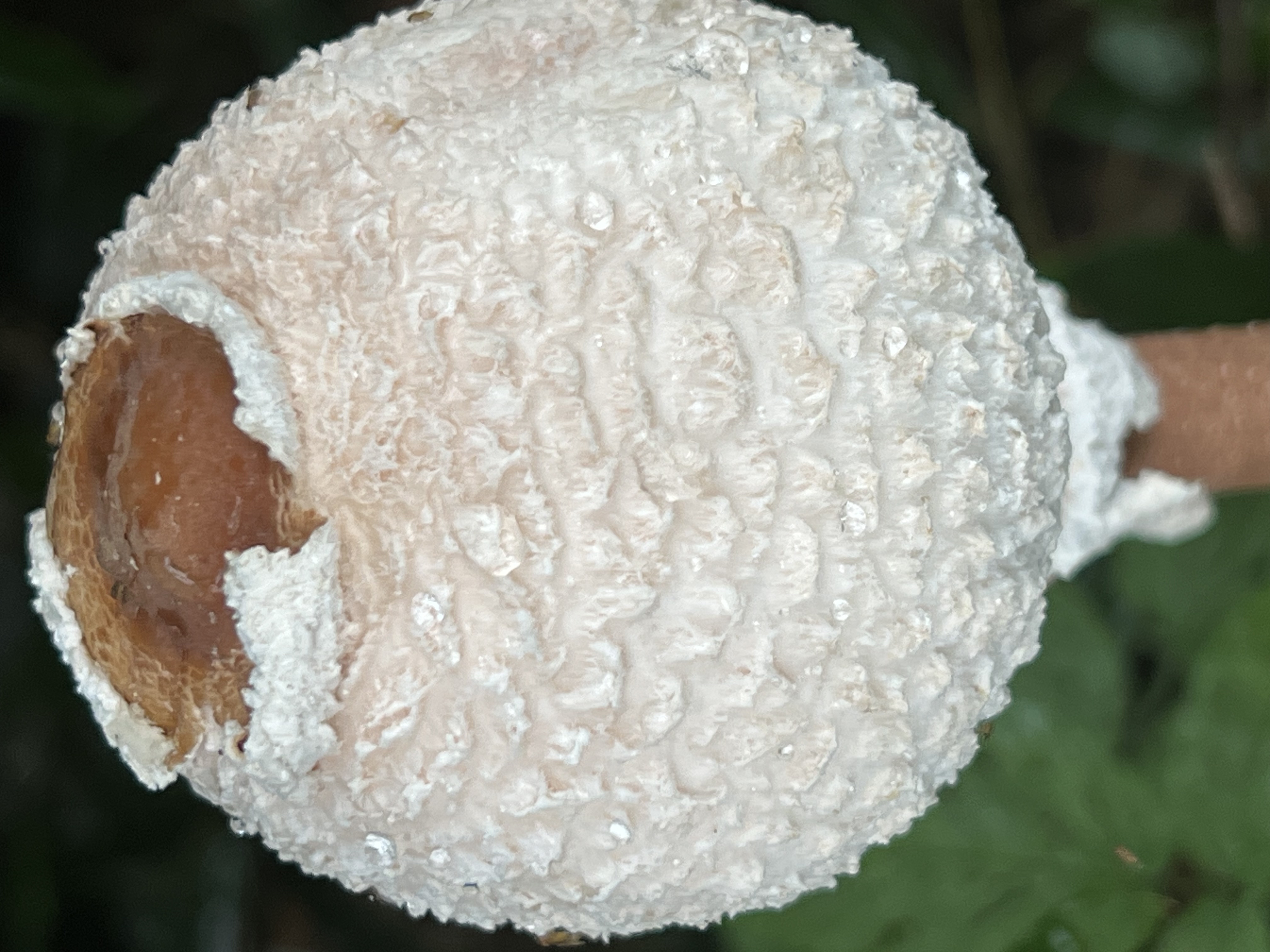
Description based on new collections (HTBM???0 & HKAS???647):—Basidiomata large to huge; odourfungal; taste fungal. Pileus 58–260 mm in diameter, conical at first, becoming plano-concave, more or less umbonateat centre, pure white (#FFFFFF) to ceramic white (#FEFEFA) at background, covered with flaky, cotton brown(#D2CAAD) to beaver brown (#9D7B69) squamules, indistinctly shortly groovily striate at margin. Lamellae free,crowded, ceramic white (#FEFEFA), pale brown (#E3DECC) to turtledove brown (#D0BCA4), with a smooth toserrated edge, interspersed with lamellulae. Stipe 220–450 mm long, 7–18 mm thick, subcylindrical, bulbous at thebase, densely covered with beaver brown (#9D7B69) squamules, rendering a snakeskin-like surface. Annulus superior,conspicuous, persistent, pure white (#FFFFFF) to ceramic white (#FEFEFA).
Basidiospores {40/2/1} (12) 13–17.5 (19) [14.74 ± 1.47, 14.50] × (8.5) 9.5–12.5 (13.5) [10.49 ± 1.15, 10.00] µm,Q = (1.24) 1.30–1.58 (1.60) [1.41 ± 0.09, 1.33], ellipsoid, more or less ovoid to amygdaliform, thick-walled, smooth,palely brownish, strongly dextrinoid, cyanophilic, with a small apiculus, with an opercular germ pore. Hymeniumcollapsed. Squamule at pileus centre composed of a palisadoderm to trichoderm by 5–14 µm wide, more or less thick-walled, brownish, moderately compact to compact, frequently septate, rarely branching hyphae. Clamp connectionspresent.
Other collections examined:—CHINA. Yunnan Province: Dehong Dai and Jingpo Autonomous Prefecture,Yingjiang County, Tongbiguan Nature Reserve, exact location unknown, 7 August 2022, Zi-Rui Wang, Xue-PingFan, Zhu L. Yang, Kun L. Yang et al., WZR095 (HKAS139647). Anhui Province: Bengbu City, Yuhui District,32°55’37”N, 117°13’53”E, elevation 71 m, 20 September 2025, Xinyi Zhang, Ming Liu, Kun L. Yang & Jia Y. Lin,S25135 (HTBM3520).
Notes:—This species was interpreted as possibly close to Oudemansiella Speg. or Xerula Maire by Wei et al.(2009), and overlooked in a study on termitomycetoid fungi in China by Yang et al. (2025d). Only a holotype anda paratype, cited in the protologue (Zang & Zhang 2004), are known for this species, and these two specimens areactually two sections from a single basidioma, as examined by Kun L. Yang (Fig. 38). The preliminary genomesequencing on its holotype by Tang (2025) detected an ITS sequence conspecific with Macrolepiota detersa. Therepeating sequencing by Kun L. Yang yielded a genome with better completeness, yet with two ITS sequences found,one still conspecific with M. detersa (GenBank No. PX939617) and the other with Aspergillus halophilicus M. Chr.et al. (not uploaded). The presence of Aspergillus halophilicus has also been confirmed by observations and a Sangersequencing test (GenBank No. PX857148). Combining the morphology of type materials, Kun L. Yang has no doubt that this species and M. detersa are conspecific.