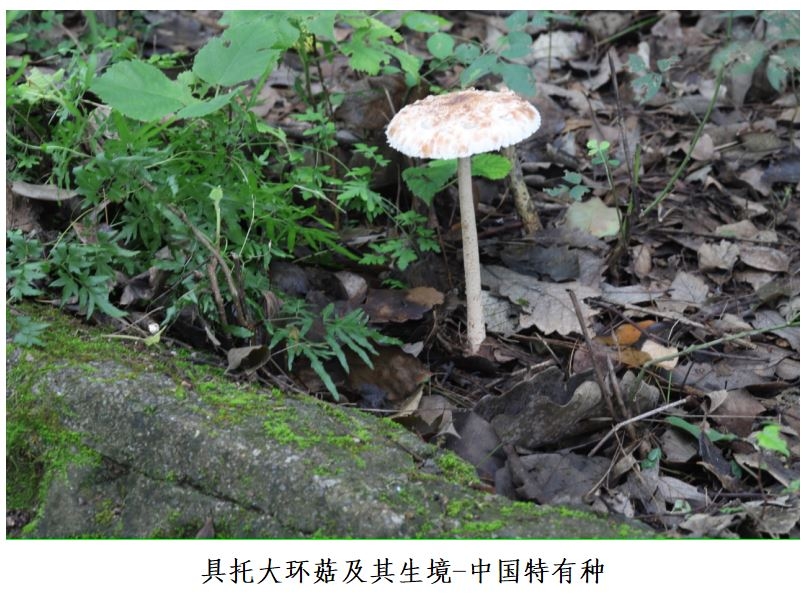
Macrolepiota velosa Vellinga & Zhu L. Yang, spec. nov. — Fig. 1.
Pileus squamis brunneis, et pannis volvatis albidis, stipes basi volvatus, sporae 8.0-10.0 x 6.0-7.0 tum, cheilocystidia 44-68 x 4.5-7.5 um, cylindracea, fibulae non observatae.
Typus hic designatus: “China, Yunnan Prov.: Jinghong, Damenglong, 14-VIII-1995, Z. L. Yang 2172 (Holotypus HKAS 29487; isotypus L)”.
Pileus 7-9 cm, plano-convex with wide indistinct umbo, dark brown and tufted-plushy at centre, around centre with brown to dark brown squamules, sometimes with purplish tinge, on brownish to pale brownish or grey with purplish tinge, radially fibrillose background, and with white to dirty white membranous volval remnants as patches on the surface. Lamellae free and remote from stipe, not ventricose, whitish, with white cystidiose edge. Stipe 10-17 x 0.4-1.0 cm, cylindrical, widened at utmost base (up to 1.3 cm), brownish to purplish brown, paler at apex, finely fibrillose or squamulose, hollow. Annulus ascending, whitish on upperside with brown rim, and brownish underside. Volva limbate, white, membranous. Context in pileus white, in stipe white, with pinkish to brownish tinge. Smell indistinct. Taste indistinct or mild.
Spores [56, 5, 4] 8.0-10.0(-11.0) x 6.0-7.0 pm, avl x avw = 9.3 x 6.6 um, Q = 1.3 1.5, avQ = 1.4, amygdaloid-ellipsoid in side-view, ellipsoid in frontal view, with thickened wall, with apical central germ pore, covered by a hyaline cap, congophilous, cyanophilous, dextrinoid, and metachromatic in Cresyl Blue. Basidia 25-30 x 9.5-11.5 um, 4-spored, without clamp connection. Lamella edge sterile, made up of tightly packed cheilocystidia. Cheilocystidia 44-68 x 4.5-7.5 um, cylindrical, some slightly widened at apex, with rounded apex, with greyish-granular contents, and refractive patch at apex. Pleurocystidia absent. Squamules on pileus made up of ellipsoid to subglobose brown-walled elements in chains; terminal elements up to 100 x 25 um, often clavate or broadly clavate; some brown cylindrical hyphae, 5-8 um in diameter present as well; squamules at centre rather regular (see Fig. 1), close to pileus margin more irregularly arranged, with a wider range of cell sizes. Velar patches made up of hyaline, non-coloured, cylindrical narrow hyphae, c. 2-4 im wide. Stipitipellis a cutis of brown-coloured hyphae with irregular loose-lying, cylindrical hyphae, c. 5-10 um in diameter. Clamp-connections not observed at base of basidia, cheilocystidia, nor in pileus covering and velum remnants.
Habitat & distribution. — Solitary, terrestrial in dry monsoon forest, in tropical limestone monsoon forest, and in tropical seasonal forest, 600-800 m a.s.l. Probably not uncommon in Yunnan.
Collections examined: China, Yunnan Prov., Jinghong, Damenglong, 14-VIII-1995, Z.L. Yang 2172 (Holotype HKAS 29487, isotype L) (nrITS sequence GenBank accession number AF482853); Mengla County, Menglun Nature Reserve, 12-VIII 1988, Z.L. Yang 381 (HKAS 21808); ibidem, 2-1X-1990, Z.L. Yang 1271 (HKAS 23312); Mengla County, Menglun, Botanical Garden, 21-X-1989, Z.L. Yang 767 (HKAS 22131).
Macrolepiota velosa Vellinga & Zhu L. Yang inMycotaxon 85: 184. 2003.
Basidiomata (Fig.7a) medium to large-sized. Pileus 7–9 cm in diam., plano-convex, with a wide indistinct umbo,purplish to pale brownish or grey with purplish tinge,fibrillose, covered with brown to dark brown furfuraceoussquamules; disc smooth, dark brown. Sometimes withwhite to dirty white membranous volval remnants aspatches on the surface. Lamellae free, remote from thestipe, moderately crowded, white to cream color ed, withwhitish cystidiose edge. Stipe brownish to purplish brown,cylindrical, 10–17×0.4–1.0 cm, attenuating and palerupwards, with fine fibril s or squamules, hollow; baseslightly enlarged up to 1.3 cm. Annulus ascending, whitishon upperside with brown rim, and brownish underside,membranous. Volva limbate, white, membranous. Contextwhite, with pinkish to brownish tinge both in pileus andstipe, odorless. Smell indistinct. Taste mild or indistinct.
Basidiospores (Fig. 7c)[145/6/6] (8.0) 9.0–11.0 (11.5)×(5.5) 6.0–7.5 (8.0) μm, Q=(1.2)1.36– 1.5 (1.62), avQ=1.42±0.06, amygdaloid-ellipsoid in side view, ellipsoid infront view, thick-walled, smooth, hyaline, dextrinoid,congophilous, metachromatic in cresyl blue, with a germpore caused by an interruption in the episporium on therounded apex, covered with a hyalinous cap in KOH,apiculus not distinctive, about 1 μm long. Basidia (Fig. 7d)25–30×9.5–11.5 μm, clavate, 4-spored, without clampconnections. Cheilocystidia (Fig. 7e)44–68×4.5–7.5 μm,cylindrical, some slightly widened at apex, with roundedapex, with grayish granular contents, and refractive patch atapex, thin-walled, forming a sterile edge. Pleurocystidiaabsent. Squa mules on pileus (Fig. 7b) a palisade ofellipsoid to subglobose, clampless elements (20–65 μm inlength, 5–10 μm in diam.) in chains, rarely branched, withclavate to narrowly clavate terminal elements (up to 100×25 μm), slightly thick-walled, brownish, interspersed withsome cylindrical hyphae 5 – 10 μm wide. Velar patchesmade up of hyaline, non-colored, cylindrical narrow hyphaeabout 2–4 μm. Clamp connections not observed at thebase of basidia, cheilocystidia.
Habitat and known distribution in China: Terrestrialand saprotrophic, solitary to scattered on the ground inmixed forest. So far only found in Yunnan and Hainan.
Materials examined: Yunnan Province: Jinghong City,Damenglong, alt. 650 m, 14 Aug. 1995, Z. L. Yang 2172(HKAS 29487); Mengla County, Menglun Natural Reserve,alt. 700–800 m, 2 Sept. 1990, Z. L. Yang 1271 (HKAS23312); Mengla County, Menglun Nature Reserve, alt.580 m, 12 Aug. 1988, Z. L. Yang 381 (HKAS 21808);Mengla County, Menglun, Botanical Garden, alt. 580 m,12 Oct. 1989, Z. L. Yang 767 (HKAS 22131). HainanProvince:Changjiang County, Bawangling Nature Reserve, alt. 680 m, 19 Aug. 2009, N. K. Zeng 518 (HKAS58050); same locality, alt. 693 m, 23 Aug. 2009, N. K.Zeng 562 (HKAS 58051).
Comments: The distinctive characters of M. velosa arethe basidiomata with a volva at the base of the stipe,sometimes with white to whitish volval remnant patches onthe pileus; small basidiospores and the squamules made upof ellipsoid to subglobose brown-walled elements in chainsinterspersed with some brown filamentous hyphae.
Comparing to other Macrolepiota species with a volva,M. pulchella de Meijer & Vellinga from Braz il differs fromM. velosa by longer basidiospores (10.0–14.5×6.0–7.5 μm), shorter cheilocystidia (23– 42 μm), and thesquamules made up of clavate elements and long, colorlessemerging hyphae; M. eucharis Vellinga & Halling fromAustralia differs in larger basidiospores (10.8–15.5×7.0–9.0 μm), wider and shorter cheilocystidia (25–53×5.0–12.0 μm), and squamules lacking ellipsoid to globose orclavate elements. Macrolepiota brunnescens Vellinga, alsofrom South America, has velar patches on the pileus, butbecomes brown in all part. Macrolepiota clelandii Grgur.superficially resembles M. velosa, but differs from the latterby the absence of a volva at the base of the stipe, thepredominantly 2-spored basidia, and much bigger spores upto 28.5×15.5 μm (Vellinga 2003).
Macrolepiota velosa is also known from northern Thai-land; its edibility remains unknown.