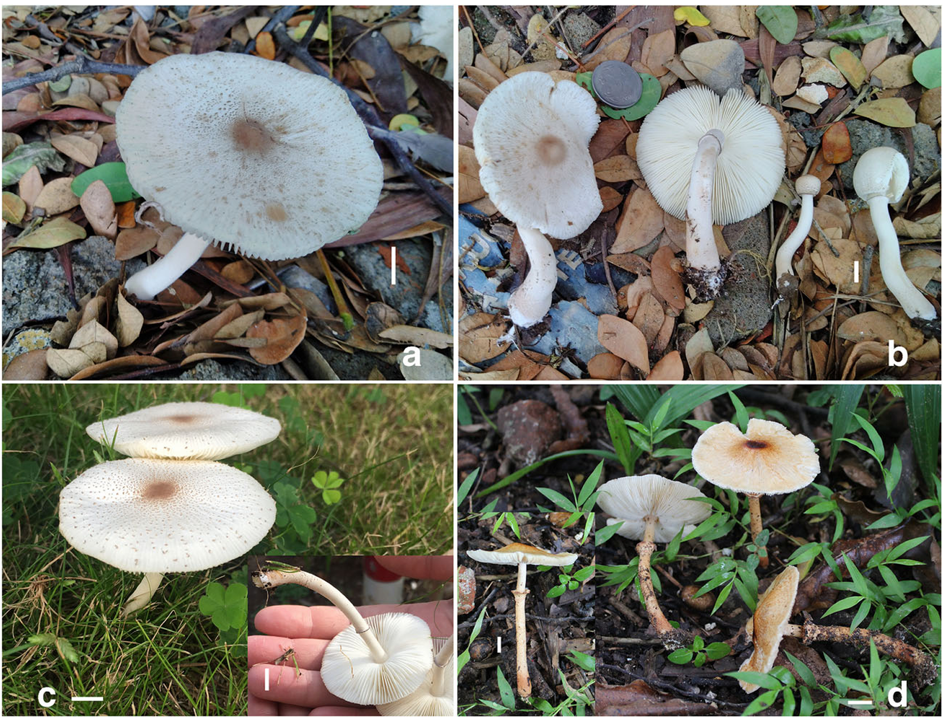
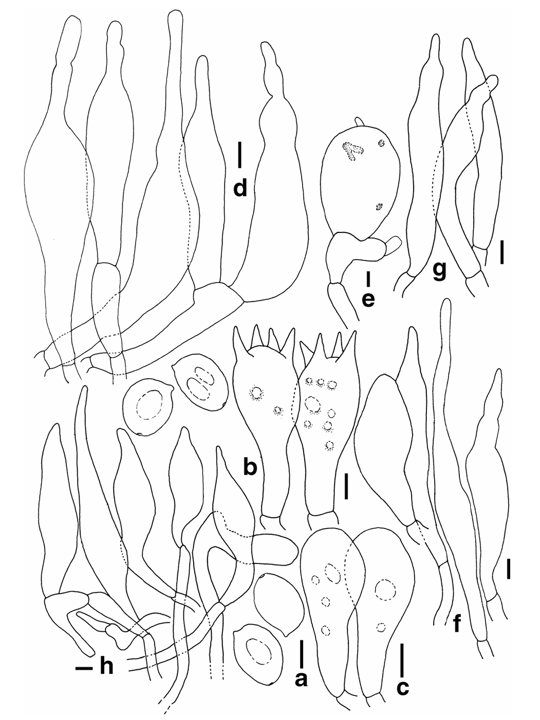
Leucoagaricus tropicus A.K. Dutta, Stallman & K. Acharya, sp. nov. Fig. 2a–c, 3
MycoBank: MB 836008
Diagnosis. Differs from La. meleagris by lack of yellow colouration of the basidiocarp before turning red when cut, presence of dimorphic cheilocystidia and smaller cystidioid pileipellis elements; from La. americanus by smaller basidiomata with white stipe and context turning directly brownish-red to brown; from La. majusculus by its almost smooth stipe, presence of narrowly clavate to narrowly fusi form cystidioid elements in the annulus and dimorphic cheilocystidia.
Holotypus. India, West Bengal, North 24 Parganas District, Barasat, near Kazibari, 22°44'46.4"N, 88°26'43.3"E, 9 m asl., 31 July 2019, A.K. Dutta & S. Paloi, CUH AM699.
Etymology. The epithet ‘tropicus’ refers to the tropical climatic condition of the places where the species was collected.
Basidiomata medium to large (Fig. 2a–c). Pileus 60–78 mmdiam., hemispherical to parabaloid when young, becom ing convex, then almost applanate or with upturned margin on maturity, often with an obtuse central umbo, umbo brown (6E4) to dark brown (6F6), elsewhere white with brown (6E4) to dark brown (6F5) fibrillose squamules radiating from the disc, surface turning light brownish with KOH, becoming greyish-yellow (4B3) to yellowish-brown (5D5) or light brown (5D6) with yellowish-brown (5E5) to dark brown (6F6) centre on drying, squamules easily peeling off on bruis ing, semimoist, margin striate, sometimes rimose; context ca. 5-mmthick towards centre, gradually thinner towards margin, white, turning brownish-red to brown with KOH. Lamellae 2-8-mm broad, free to slightly adnexed, moderately crowded with two series of lamellulae, white, light brownish with KOH, light brown (5D6) on drying, margin entire, concolourous. Stipe 63–95 (105) × 6–8(9)mm,central,cy lindrical, gradually broader towards base (11–14.5-mm wide), mostly curved, surface white, turning brick red on bruising, initially brownish-red and then turning light brown to brown with KOH, brown (6F4) to dark brown (6F5–6) on drying, smooth, slightly squamulose towards base, basal mycelia white; context ca. 2-mm thick, turning brownish-red to brown with KOH. Annulus present, persistent, ascending, white at upper side, greyish-brown (6–7F3) to brown (6F4) below. Odour indistinct. Taste not recorded.
Basidiospores [60,3,2] in side view (7.7) 9.5–10.5 (12) × 7.2–7.5 (8.5) μm, Q =1.03–1.6 [Xm =9.9±0.7×7.5±0.3, Qm = 1.3 ± 0.1], light brownish when viewed with KOH, ellipsoid, with inconspicuous germ pore, dextrinoid, congophilous, metachromatic in Cresyl Blue, with one to two guttules when viewed with KOH, thick-walled, wall 1.0–1.3-μm thick (Fig. 3a). Basidia (28) 31–33 (35) × 10–11 (13) μm, clavate, guttules present when viewed with KOH, thin-walled, basal clamps absent, predominantly 4-spored, oc casionally 2-spored, sterigmata 2.5–5-μm long, cylindrical (Fig. 3b). Basidioles 20–23 (25) × 8–10 (11) μm, clavate, guttules present when viewed with KOH, thin-walled (Fig. 3c). Pleurocystidia absent. Lamella edge sterile with crowded cheilocystidia. Cheilocystidia dimorphic: (a) (20) 35–52.5 (60) × (6.5) 10–12.5 (15.5) μm, narrowly clavate to clavate or narrowly fusiform, thin-walled, with brownish intracellular pigments, with apical excrescences, measuring (10) 15–25 (37.5)-μm long, sometimes moniliform (Fig. 3d); (b) 34–50 (53) ×20–24(27.5)μm,clavatetofusiform-clavateorbroadly clavate, with brownish contents or scattered granules, thin walled, sometimes with a short apical excrescence; sometimes outgrowth of the basal hypha appears asa clamp-like structure (Fig. 3e). Lamella trama hyphae (7.5) 10–12.5 (15.5)-μm broad, interwoven, hyaline, thin-walled. Pileus covering a trichoderm with upright cystidioid elements arising from a cutis of repent hyphae, 2.5–5-μm broad, rarely branched, hy aline or sometimes with brownish encrustations, thin-walled; upright elements (27) 50–65 (90) × (8) 12–15 (16) μm, nar rowly clavate to fusiform, sometimes with apical excres cences, yellowish-brown when viewed with KOH, thin- to slightly thick-walled (Fig. 3f). Pileus trama hyphae (5) 7.5 12 (15.5)-μm broad, interwoven, hyaline, sometimes branched, thin-walled. Stipitipellis a cutis, hyphae 5–10 (12)-μm broad, hyaline to pale brownish when viewed with KOH, thin-walled. Caulocystidia 43–56 × 5.5–8 μm, narrow ly clavate to narrowly fusiform, with narrow, long appendices, measuring 6–8(24)×2–3 μm, scattered, hyaline, thin-walled (Fig. 3g). Stipe trama hyphae (12) 18–20 (25)-μm broad, more or less parallel, mostly with brownish encrustations, thin-walled, often outgrowths near septa appears to form clamp-like structures; oliferous hyphae occasionally present, 7–8-μm broad, pale yellowish. Annulus hyphae of the white upper side (2.5) 3–4.5 (5)-μm broad, hyaline, rarely branched, thin-walled; hyphae of the grey and brown bottom side com posed of elements as in the pileus covering, 35–60 (75) × 8 12.5 (15) μm, narrowly clavate to narrowly fusiform, some times with narrow, long appendices, measuring 8–15 (18) × 2–3(4)μm,hyaline,thin-walled (Fig. 3h).Clamp connections absent.
Habit and habitat. In India, solitary to gregarious in small groups, terrestrial on soil mixed with leaf litter, in roadside vegetation covered by planted deciduous trees, such as Lagerstroemia sp. and Albizia lebbeck. In Hawai‘i, USA, scattered in grass in disturbed urban environment.
Additional specimens examined. India, West Bengal, North 24 Parganas District, Barasat, Jagannathpur, 22°44'41.4"N, 88°26'33.2"E, 8.0 m asl., 05 August 2019, A.K. Dutta & S. Paloi, CUH AM707; USA, Hawai‘i, O'ahu, UH Mānoa Campus, ~29 m asl., 02 November 2017, Sean Swift, HAW F-00249.
Remarks. Leucoagaricus tropicus is distinguished by its medium-sized pileus coloured white with brown to dark brown fibrillose squamules radiating from the disc; stipe sur face and context coloured white turning directly brownish-red to brown on bruising or with KOH; ellipsoid basidiospores with inconspicuous germ pore; dimorphic cheilocystidia; nar rowly clavate to narrowly fusiform cystidioid elements in the annulus; and a trichoderm type pileus covering with narrowly clavate to fusiform cystidioid elements.
Leucoagaricus tropicus is distributed across the tropical regions of three different countries (viz. India, the USA and Australia). Morphologically, the collection from Hawai‘i, USA, was indistinguishable from Indian collections. However, the Indian and American collections were not mor phologically compared with the Australian collection as it was not available for study.
Considering similar reddening reaction of the stipe surface and presence of cystidiform elements in the pileipellis, two Sri Lankan species, Leucocoprinus holospilotus (Berk. & Broome) D.A. Reid and Lc. biornatus (Berk. & Broome) Locq., appear to be close to La. tropicus. However, Lc. holospilotus has a pale pinkish pileus with scattered brown-purple scales, yellowish lamellae, a movable annulus coloured brown-purple and much smaller basidiospores measuring 7.62-μm long (Berkeley and Broome 1871;Reid1990). Leucocoprinus biornatus primarily differs from La. tropicus by its caespitose habit and much smaller basidiospores measuring 7–8.5 × 5–6 μm(Berkeley and Broome 1871;Reid1990).
The Indian species La. lacrymans (T.K.A. Kumar & Manim.) Z.W. Ge & Zhu L. Yang also shows a reddening reaction of the basidiocarp and appears in the same clade as La. tropicus (Fig. 1), but it differs by the presence of golden yellow to reddish-brown watery exudates on the basidiocarps, changing of the lamella colour from white to yellowish-white and then reddening and narrowly cylindrical to flexuose cheilocystidia with an ob tuse apex (Kumar and Manimohan 2004). Leucoagaricus majusculus T.K.A. Kumar & Manim. has considerably larger (113–125 × 9–13 mm) densely fibrillose to villose stipe covered entirely with brown squamules, longer basidiospores (mean val ue of 11.7 × 7.7 μmvs.9.9×7.5μminLa. tropicus), mono morphic, larger cheilocystidia (17–75 × 6–30 μm), considerably larger cystidioid elements of the pileipellis (36–117 × 4–27 μm) and habitat on decomposing sawdust (Kumar and Manimohan 2009).
Among other species with similar reddening reaction, two species described from the southern part of the USA and from the Caribbean, Lepiota besseyi is readily distinguished by the presence of abundant pleurocystidia and much longer pileocystidia measuring 45–240 × 9–20 μm(Smithand Weber 1987); Lepiota jamaicensis Murrill predominantly grows on dead wood and has a caespitose habit, a minutely scaly umbo, a movableannulusandmuchlongerpileocystidia (95–140-μmlongvs27–90-μmlonginLa. tropicus; Smith and Weber 1987).
Among phylogenetically related species, the Chinese tax on, Leucoagaricus sinicus, differs from La. tropicus by its pileus surface coloured vinaceous-cinnamon with darker disc, an annulus with pinkish upper surface, presence of irregularly cylindrical and sinuous cheilocystidia measuring 50–150 × 3 13 μm and much longer (50–200 × 5–20 μm) subcylindrical to lanceolate caulocystidia (Ying 1995;Yang2007). Leucoagaricus meleagris is readily distinguished from La. tropicus by cystidia shape, caespitose growth habit and the intermediate yellow colouration before turning to red on bruising or when cut (Vellinga 2001).