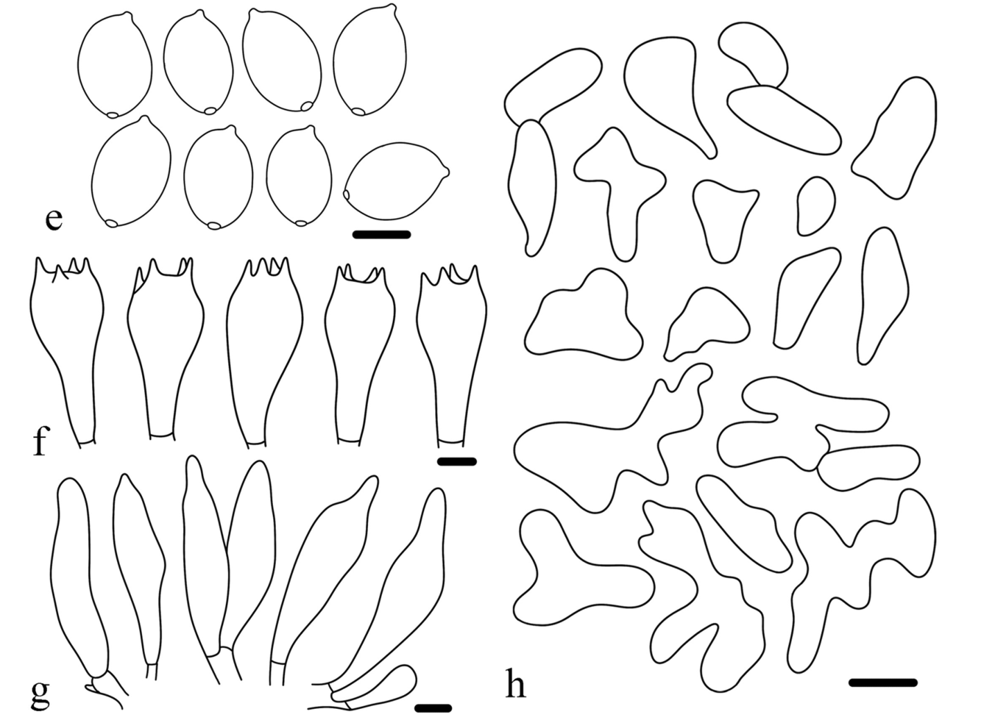
Conioexocarpus cretaceus (Bull.) R.L. Zhao & J.X. Li,comb. nov. Fig. 16
Chinese name: 石灰粉鳞伞 (Pinyin: shí huī fěn lín sǎn)
Fungal Names registration: FN 572647
Basionym: Agaricus cretaceus Bull., Herb. Fr. (Paris) 8:pl. 374 (1788)
Macroscopic description: Pileus 25–60 mm broad, hemi-spherical when young, expanding to plano-convex or cam-panulate; margin decurved, slightly sulcate-striate. Surfacedensely covered with soft floccules when young, which col-lapse or wear off easily, leaving a farinose coating, lightbuff to white at the center, white elsewhere. Lamellae freeand rather distant, moderately broad and thin; white, withslightly fimbriate edges. Stipe 50–80 mm long, 4–6 mm wideat the apex, gradually expanding downward to a broadlyclavate to somewhat fusiform base, 6–14 mm wide; some-times coarsely farinose to slightly flocculose-farinose belowthe annulus, subfarinose above; white to ivory with a yel-lowish tint. Annulus white, soft, rather flaring, located at themedian to superior position.
Microscopic description: Basidiospores[44/2/2], 9.0–10.4(11.9) × (5.6)6.0–6.9(7.6) μm,X = 9.8 ± 0.7 × 6.5 ± 0.4 µm, Q = 1.4–1.6, Qm = 1.5 ± 0.1,ellipsoid to amygdaliform, thick-walled, metachromatic inCresyl Blue, dextrinoid, with a distinct apical germ pore.Basidia 25–27 × 10–11 μm, pyriform to clavate with a bul-bous base, 4-spored, surrounded by four pseudoparaphy-ses. Pseudoparaphyses 10–13 × 7–10 μm, sphaeropedun-culate to broadly clavate or pyriform, with a very broadpoint of attachment. Cheilocystidia 27–75 × 7–18 μm, hya-line and thin-walled, subcylindrical to narrowly fusiformor slightly lageniform, usually mucronate, occasionallyobtuse, moderately pedicellate. Pileus covering composedof slightly inflated to cylindrical, irregular, short, non-pigmented hyphae. Clamp connections absent.
Habitat and distribution: Saprotrophic and thermo-philic. Typically found solitary or in clusters on nutri-ent-rich, humicolous substrates. In temperate regions, itis almost exclusively found indoors in potted plants orgreenhouses. In tropical and subtropical regions, it alsooccurs outdoors on soil, woodchips, and compost heaps.Cosmopolitan, with records from Africa, the Americas,Asia, and Europe.
Specimens examined: China, Beijing, Changping Dis-trict, Guanniufang Village, Guanniufang Country Park, 10Aug. 2023, J.X. Li, ZRL20233123 (HMAS); ZRL20233128(HMAS); ZRL20233129 (HMAS); China, Yunnan Province,Baoshan City, Gaoligongshan National Nature Reserve, 2Aug. 2017, W.H. Qi, glgs20170097.
Notes: In the phylogenetic tree (Fig. 5), Coe. cretaceusforms a fully supported subclade, sister to the remainingspecies within Conioexocarpus. While Coe. cretaceus ismorphologically quite different from the other species nowplaced within this genus. Among the related species, Conio-exocarpus amazonicus, described from Colombia, differsmacroscopically by its dark brown fibrils and squamules ona white pileus surface. Microscopically, it produces smallerbasidiospores measuring 4.0–6.0(–7.0) × (3.0–)3.5–4.0(–5.0) µm (Ortiz et al. 2008). Conioexocarpus attinorum andCoe. dunensis, both described from Brazil, share a pileuswith a brown center that breaks into small, radially arrangedscales toward the margin, which easily distinguishes themfrom Coe. cretaceus. Additionally, both species possesshighly variable cheilocystidia, which are clavate to lageni-form, often bearing a long projection or an apical cylindricalexcrescence (Urrea-Valencia et al. 2023).
参考翻译:
石灰粉鳞伞Conioexocarpus cretaceus (Bull.) R.L. Zhao & J.X. Li, comb. nov. 图16
基原异名:Agaricus cretaceus Bull., Herb. Fr. (Paris) 8: pl. 374 (1788)
宏观描述:菌盖宽25–60毫米,幼时半球形,后平展呈凸镜形或钟形;边缘下弯,具微弱沟纹。幼时表面密被柔软絮状物,易脱落或磨损,留下粉状覆盖层;中部浅米色至白色,其余部分白色。菌褶离生,较稀疏,中等宽度且薄;白色,边缘微呈流苏状。菌柄长50–80毫米,顶部宽4–6毫米,向下逐渐膨大,基部呈阔棒状至稍纺锤形,宽6–14毫米;菌环下方有时粗糙粉状至稍絮状粉状,上方近粉状;白色至象牙白,带淡黄色调。菌环白色,柔软,较平展,位于菌柄中部或中上部。
微观描述:担孢子[44/2/2],9.0–10.4(11.9) × (5.6)6.0–6.9(7.6)微米,X = 9.8 ± 0.7 × 6.5 ± 0.4微米,长宽比Q = 1.4–1.6,平均长宽比Qm = 1.5 ± 0.1,椭圆形至杏仁形,壁厚,在甲酚蓝中呈异染性,类糊精质,具明显的顶端芽孔。担子25–27 × 10–11微米,梨形至棒状,基部膨大,4孢,被四个假侧丝环绕。周细胞10–13 × 7–10微米,球柄状至阔棒状或梨形,着生点极宽。褶缘囊状体27–75 × 7–18微米,透明、薄壁,近圆柱形至窄纺锤形或稍葫芦形,通常具细尖,偶钝圆,柄中等长度。菌盖皮层由略膨大至圆柱形、不规则、短、无色的菌丝组成。无锁状联合。
生境与分布:腐生,喜温。通常单生或簇生于营养丰富、富含腐殖质的基质上。在温带地区,几乎仅见于室内盆栽植物或温室中。在热带和亚热带地区,也见于户外土壤、木屑和堆肥上。世界性分布,在非洲、美洲、亚洲和欧洲均有记录。
研究标本:中国,北京市,昌平区,关牛坊村,关牛坊郊野公园,2023年8月10日,李俊晓采集,ZRL20233123 (HMAS);ZRL20233128 (HMAS);ZRL20233129 (HMAS)。中国,云南省,保山市,高黎贡山国家级自然保护区,2017年8月2日,齐文豪采集,glgs20170097。
附注:在系统发育树(图5)中,Coe. cretaceus 形成一个得到完全支持的分支,与 Conioexocarpus 属内其余物种构成姐妹群。然而,Coe. cretaceus 在形态上与目前归入该属的其他物种差异显著。在相关物种中,采自哥伦比亚描述的 Conioexocarpus amazonicus 宏观上区别在于其白色菌盖表面具有黑褐色纤毛和小鳞片;微观上,其产生较小的担孢子,大小为4.0–6.0(–7.0) × (3.0–)3.5–4.0(–5.0)微米(Ortiz等,2008)。采自巴西描述的 Conioexocarpus attinorum 和 Coe. dunensis,均具有菌盖中央褐色、向边缘碎裂成小的放射状排列鳞片的特征,这易于与 Coe. cretaceus 区分。此外,这两个物种的褶缘囊状体形态变异很大,呈棒状至葫芦形,常具长突起或顶端圆柱状赘生物(Urrea-Valencia等,2023)。