返回搜索
Logo Pic

皱盖血芝

Sanguinoderma rude


(Berk.) Y. F. Sun, D. H. Costa & B. K. Cui 2020

基本信息 General Info.

  • 通用中文名Chinese name:皱盖血芝
  • 拉丁学名Scientific name:Sanguinoderma rude (Berk.) Y. F. Sun, D. H. Costa & B. K. Cui 2020
  • 科Family:多孔菌科Polyporaceae
  • 属Genus:血芝属Sanguinoderma
  • 分布Distribution:澳大利亚、巴西,中国可能没有分布
  • 有分布的省区Provinces:*暂无信息*
  • 生态Ecology:生于地面。
  • 营养类型Nutrition Type:腐生Saprotrophic: 分解死亡生物体或有机物获取养分
  • 置信指标Confidence:★✩✩
    *该物种(名称)的真实性值得怀疑。除非有充分的证据,否则我们不建议使用该名称。

物种介绍

该种是血芝属的一种多孔菌。和该属的其他物种类似,皱盖血芝菌盖黑褐色,菌孔面受伤变血红。此种可能是个广布种,但目前没有定论。过往记载本种在中国有分布,但相关标本并未得到进一步研究,缺乏分子数据支持鉴定结论。

主要特征

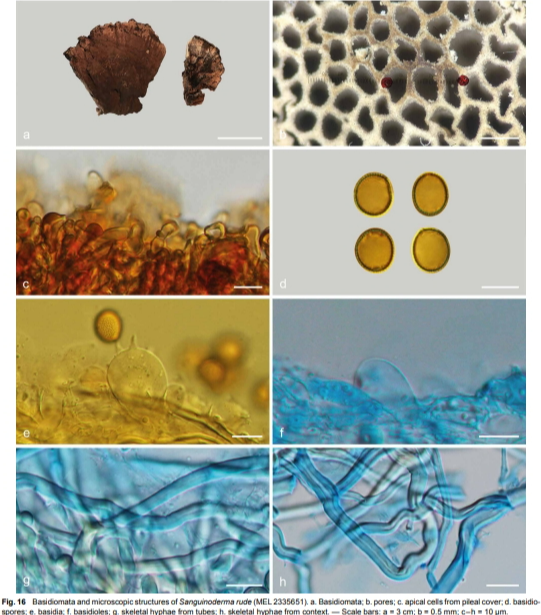
子实体一年生,具柄或几乎不具柄。菌盖单片,近圆形至扇形,木栓质;菌盖表面光滑,不具漆状光泽,有隐约的同心环状纹路和辐射状皱起,黑褐色至锈色色调;边缘锐至钝,干燥时呈波浪状和内曲状。菌孔面浅灰色至灰黄色,受伤时变为血红色随后变暗;菌孔近圆形至不规则状,较大;孔壁全缘;菌管颜色比菌孔面暗,硬木栓质;菌肉木质色至浅棕色,不具暗色线,软木栓质;菌柄侧生或无柄,圆柱形,空心,与菌盖表面同色。

相似物种

本种和Amauroderma intermediumSa. perplexum相似。前者菌孔面受伤不变为血红色,在南美洲新热带地区分布,但根据2022年Costa-Rezende等人的报道,皱盖假芝在巴西也有分布。后者子实体较硬(硬木质),菌孔较小(5-6个/mm)且具中等程度的厚管壁和蠕虫状至类网状纹饰的外孢壁以及厚且长的内孢壁小刺。

物种描述

文献中物种描述

  • 以下描述摘自相关参考文献,由文字识别而来,请以原文为准。
  • 部分文献可能存在描述过时、描述错误或者描述片面等情况,仅供参考。
  • 外文描述的参考翻译系网站管理者的个人翻译,详请参见原文。

描述 1 来源:Taxonomy and phylogeny of polypores with ganodermatoid basidiospores (Ganodermataceae)

类型:完整的描述(摘录自专著、论文等)

Basidiomata annual, lateral stipitate to almost sessile, corky. Pileus single, suborbicular to flabelliform, up to 7.5 cm diam and 1.7 cm thick. Pileal surface dark brown to ferruginous, dull, glabrous, with faintly concentric zones and radial wrinkles; margin acute to obtuse, entire, wavy and incurved when dry. Pore surface pale grey to greyish yellow, colour changing to blood red when bruised, then quickly darkening; pores subcircular to irregular, 1–4 per mm; dissepiments slightly thick, entire. Context woody colour to pale brown, without resinous lines, soft corky, up to 9 mm thick. Tubes darker than pore surface, hard corky, up to 8 mm long. Stipe concolorous with pileal surface, cylindrical and hollow, up to 5 cm long and 4 mm diam. Hyphal system trimitic; generative hyphae with clamp connections, all hyphae IKI–, CB+; tissues darkening in KOH. Generative hyphae in context colourless, thin- to slightly thick-walled, 2–4 μm diam; skeletal hyphae in context pale yellow, thick-walled with a wide to narrow lumen or subsolid, arboriform branched and flexuous, 2–8 μm diam; binding hyphae in context pale yellow, subsolid, branched and flexuous, 1–2 μm diam. Generative hyphae in tubes colourless, thin- to slightly thick-walled, 2–4 μm diam; skeletal hyphae in tubes pale yellow, thick-walled with a wide to narrow lumen or subsolid, arboriform branched and flexuous, 3–6 μm diam; binding hyphae in tubes pale yellow, subsolid, 1–2 μm diam. Pileal cover composed of clamped generative hyphae, thin- to thick-walled, apical cells clavate, faintly inflated, flexuous, yellowish brown, about 40–80 × 4–6 μm, forming an irregular palisade. Cystidia or cystidioles absent. Basidia barrel-shaped to clavate, colourless, thin-walled, 13–33 × 12–28 μm; basidioles suborbicular to clavate, colourless, thin-walled, 15–25 × 8–19 μm. Basidiospores subglobose to broadly ellipsoid, pale yellow, IKI–, CB+, with double and medially thick walls, exospore wall smooth, endospore wall with conspicuous spinules, (9–)9.5–12.5(–12.9) × 8–10.7(–11) μm, L = 11.18 μm, W = 9.5 μm, Q = 1.17–1.19 (n = 60/2). Under SEM, exospore wall alveolate to semi-reticulate with small and deep pits, endospore wall with short and slightly thick columnar spinules tightly arranged. Notes — Amauroderma rude was described from Tasmania as Polyporus rudis (Berkeley 1839). We have examined the specimens collected from the type locality of Tasmania and mainland in Australia. It can be characterized by its big pores (1–4 per mm) with slightly thick and entire dissepiments, and alveolate to semi-reticulate exospore wall with small and deep pits (Fig. 8o–p). Amauroderma rude was shown as a distinct well-supported lineage in Sanguinoderma (Fig. 1, 2). Sanguinoderma rude is similar to S. perplexum by the subglobose to broadly ellipsoid basidiospores, but S. perplexum differs from S. rude by the woody hard basidiomata, small pores (5–6 per mm) with medially thick dissepiments and vermiculate to semi-reticulate exospore wall with long and thick endospore spinules (Fig. 8k–l). Amauroderma intermedium is quite similar to S. rude both in macro- and micro-morphology (Gomes-Silva et al. 2015), but it can be distinguished by its Neotropical distribution, darker context and colour-unchanging pore surface when bruised (Torrend 1920, Ryvarden 2004).

涉及该物种的相关文献

  1. Species diversity, systematic revision and molecular phylogeny of Ganodermataceae (Polyporales, Basidiomycota) with an emphasis on Chinese collections

    ,

    2022. Sun Y-F, Xing J-H, He X-L, Wu D-M, Song C-G, Liu S, Vlasák J, Gates G, Gibertoni TB, Cui B-K. Studies in Mycology 101: 287–415

        https://doi.org/10.3114/sim.2022.101.05
  2. Multi-gene phylogeny and taxonomy of Amauroderma s. lat. (Ganodermataceae)

    ,

    2020. Sun YF, Costa-Rezende DH, Xing JH, et al.. Persoonia 44: 206–239

       
  3. Ganodermataceae of China

    ,

    1981. Zhao, J.D., Xu, L.W., and Zhang, X.Q. Science Press, Beijing

       
  4. Filling gaps in the phylogeny of Amauroderma s. lat. (Polyporales, Ganodermataceae)

    ,

    2023. R.S. Peres, F. Bittencourt , G.L. Robledo, E.R. Drechsler-Santos, K.Põldmaa, L. Ryvarden, E. Crespo , D.H. Costa-Rezende. South African Joural of Botany 155: 140-153

        https://doi.org/10.1016/j.sajb.2023.02.018
  5. Taxonomy and phylogeny of Sanguinoderma rugosum complex with descriptions of a new species and a new combination

    ,

    2022. Sun Y.F., Fang Y.X., Cui B.K. Frontiers in Microbiology 13:1087212

        https://doi.org/10.3389/fmicb.2022.1087212
  6. Taxonomy and phylogeny of polypores with ganodermatoid basidiospores (Ganodermataceae)

    ,

    2020. D. H. Costa-Rezende, G. L. Robledo, E. R. Drechsler-Santos, M. Glen, G. Gates, B. R. de Madrignac Bonzi et al.. Mycological Progress 19: 725–741

        https://doi.org/10.1007/s11557-020-01589-1

本词条的创作得到了共同创作者 Uwiling 的帮助。

感谢共同创作者整理物种列表、撰写内容或给出专业性指导!