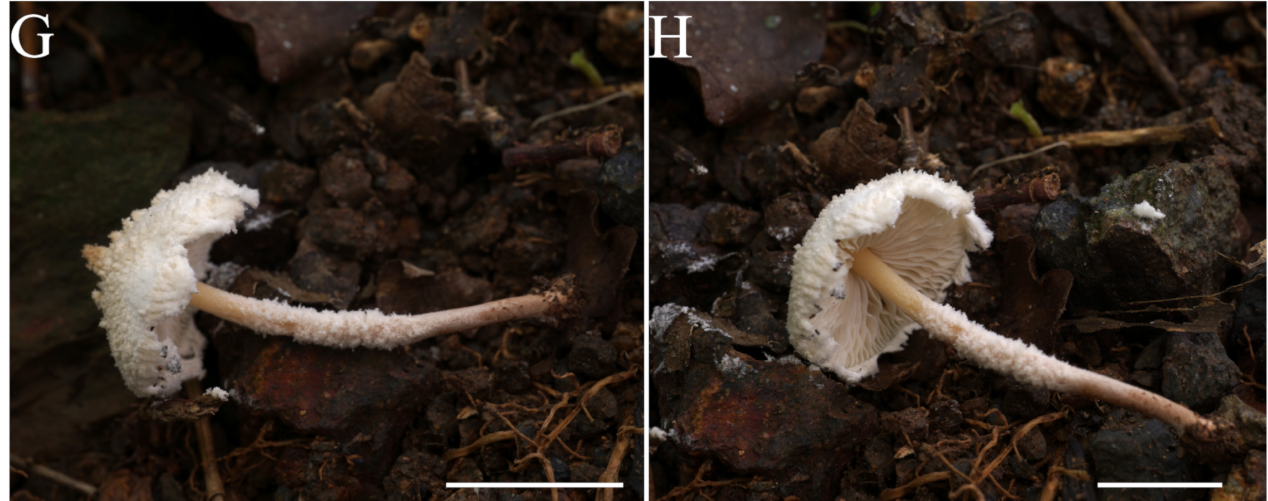
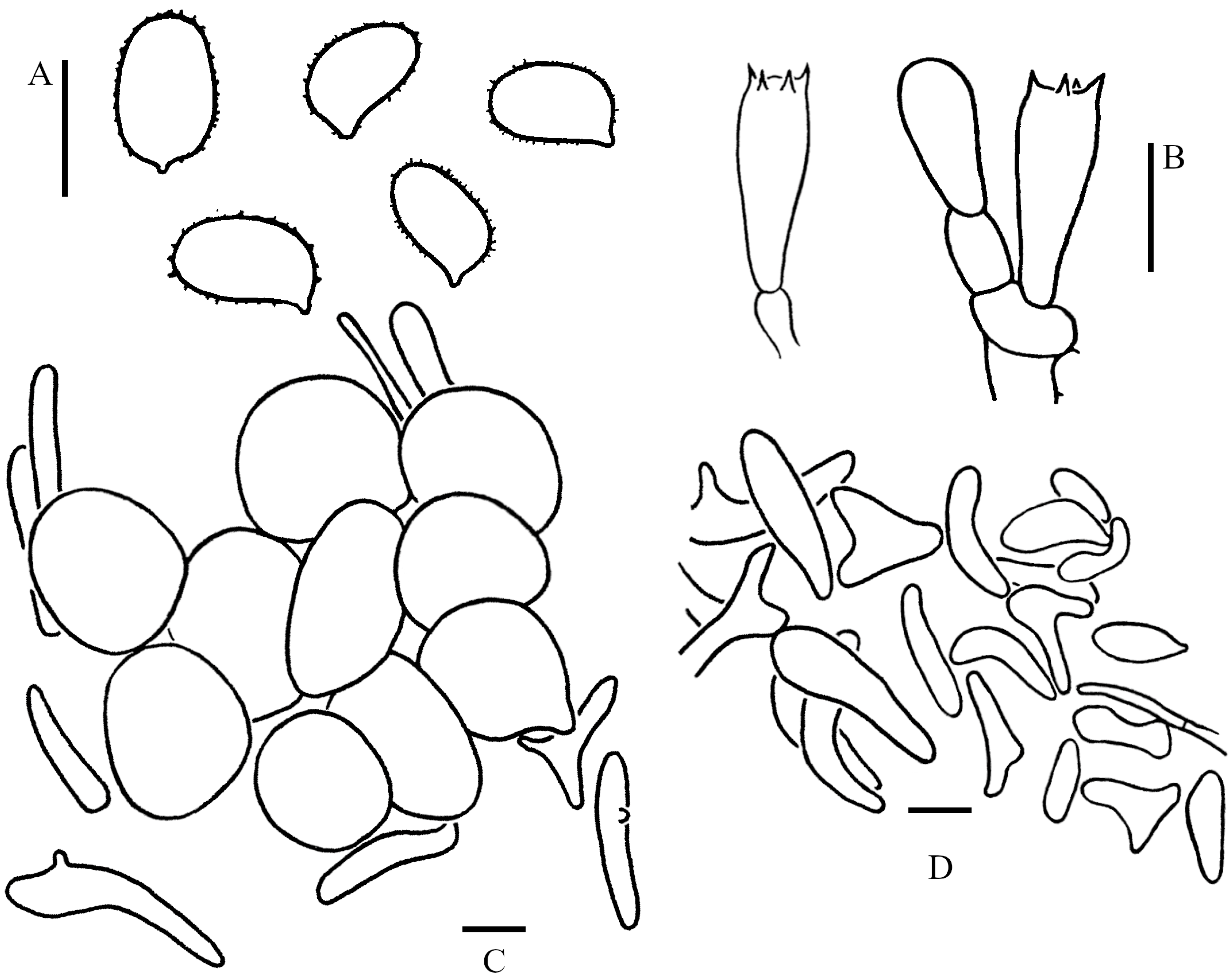
Pulverolepiota oliveirae (P. Roux, M. Paraíso, J. P. Maurice, A. C. Normand & F. Fouchier) H. Qu, Damm & Z. W. Ge, comb. nov. Figure 3G,H, Figure 4J,K and Figure 9.
≡ Cystolepiota oliveirae P. Roux, M. Paraíso, J. P. Maurice, A. C. Normand & F. Fouchier, Mycologia Montenegrina 19: 22 2017 (Basionym).
MycoBank: MB847958
Description: Pileus 14 mm in diam, about 18 mm high, plano-conical, with a distinct umbo, surface whitish to cream, covered with thick flocculose squamules, erect at center, brownish orange (6C8) at the center, fading to yellowish or pale orange (5A2-4) or cream toward the margin; margin appendiculate, easily detachable. Lamellae free, wavy, brownish (5B2), distant, up to 2 mm broad, with 2–3 tiers of lamellulae. Stipe 30 × 1.5 mm, light orange (5A5) at the upper part, reddish-orange (7A6-8) at the base, central, hollow, subcylindrical, with a slightly bulbous base; surface smooth, covered with white, flocculose, easily-detachable squamules on the middle part. Context white in stipe and pileus, thin. Odorless; taste not recorded.
Basidiospores [30/1/1] (4–)4.5–5.5(–6) × (2.5–)3–3.5 μm, Q = (1.43–)1.46–1.86(–2.03), Qm = 1.66 ± 0.14, ellipsoid, colorless, thin-walled, nonamyloid, slowly staining to reddish-brown in Melzer’s reagent (after 24 h); metachromatic in cresyl blue; surface distinctly punctate-rough under LM; isolated irregular warts (up to 0.3 µm in height) visible under SEM (Figure 4J,K); apiculus small. Basidia 14.5–18.5 × 5–7 μm, clavate, hyaline, 4-spored; sterigmata 1.5–3 μm long. Lamellar trama regular, made up of colorless cylindrical hyphae, 3–10 μm in diam. Cheilocystidia and pleurocystidia not observed. Squamules mainly composed of loosely arranged, irregular, branched, cylindrical, oblong cells with a brownish, slightly thick wall; rare tightly-arranged globose to subglobose cells present in the midst of loosely arranged cells, 36–55 × 40–70 μm, colorless, covered with thick gelatinous substances. Clamp connections absent (Figure 9).
Specimen examined: China, Yunnan Province, Xishuangbanna Dai Autonomous Prefecture, Jinghong City, Xishuangbanna Primitive Forest Park, on the roadside, 100.8837777° N, 22.0348152° E, alt. 718 m, 5 July 2021, H. Qu 375 (KUN-HKAS 124759).
Habitat and distribution: Solitary or scattered on soil or on a trunk of Dicksonia antarctica in Europe (Portugal), Asia (tropical region of southwestern China) and Australia.
Notes:Pulverolepiota oliveirae was described as C. oliveirae from Portugal [55], characterized by a whitish to cream pileus with erect flocculose squamules, a brown stipe with white flocculose squamules, a lack of cystidia, and rough and slow-staining dextrinoid spores. Our collection represents a new report for China; it matched the protologue of P. oliveirae regarding macro- and micro-characteristics, except for the pileus of the specimen from China that has a distinct umbo. The basidiospores of the specimen from China [(4–)4.5–5.5(–6) × (2.5–)3–3.5 µm] are slightly smaller than those in the protologue of C. oliveirae (5.0–6.4 × 2.9–4.0 µm) [55]. The morphological differences could be explained by population and measurement differences. Furthermore, the ITS sequence is 99.74% identical with the sequence generated from the type specimen (KY472789).
The two closely related species, P. oliveirae and P. petasiformis (=C. pulverulenta) can easily be confused. However, the squamules of C. oliveirae present tightly-arranged globose to subglobose cells among the loosely-arranged cells. Those tightly arranged cells have not been observed in C. petasiformis [5,56]. Paraíso et al. (2016) suggested the size of the basidiospores as a characteristic to distinguish the two species [55]. However, the spores of the collection from China are not significantly larger than those of C. petasiformis. Several Cystolepiota species, including C. fumosifolia, C. pseudofumosifolia, and C. pyramidalis, that are not closely related with P. oliveirae are also similar in the presence of distinct squamules. However, they differ in forming cheilocystidia, inamyloid and non-dextrinoid basidiospores and squamules that are composed of loosely-arranged globose to subglobose cells, while irregular, branched, cylindrical to oblong cells are lacking. Cystolepiota pyramidosquamulosa, a species newly described in this paper, also forms distinct squamules. It can be distinguished from P. oliveirae by having neither amyloid nor dextrinoid basidiospores and forming loosely-arranged globose to subglobose cells in the squamules.