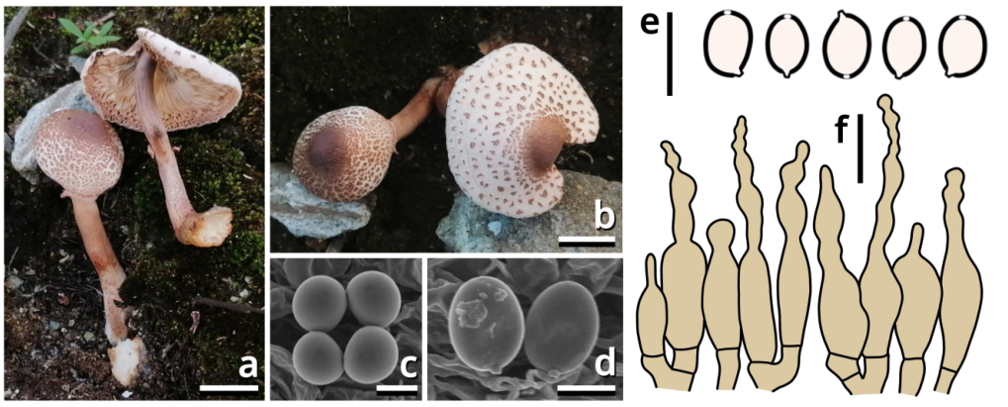
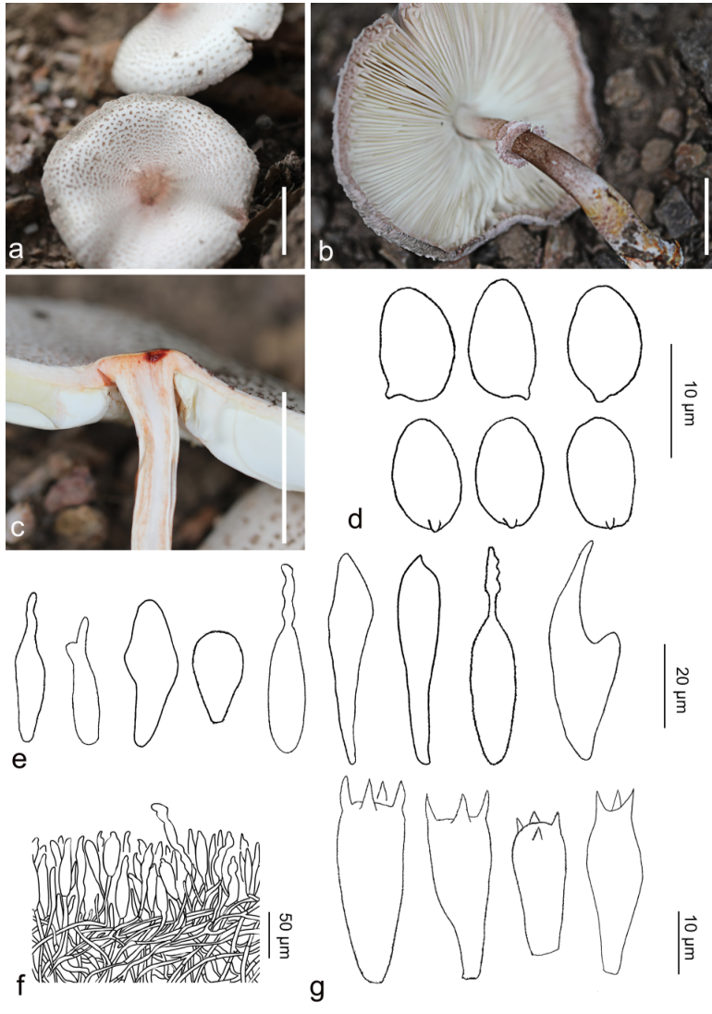
Leucoagaricus subtropicus Y. Yang, X. Luo & Y.P. Xiao, sp. nov. FIGURES 2, 3
Index Fungorum number : IF559770; Facesoffungi number : FoF 12619
Etymology: The designation "subtropicus" refers to the subtropical climate of the region from where the specimens were collected.
Holotype : CHINA, Anhui Province, Chuzhou District, Daliu Grassland at 178m a.s.l., 118.14 E, 32.25 N, scattered or in small groups, on loamy soil, 29 June 2021, HKAS 124380 (holotype), GenBank accessions: OP339899 (ITS), OP339901 (LSU).
Diagnosis: Leucoagaricus subtropicus is distinguished by brownish-red fibrous scales in pileus with darker in the middle, striate towards the margin, occasional dehiscence at maturity, blood-red bruising, at base stipe with brownish-orange droplets, presence of polymorphic cheilocystidia, and ellipsoid basidiospores.
Description: Basidiomata medium-sized (FIGURE 2a–c). Pileus 55–80 mm diam., oval-campanulate when young, then convex to flat, with a broad, low umbo in the middle; surface with small pale red (10A3) to violet brown (12F8) fibrous scales arranged in subconcentric rings, small scales sometimes inconspicuous, becoming smooth, tapering towards the periphery, more dark red in the disc area, sparser violet brown (11F8) scales elsewhere, occasional dehiscence at the edge of the cap when mature; finely striate towards the margin. Context, 1–3 mm, thick towards the center, becoming greyish red (10B4) to blood-red (10C8) when bruised or on handling. Lamellae medium crowded, unequal, free, subventricose, dirty white (12A1) to pale pink (12A2), turning brownish black (12F3) when dry, average about 8 mm broad, with the edge pale pink (12A2). Stipe 85–100×7–10 mm, centrally attached, white (12A4) when young, then gradually turning brownish red (10F7), covered with brown (10E2) squamules, cylindrical and slightly expanded at the base, up to 14–16 mm, hollow, often with brownish orange (6C8) droplets in the lower part. Annulus broad, membranous, attached to the upper part of the stipe, calypso pink (13A2), gradually becoming lighter from the inside out, with tiny light lilac (15A4) scales, not easy to remove. Odour not distinctive. Taste not recorded.
Basidiospores 7.4–9.6×4.3–6.5 µm, Q = 1.72–2.23, Qav = 1.98, ovoid to ellipsoid, with conspicuous hilar appendix, smooth, thin to slightly thick-walled, with inconspicuous germ-pore, hyaline, dextrinoid, cyanophilous, metachromatic in cresyl blue (FIGURE 2d). Basidia 21.2–30.4×8.3–12.6 µm, clavate, hyaline, thin-walled, 3-or 4-spored; sterigmata up to 5 µm long (FIGURE 2g). Lamellaedge crowded with tufts of cheilocystidia. Cheilocystidia abundant, hyaline, 23.2–54.4×8.0–15.6 µm, mostly broadly pedicellate-clavate, at times narrowly utriform, or narrowly rod-shaped to fusiform, or clavate with a mucronate apex or with a strangulated or flexuose, appendage (FIGURE 2e). Pileipellis is a trichoderm composed of tufts, ascending or erect chains of cystidioid elements (FIGURE 2f); hyphae 6–15 µm wide, thin- to slightly thick-walled, hyaline and some with pale yellow to light brown intracellular pigments, terminal elements cystidioid 30–78×5–18 µm, narrowly clavate, clavate, subglobose, fusiform, cylindrical with an obtuse apex, or ellipsoidal or utriform. Clamp connections not observed on any hypha.
Habit and distribution: On soil, scattered in the deciduous broad-leaved forest, in summer.
Additional material examined: CHINA, Anhui Province, Chuzhou District, Daliu at 178m a.s.l., 118.14 E, 32.25 N, scattered or in small groups, on loamy soil, 29 June 2021, HKAS 1243801 (paratype), GenBank accessions: OP339900 (ITS), OP339902 (LSU).