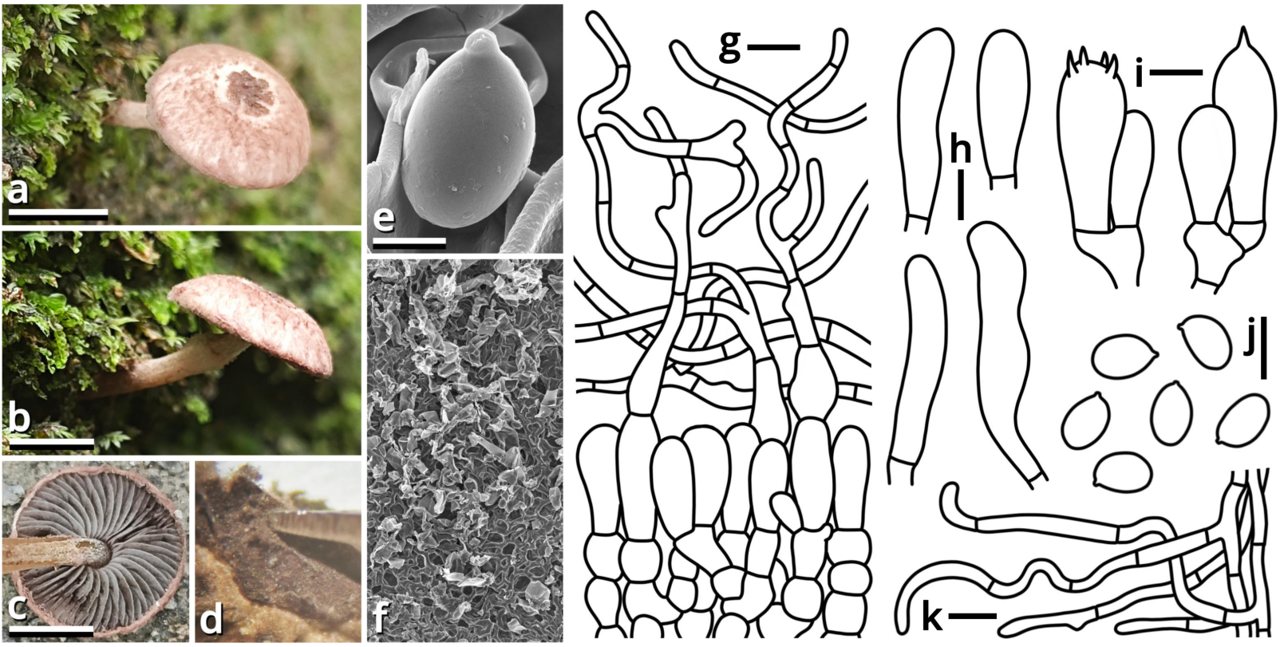
Hymenagaricus conghuaensis Kun L. Yang, Jia Y. Lin & Zhu L. Yang, sp. nov. (Figs 5–6; Table 4; Supplements 2and 5)
Registration identifier FN572704
Etymology:—Referring to the type locality.
Diagnosis:—Differing from other Asian Hymenagaricus species by a combination of purplish brown pileus
squamules flaky and slightly felty at center, becoming fibrous towards margin, and ellipsoid basidiospores sized 4.5–5× 3–3.5 µm.
Type:—CHINA. Guangdong Province: Guangzhou City, Conghua District, Liuxi River National Forest Park,on a moss land, 23°45’17”N, 113°46’56”E, elevation 200 m, June 20, 2024, Kun L. Yang & Jia Y. Lin, K24041(HKAS147741, holotype (ITS: PV620889; nrLSU: PV616969; rpb1: PV642282; rpb2: PV642294; tef-1α: PV642311);HTBM2031, isotype).
Description:—Basidioma small; odour fungal; taste unknown. Pileus 11 mm in diameter, plano-convex;background ceramic white (#FEFEFA); squamules flaky and slightly felty at center, becoming fibrous towardsmargin, merino white (#F9F5EC), meat brown (#D7B19D) to beaver brown (#9D7B69), becoming lighter towardsmargin. Lamellae adnexed to free, nearly crowded, medium grey (#E0DEDD), muddy grey (#938F89) to flint brown(#736960), with a slightly serrate edge, interspersed with abundant lamellulae. Stipe 18 mm long, 1.5 mm thick,cylindrical, slightly curved; background merino white (#F9F5EC) to mist brown (#DCD8C9); squamules fibrous,merino white (#F9F5EC); context turning darker and reddish after damaged. Annulus superior, fibrous and fugacious,concolorous with the squamules on the stipe.
Basidiospores {40/1/1} (4) 4.5–5 [4.63 ± 0.27, 4.50] × 3–3.5 [3.23 ± 0.25, 3.00] µm, Q = 1.29–1.67 [1.44 ± 0.13,1.50], ellipsoid, slightly thick-walled, smooth, tinged cotton brown (#D2CAAD) to dark heather brown (#9D917B),with a small apiculus, with an indistinct germ pore. Basidia 16–18.5 × 5–7 μm, clavate, one-, two-, three- or four-spored, thin-walled, nearly colourless. Lamella trama regular to subregular, composed of 3–11 µm wide, thin-walled,nearly colourless, compact, moderately to frequently branching hyphae. Cheilocystidia abundant, 12–26 × 3–6 µm,clavate to subcylindrical, sometimes flexuous, thin-walled, smooth, nearly colourless. Pleurocystidia absent. Pileussquamules composed of a hymeniderm to trichoderm at center, becoming an entire trichoderm towards margin,by slightly thick-walled and encrusted, interwoven hyphae 2–8 µm wide issued from a lower layer of clavate tosubcylindrical cells measured 13.5–24 × 6.5–11 µm standing on subglobose cells measured 11–17 × 10–17 µm, tingedblush red (#D9B7B4). Stipe squamules composed of a trichoderm by 2.5–4 µm wide, thin- to slightly thick-walled andencrusted hyphae, tinged light cardamon yellow (#E9E9AD). Clamp connections occasionally present in the pileussquamules, absent in the other tissues.
Habit and distribution:—Solitary, on soil, in southern subtropical monsoon forests. Currently known fromChina.
Phylogeny:—According to the BLAST search of ITS sequence in GenBank (NCBI 2025), our collectionHKAS147741 is a species of Hymenagaricus. Therefore, a phylogeny was inferred to classify our collections withrepresentative collections of known species of Hymenagaricus and HKAS147741 as the ingroup, and two collectionsof Coniolepiota as the outgroup according to our recent study on phylogeny of Agaricaceae (Yang et al. 2024a), usingtwo loci (ITS and nrLSU) available for most species in this group (Table 4; Supplement 5). In the result, the ML and BItopologies are almost identical, only with a minimal variation in statistical support, so only the tree inferred from theML analysis is displayed (Fig. 5). The genus Hymenagaricus is resolved into five distinct groups, and our collectionHKAS147741 forms an undescribed clade sister to Hy. splendidissimus with significant support.
Notes:—The genus Hymenagaricus is typically characterized by brownish basidiospores and pileus squamuleswith a more or less hymeniform structure (Heinemann 1981, Heinemann 1985, Heinemann & Little Flower 1984).Watling (1999) proposed a new genus Heinemannomyces to accommodate a species similar to Hymenagaricus butwith floccose squamules, called He. splendidissimus. Yang et al. (2024b) found hymeniform structure beneath thefloccose squamules, explained He. splendidissimus as a modified Hymenagaricus species with outgrowing hyphaeon squamules, and synonymized Heinemannomyces to the earlier name Hymenagaricus with the new combinationHymenagaricus splendidissimus.
According to the current phylogeny (Fig. 5), the new species Hy. conghuaensis proposed here, is a species mostclosely related to Hy. splendidissimus ever known. It also exhibits outgrowing hyphae on the central squamule onpileus, generally similar to Hy. splendidissimus, but the squamules are fewer and sparser, the basidioma size is smaller,and the greyish brown lamellae and brownish basidiospores are different.