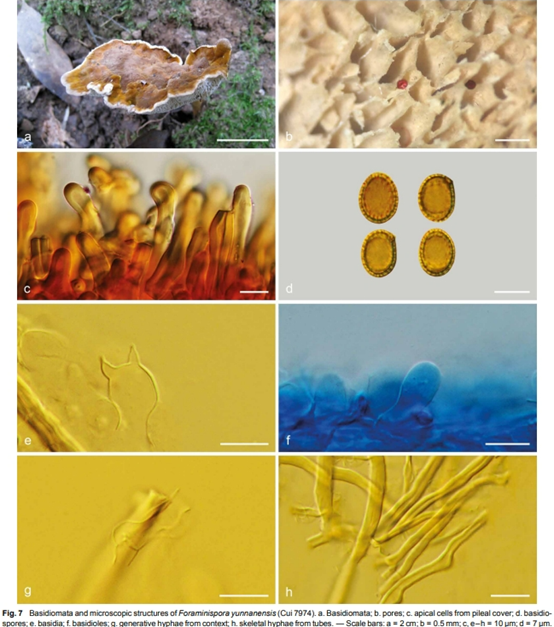
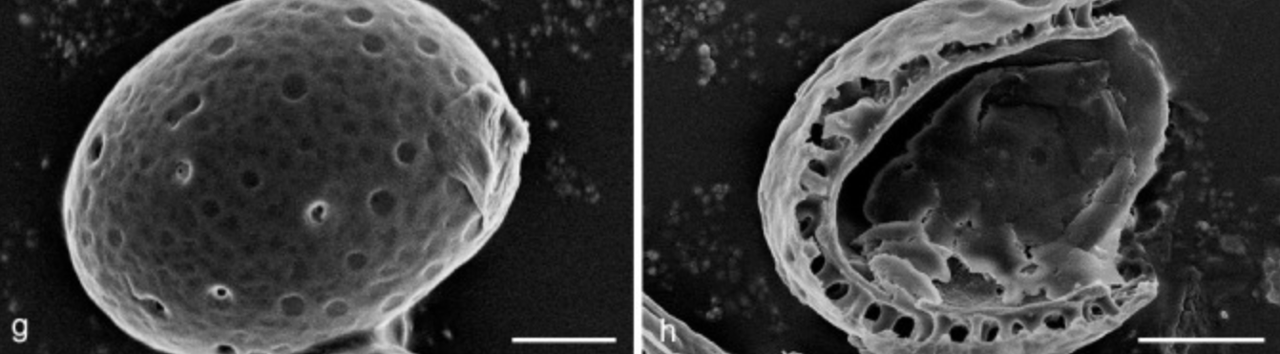
Basidiomata annual, centrally to laterally stipitate, coriaceous to corky. Pileus single, suborbicular to flabelliform, up to 6.5 cm diam and 6 mm thick. Pileal surface cinnamon to reddish brown when dry, dull, tomentose, with faintly concentric furrows at the margin and irregular wrinkles; margin subacute to obtuse, entire and wavy when dry. Pore surface white to pale straw, colour unchanging when bruised; pores circular to angular, 2–3 per mm; dissepiments thin, fragile when dry. Context white to pale yellow, without dark resinous lines, corky, up to 2 mm thick. Tubes concolorous with pore surface, occasionally fascicular, woody hard, up to 4 mm long. Stipe concolorous with pileal surface, cylindrical and solid, slightly swollen at base, up to 8 cm long and 6 mm diam. Hyphal system trimitic; generative hyphae with clamp connections, all hyphae IKI–, CB+; tissues darkening in KOH. Generative hyphae in context colourless, thin-walled, 3–4 μm diam; skeletal hyphae in context pale yellow, thick-walled with a wide to narrow lumen or subsolid, arboriform branched and flexuous, 3–6 μm diam; binding hyphae in context colourless, subsolid, branched and flexuous, 1–3 μm diam. Generative hyphae in tubes colourless, thin-walled, 2–4 μm diam; skeletal hyphae in tubes colourless to pale yellow, thick-walled with a wide to narrow lumen or subsolid, arboriform branched and flexuous, 2–5 μm diam; binding hyphae in tubes colourless, subsolid, branched and flexuous, 1–2 μm diam. Pileal cover composed of clamped generative hyphae, thin- to thick-walled, apical cells clavate, inflated or constricted, arranged loosely, yellowish brown, about 40–60 × 6–9 μm, forming an irregular palisade. Cystidia or cystidioles absent. Basidia barrel-shaped to clavate, colourless, thin-walled, 20–35 × 11–18 μm; basidioles in shape similar to basidia, colourless, thin-walled, 13–23 × 6–10 μm. Basidiospores broadly ellipsoid to ellipsoid, pale yellow, IKI–, CB+, with double and distinctly thick walls, exospore wall smooth, endospore wall with conspicuous spinules, 8–10.7(–11.2) × (6.8–)7–8.3(–8.7) μm, L = 9.35 μm, W = 7.63 μm, Q = 1.18–1.27 (n = 60/2). Under SEM, exospore wall uneven or foveolate, endospore wall with some hollow and columnar spinules which persist to exospore wall forming holes.
Notes — Foraminispora yunnanensis can be distinguished by large lacerate pores (2–3 per mm), occasionally fascicular tubes and broadly ellipsoid to ellipsoid basidiospores. It is also consistent with Foraminispora in the unique ultrastructural characteristics of the exospore wall with obvious holes caused by hollow and columnar spinules on the endospore wall which persist to the exospore wall (Fig. 3g–h). In the phylogenetic analyses, Fo. yunnanensis was shown to be a distinct lineage in Foraminispora with high support (100 % ML, 1.00 BPP)
Amauroderma yunnanense J.D. Zhao & X.Q. Zhang, Acta Mycol. Sinica,Suppl. 1: 268. 1987 ["1986"].
Holotype: China. Yunnan Prov., Xichou County, ground, Xiaogiaogou, 14.V.1959, Wang Qing-zhi 89 (HMAS 48231).
BASIDIOCARPS annual, centrally to laterally stipitate, coriaceous to corky,brittle when dry. PiLeus single, flabelliform, suborbicular, umbilicate, PILEAL SURFACE pale yellowish brown to dark brown, adpressed velutinate, with distinct concentric zones at the margin and fine furrows in the middle; MARGIN inflexed, acute or subacute, entire or slightly lacerated and thin; stipe concolorous with the pileus, up to 7 cm long, inflated at base. ConTExT homogeneous, white to pale yellow. PoRE SURFACE white when fresh, pale straw yellow when dry, bruising unchanged; porgs angular, 2-3 per mm; TuBEs concolorous with pore surface, up to 5 mm thick.
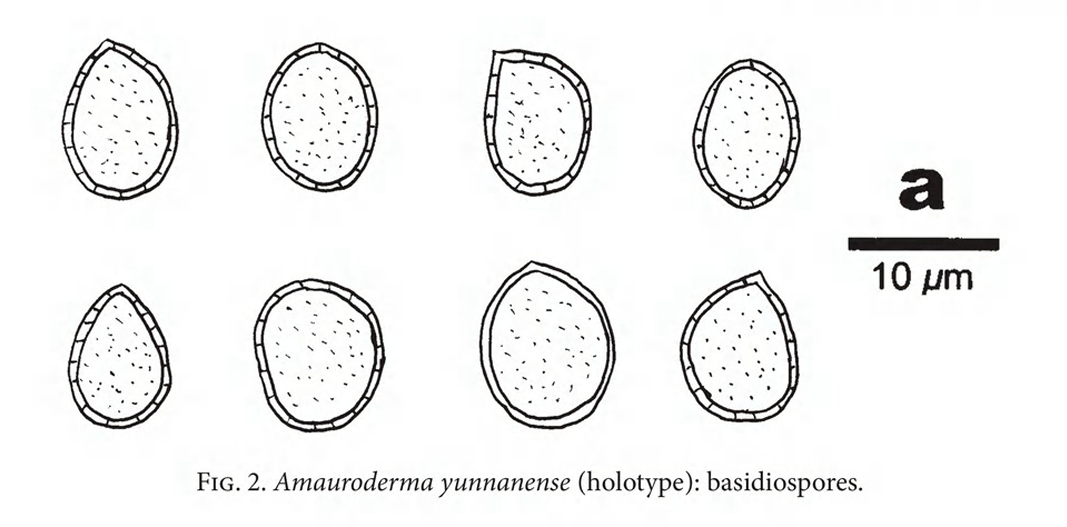
HYPHAL SYSTEM trimitic; GENERATIVE HYPHAE with clamps, hyaline, thin-walled, 2-4.3 μm in diam; SKELETAL HYPHAE thick-walled, pale yellow, arboriform, 3.5-5.5 μm in diam; BINDING HYPHAE hyaline, branched, tortuous, 1.8-2.5 μm in diam; all the hyphae IKI-, CB+; tissues darkening in KOH. Basipiospores broadly ellipsoid to subglobose, pale yellow brown, IKI-, CB+, doubled-walled, exospore smooth, hyaline, endospore with conspicuous echinule, (8.3—)8.9-10.3(-10.7) x (6.3-)6.7-8(-8.8) μm, L = 9.35 μm, W = 7.32 μm, Q = 1.22-1.34 (n = 120/4).
ADDITIONAL SPECIMENS EXAMINED: CHINA, YUNNAN PRov., Chuxiong, Zixishan Forest Park, ground, 8.[X.2006, Yuan 2253 (IFP 013207); Ailaoshan, 5.[X.2007, Yuan 3367 (IFP 013182); Kunming, Qiongzhusi Park, 21.X.2009, Cui 7974 (BJFC 006463); Xiaoshao Village, 22.1X.2012, Dai 13021 (IFP 019123).
REMARKS: Amauroderma yunnanense is an accepted species characterized by a brown tomentose pileus and stipe. Amauroderma perplexum Corner and A. yunnanense both have a velutinate pileus and stipe as well as stipes that dilate at the base; A. perplexum can be separated by larger basidiospores, longer tubes, and a pore surface that changes color when bruised (Corner 1983). Amauroderma partitum (Berk.) Wakef., which may be confused with A. yunnanense as they share similar angular pores that are 2-3 per mm, can be distinguished by its glabrous, slightly shiny pileus and larger basidiospores (12-15 x 8-10 um; Ryvarden 2004)