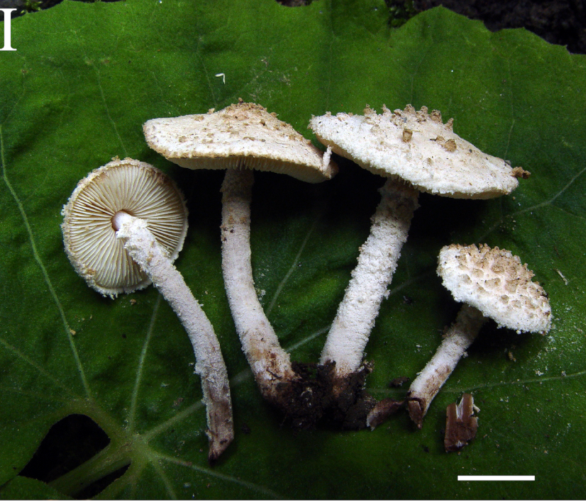
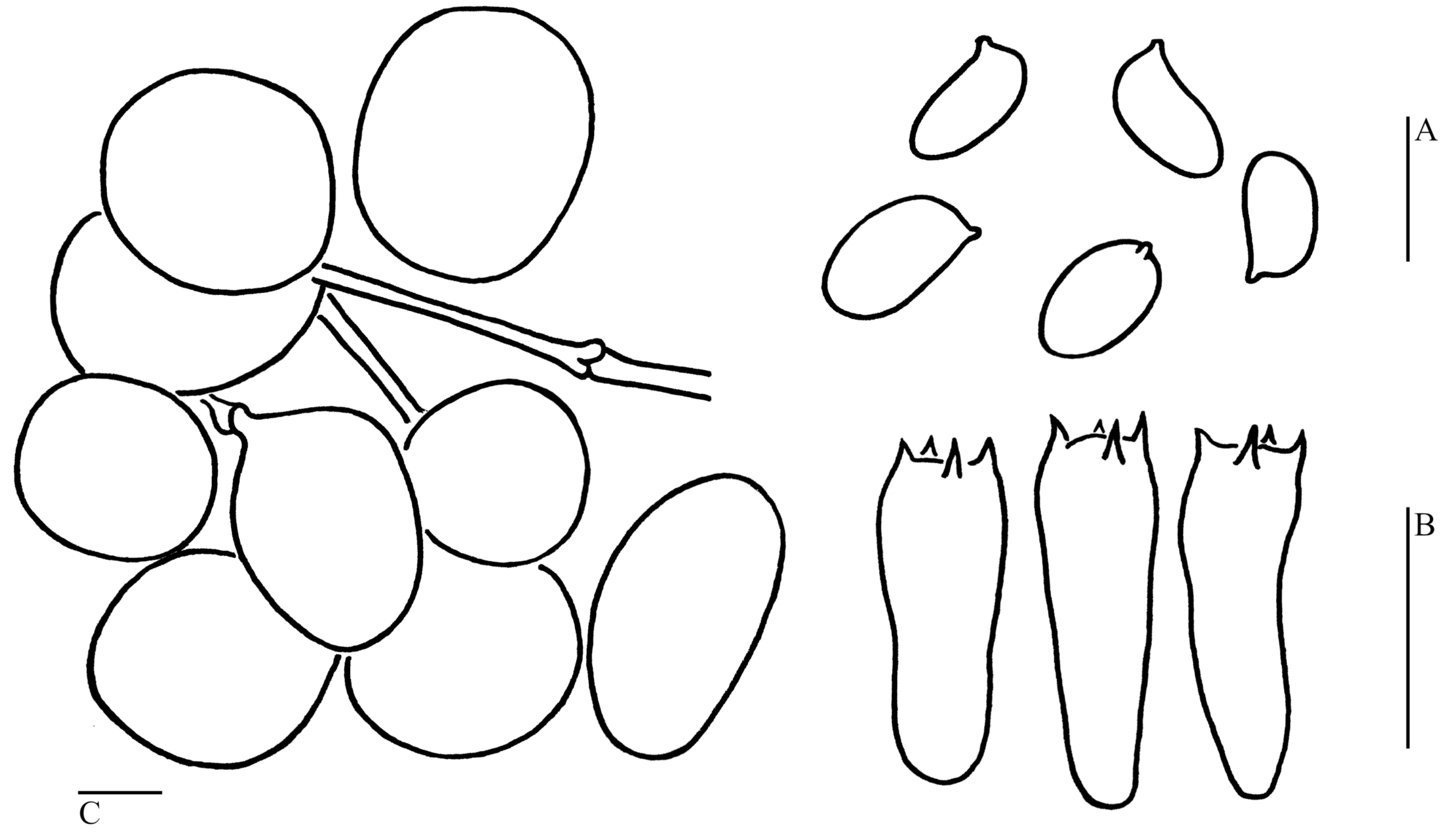
Cystolepiota pyramidosquamulosa H. Qu & Z. W. Ge sp. nov. Figure 3I, Figure 4L and Figure 7.
MycoBank: MB845060.
Etymology: The epithet “pyramidosquamulosa” refers to the pyramidal squamules on the pileus.
Diagnosis: Cystolepiota pyramidosquamulosa is distinguished from all other Cystolepiota species by its brownish, relatively large, irregular pyramidal squamules on the pileus, an annulus-like zone on the upper portion of the stipe, the smooth-walled (under LM and SEM), inamyloid, and non-dextrinoid basidiospores, the absence of cystidia, and the presence of clamp connections. Its ITS, LSU, rpb2, and tef1 sequences are distinct from other species.
Type: China, Sichuan Province, Aba Tibetan and Qiang Autonomous Prefectures, Maerkang (Barkam) City, Dangba Township, Yinlang Village, on soil, 17 August 2007, Z. W. Ge 1900 (Holotype, KUN-HKAS 53985). GenBank: ITS = OP059088, LSU = OP059068, rpb2 = OP104335, tef1 = OP141792.
Description: Pileus 24–28 mm in diam, convex to plano-convex with an indistinct broad umbo; surface white, covered with concolorous flocculose squamules and brownish (5B4-5) irregular pyramidal squamules (up to 5 mm in height) that spread out towards the margin and can easily be wiped off; margin with overhanging squamules similar to those on the pileus. Lamellae free, close, up to 2.5 mm wide, yellowish-white (2A3), with 1–3 tiers of lamellulae; lamellae margin smooth. Stipe 30–45 × 15–25 mm, central, cylindrical, with a slightly expanded base, hollow, stuffed with white fibers, brownish (5B4-5); glabrous or slightly pruinose at the apex, with an annulus-like zone on the upper part covered with similar squamules as the pileus; squamules on lower portion cream to yellowish white (2A2-3), flocculose or pulverulent. Context of stipe and pileus cream to brownish (5B4). Smell and taste were not recorded.
Basidiospores [100/5/1] (3.5–)4–5 (–5.5) × (1.5–)2–3 μm, Q = (1.44–)1.60–2.28(–2.47), Qm = 1.95 ± 0.20, ellipsoid to elongate, sometimes cylindrical, colorless, thin-walled, smooth-walled under the LM and SEM (Figure 4L); inamyloid, non-dextrinoid, metachromatic in cresyl blue. Basidia (13.5–)15–18.5 × 5–7 μm, clavate, hyaline, 4-spored; sterigmata 2.5–3.5 μm long. Cheilocystidia and pleurocystidia not observed. Lamellar trama regular, colorless, composed of cylindrical hyphae, 5–7.5 μm in diam. The squamules on pileus and stipe consist of inflated cells and filamentous hyphae; inflated cells abundant, globose to subglobose, rarely fusiform or sphaero-pedunculate, 21–33 × 20–29 µm, smooth-walled, with a slightly thick, chartreuse-yellow wall, usually 2–5 cells forming loosely arranged chains; hyphae rare, 1–3 µm in diam, chartreuse-yellow. Clamp connections present in all tissues (Figure 7).
Habitat and distribution: Presumably saprotrophic. Solitary or scattered on soil. Found in Asia (China, India) and Europe (Italy).
Notes: Pyramidal squamules are the most distinctive macroscopic characteristic of Cystolepiota pyramidosquamulosa. The pilei of P. oliveirae and P. petasiformis (=P. pulverulenta) are also covered with obvious squamules and also lack cystidia. However, the two species can be distinguished from C. pyramidosquamulosa by the rough basidiospores that slowly become red-brown in Melzer’s reagent and the squamules composed of irregular, branched, inflated, and oblong elements. In addition, the basidiospores of C. pyramidosquamulosa are narrower than those of the latter two species [5,55,56]. Cystolepiota pyramidalis Sysouph. and Thongkl. forms squamules similar to C. pyramidosquamulosa. However, C. pyramidalis forms cheilocystidia and ellipsoid–ovoid spores and has so far only been collected in Laos and Thailand [57]. In contrast to C. pyramidosquamulosa, C. fumosifolia (Murrill) Vellinga and C. pseudofumosifolia M.L. Xu & R.L. Zhao form warty to granulose squamules and have cystidia [5,58]. Cystolepiota adulterina F.H. Møller ex Bon has warty squamules and somewhat resembles C. pyramidosquamulosa macroscopically. However, it differs in the presence of abundant cheilocystidia. In addition, C. pyramidosquamulosa can be distinguished from other species by its distinct ITS, LSU, rpb2, and tef1 sequences.
Two ITS sequences from GenBank, JF907983 (from Italy) and KU847887 (from India), are similar to the sequence derived from the type specimen of C. pyramidosquamulosa; both differ by seven nucleotides from C. pyramidosquamulosa, which is considered within the variability of C. pyramidosquamulosa.