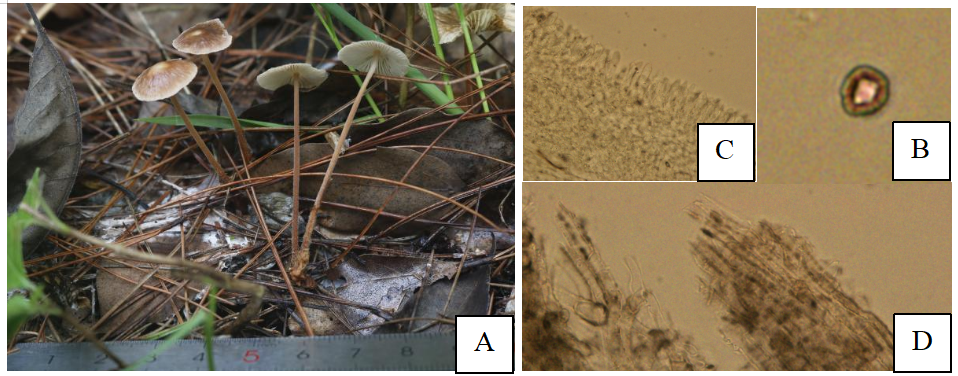
Collybiopsis undulata J.S. Kim & Y.W. Lim, sp. nov.MycoBank No: 842058 Fig. 4C–D, Suppl. material 1: Fig. S1F
Etymology. Epithet “undulata” referring to having an undulate margin of pileus.
Holotype. The Republic of Korea, Chungcheongnam-do, Boryeong-si, recrea-tion forest of Mt Sungju, 36°20'4"N, 126°39'50"E, alt. 241 m, 21 August 2012, Jae Young Park, SFC20120821–04 (GenBank accession no. ITS: OL467239; nrLSU: OL462813).
Diagnosis. It is characterized by having 10‒23 mm sized pileus that is particularly brown in the middle with a wavy margin, subdistant and creamy lamellae, a dark brown, 35–55×0.8‒2 mm stipe that becomes lighter to the apex, subcylindrical, broadly clavate or irregu-lar, sometimes lobed, 16.7–28 × 4.8–8 μm cheilocystidia, and 27–60 × 3.5–6 μm sized cau-locysitida which has a morphology similar to cheilocystidia and sometimes grows in bundles.
Description. Pileus: 10‒23 mm, convex to concave, margin becoming undulate with age; Surface smooth, hygrophanous, brown (7D2 to 7E6) in the center, becom-ing paler to the margin (5A2–5B3 to 7B2). Lamellae: subdistant, L = 15–30, l = 3–9, adnexed, cream. Stipe: 35–55 × 0.8‒2 mm, cylindrical, tomentose, dark brown (7F5 to 8F8), gradually becoming paler to apex (7B2 to 7C2). Basidiospores: 5.6–9.5 × 2–3.4 μm (average 7.3×2.8μm), Q = 2–3.1 (mean = 2.58), cylindrical, smooth, hya-line, non-dextrinoid, with drops. Basidia: 15–22.3 × 3.6–6.8 μm, 4-spored, cylindri-cal, narrowly clavate to utriform, often curved. Cheilocystidia: 16.7–28 × 4.8–8 μm, subcylindrical, broadly clavate or irregular, sometimes lobed. Pleurocystidia: absent. Trama hyphae: cylindrical, sometimes subinated, smooth, branched, non-dextri-noid, 2–8 μm wide. Pileipellis: a cutis made up of cylindrical, often incrusted, slightly brownish, with heavy annular ornamentation, 2.4–7 μm wide hyphae; terminal ele-ments adpressed to suberect, cylindrical to clavate, 3–6 μm wide. Stipitipellis: a cutis of cylindrical, smooth, 2.0‒3.5 μm wide hyphae. Caulocystidia: 27–60 × 3.5–6 μm, irregularly cylindrical, narrowly utriform, seldom apically lobed, sometimes gathered in a bunch. Clamp connections: present in all tissues.
Other specimens examined. The Republic of Korea, Gyeonggi-do: Goyang-si, Deog-yang-gu, Seooreung, 37°37'26"N, 126°54'4"E, alt. 35 m, 13 August 2015, Jae Young Park,SFC20150813–04. The Republic of Korea, Gyeongsangbuk-do, Sangju-si, Mt Noheum, 36°26'20"N, 128°5'48"E, alt. 695 m, 8 August 2013, Jae Young Park, SFC20130808–08.Habit and habitat. Scattered to gregarious on leaf litter in mixed forest dominated with broadleaf trees, in summer.
Distribution. The Republic of Korea.
Remark. Collybiopsis undulata is morphologically similar to Co. subpruinosa (Mur-rill) R.H. Petersen. Collybiopsis subpruinosa has dierences in having small central pa-pilla on pileus, fewer lamellulae (3–4 series), vivid colored lamellae, thicker basidi-ospores (4.5–5.2 μm wide), larger basidia (30–36 × 7.5–8.5 μm) and cheilocystidia (25–80 × 5–16 μm), thick-walled trama hyphae (0.5–1 μm), caulocystidia with a wid-er size range, and a habit of growing solitary on rotten twigs or logs (Desjardin et al. 1999). Collybiopsis undulata is phylogenetically close to Co. villosipes but Co. villosipes can be dierentiated by having fewer lamelluale (2–3 series), vivid colored lamellae, thicker stipe (1.5–4.0 mm), slightly thicker basidiospores (3.5–4.5 μm wide), and ba-sidia (25–34 × 6.5–7.5 μm) (Desjardin et al. 1997).