返回搜索
Logo Pic

中国美味蘑菇

Agaricus sinodeliciosus 


Zhuo R. Wang & R.L. Zhao 2015

基本信息 General Info.

  • 通用中文名Chinese name:中国美味蘑菇
  • 别称Othernames:中华美味蘑菇、苇菇、柴达木大肥菇
  • 拉丁学名Scientific name:Agaricus sinodeliciosus  Zhuo R. Wang & R.L. Zhao 2015
  • 科Family:蘑菇科Agaricaceae
  • 属Genus:蘑菇属Agaricus
  • 分布Distribution:西北地区:新疆、内蒙古等
  • 有分布的省区Provinces:内蒙古自治区,甘肃省,青海省,新疆维吾尔自治区(文献记载)
    查看具体分布情况
  • 生态Ecology:春夏季单生或散生于芦苇丛、柽柳下的沙质土壤中。
  • 营养类型Nutrition Type:腐生Saprotrophic: 分解死亡生物体或有机物获取养分
  • 置信指标Confidence:★★★

物种介绍

中国美味蘑菇是2012年科研团队在新疆艾比湖周边考察时采集到的物种,2015年正式发表为新物种。它是一种肥大的食用菌,生活在我国西北部芦苇丛之间的沙质土壤下。其种加词sinodeliciosus由“sino-”(中国的)和“deliciosus”(美味的)构成。[1]

鉴别特征

分类学上,中国美味蘑菇隶属于subg. Pseudochitonia sect. Bivelares (=sect. Duploannulati)。这一组的共同特征包括:菇体矮壮,菌柄长度通常约等于或短于菌盖宽度;各部位菌肉受伤后常变粉红色,没有变黄反应;菌肉气味不明显或呈蘑菇香味,无特殊异味;褶缘囊状体存在;Schäffer 反应和 KOH均为阴性。同组内还有许多其他著名食用菌,例如双孢蘑菇Agaricus bisporus(常被称为“口蘑”或“白蘑菇”)是全球范围内最广泛栽培的食用菌物种之一。[4]

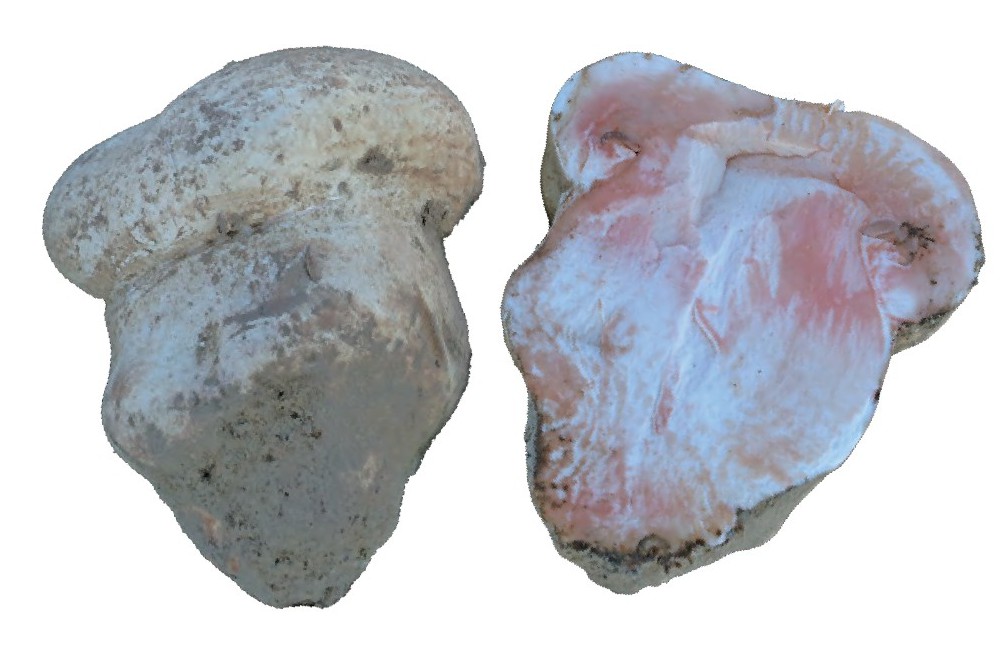
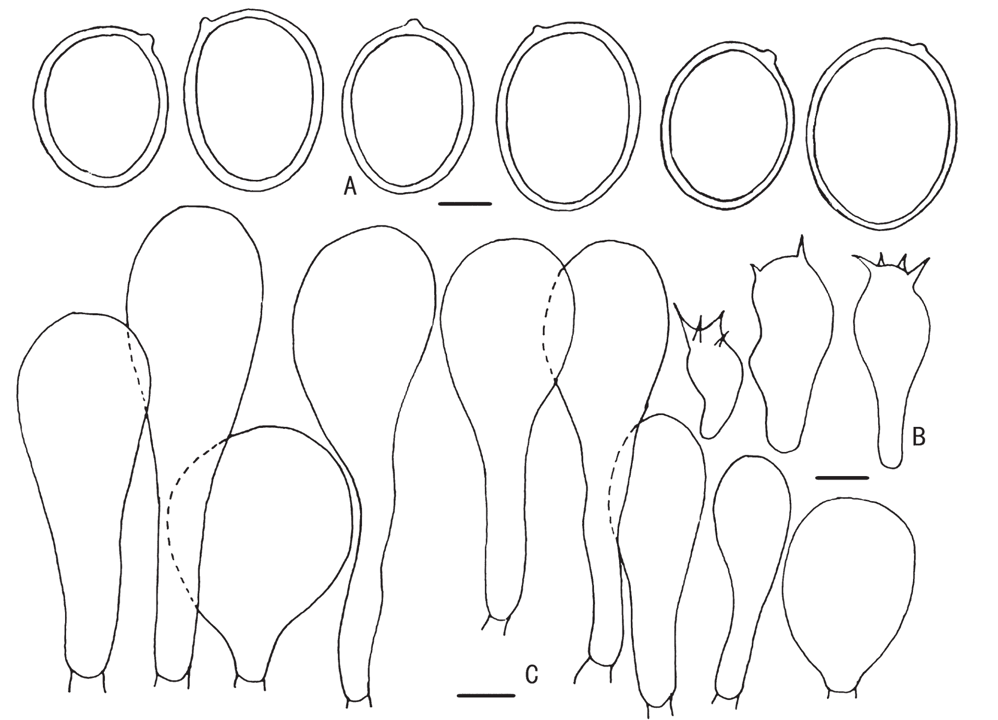
除了上述组内共享的特征外,中国美味蘑菇独特的特征包括:特别粗壮的菇体(成年菌盖宽7-12cm,菌柄宽可达7-8cm);菌盖污白色,有细小的淡褐色鳞片;菌环单层(部分描述中记载双层可能是错误的),中部有一圈凸起,白色,下位,开口向上,有时似菌托。显微特征非常特殊:担子非常罕见,甚至在部分子实体中完全缺失;同时存在褶缘和侧生囊状体(同组其他物种一般缺侧生囊状体);担孢子大小6.4–8.3 (–9) × 4.9–6.4 µm,平均7.2 ± 0.6 × 5.7 ± 0.5 µm,近球形、卵圆形至宽椭圆形,光滑,褐色。另外,它在干旱沙质土壤中半掩埋式的生活方式也非常特别。[1][2]

相似物种

形态上,和中国美味蘑菇最相似的是A. subsubensis,但是该物种原产自美国的沙质土壤,其担孢子小得多(6.2 6.6 × 5.3–5.6 µm),缺乏褶缘囊状体和侧生囊状体。模式产地位于哈萨克斯坦的巴尔喀什蘑菇Agaricus balchaschensis也拥有半埋的子实体,但依据描述,它无褶缘和侧生囊状体;Wang et al. 2015[1]尝试获得该物种的模式标本和序列,但未能成功,因此该物种和中国美味蘑菇是否确实为不同物种,以及如果答案为肯定,两者之间的更多区别,目前仍未知,国内许多鉴定为“巴尔喀什蘑菇”的样本,其真实身份可能是中国美味蘑菇[3]

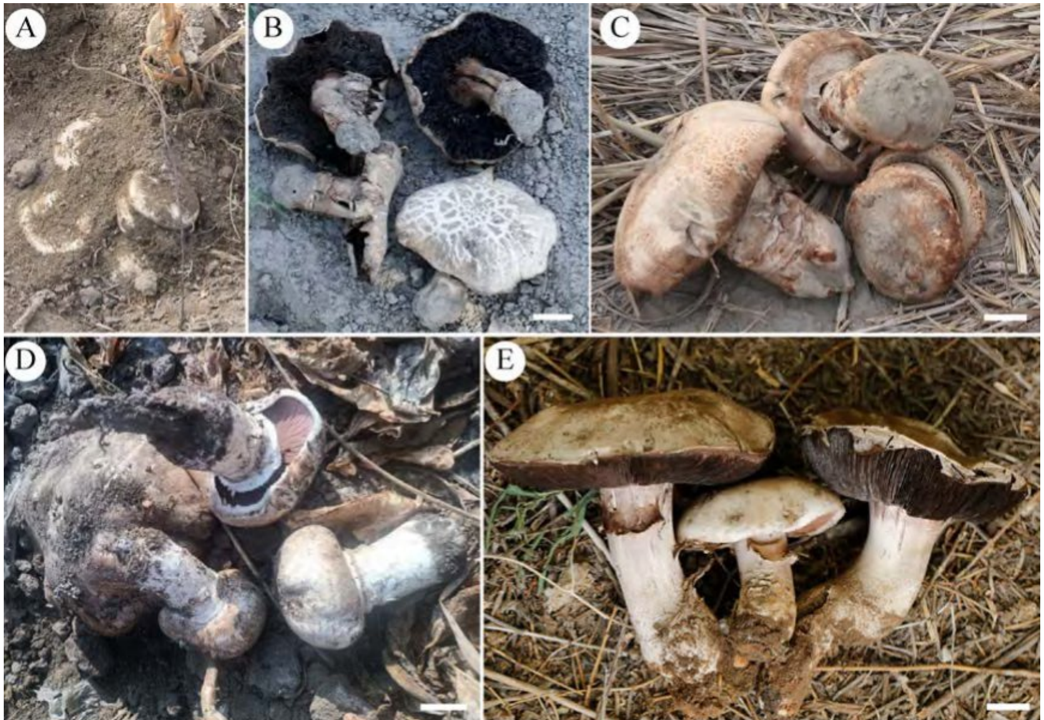
在我国西北有一系列和本物种相似的蘑菇,它们都常被俗称为“苇菇”。同组的物种有:大肥蘑菇Agaricus bitorquis(过去中国美味蘑菇常被错误鉴定为本物种)菌柄上通常形成双菌环,无侧生囊状体,担孢子较小,5.5-5.9-6.7×4.5-4.9-5µm[3]丁香蘑菇Agaricus padanus是和中国美味蘑菇一起被报道的中国新纪录种,此前仅在意大利被发现,其菌环上位,往往开口向下,呈裙状[1][3]。在西北地区还采集到sect. Nigrobrunnescentes的亚托柄蘑菇‌Agaricus subperonatus,它的菌环也常朝下开口[3]

中国美味蘑菇和其他物种的比较
中国美味蘑菇和其他蘑菇物种比较。A:示意子实体埋生的生长方式。B:大肥蘑菇。C:中国美味蘑菇。D:亚托柄蘑菇。E:丁香蘑菇。来源:野生食用菌“苇菇”的物种多样性及中华美味蘑菇适生区预测

隶属于sect. Chitonioides的圆孢蘑菇Agaricus gennadii和本物种也有些相似,卯晓岚2000[5]曾将中国美味蘑菇鉴定为本物种。但它受伤不变色或不明显(仅在菌柄皮层中受伤变淡粉色)[1],不具有半埋生习性,不具有侧生囊状体[3]

生存环境

相比于许多近缘和相似物种的广泛分布,中国美味蘑菇的生存适宜环境较为狭窄。主要分布于我国西北部,包括新疆、青海、甘肃、内蒙古等。根据模型预测,在我国西藏,和中亚地区可能也有分布。[3]

中国美味蘑菇多见于芦苇丛、红柳(柽柳属Tamarix spp.)的沙土下,但它并非和这些植物形成共生关系,而是腐生在这些环境的有机质中。这些环境通常干旱、盐碱、昼夜温差大,不适合大多数植物和真菌生存。中国美味蘑菇是天然的耐轻度盐碱蘑菇,有研究人员对其单核初级菌丝基因组进行测序组装并和其他物种进行比较基因组分析,同时进行抗逆实验和转录组分析,发现:部分基因家族收缩;基因组存在显著的LTR转座子扩张,可能参与到基因表达调控中;一系列转录因子和形态建成发育有关基因被正向选择,提示适应性演化;转录组显示参与碳氮利用、细胞稳定性和子实体形成的基因在碱胁迫下上调,特别是淀粉和蔗糖代谢、氨基酸生物合成两条代谢通路上调,增加小分子积累,而苯丙烷类生物合成下调,抑制“木质素”(这里指单分子的酚类前体,常会氧化形成无定形聚合物,导致菌菇口感发柴)合成,改变细胞壁特征。综合而言,中国美味蘑菇通过促进细胞内小分子的生物合成来对抗渗透压胁迫和氧化胁迫,抑制木质素单体的生物合成来增加细胞壁渗透性,这既让其更好地适应干旱环境,也造就了其美味的口感。[6][7]

中国美味蘑菇的资源受到当地掠夺性采挖和环境改变的威胁,例如2016年以来,博斯腾湖湖水持续上涨,造成周边芦苇、红柳面积不断缩小,导致周边的中国美味蘑菇种群濒临灭绝[3]。因此,中国美味蘑菇的种质资源急需保护。

经济价值

中国美味蘑菇营养较为丰富。对栽培个体的检测表明,粗多糖含量为1.50g/100g,粗蛋白质含量高达41g/100g,高于双孢蘑菇含量;粗脂肪为1.11g/100g,低于双孢蘑菇的含量;总膳食纤维20.9g/100g;矿物质含量丰富,灰分达9.89%,比双孢蘑菇高一倍多;含7种人体必须氨基酸(Lys, Phe, Leu, Ile, Val, Thr, His),其中Leu含量高达11.65g/kg,含硒34.985μg/kg,含维生素D[9],维生素B2、B3,麦角甾醇,多种矿质元素(K、P、S、Ca、Mg、Fe、Cu、Mn、Na)等,但维生素C未检出[10]。野外个体含维生素C 904.04mg/kg[9]

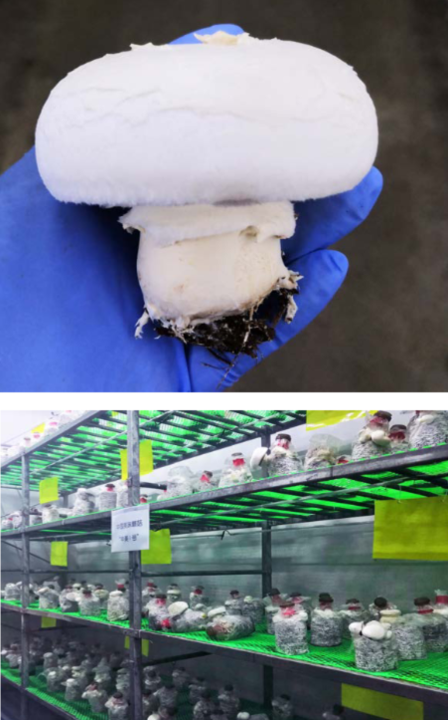
野生的中国美味蘑菇个体生长于地下,表面较污、品相各异,且野生资源稀缺,影响其商业化价值。幸运的是,中国美味蘑菇已经可以栽培。多数蘑菇属食用菌,例如常见的双孢蘑菇,种植时需要覆土,然而覆土存在成本高、带来重金属污染、导致农药残留等弊端。中国美味蘑菇是一种不需要覆土即可出菇的优良食用菌。栽培中国美味蘑菇可用稻草、麦草、芦苇等等原材料为主要成分做菌包[9]。关于栽培的最适pH,研究结论尚有争议,有研究认为最适pH为6.0,在pH6-7生长最快[9];亦有研究发现碱性pH(7-9)比酸性pH更适合[2][8];争议原因可能是菌株的采集地点不同。

2016年,从甘肃嘉峪关的中国美味蘑菇野外个体种筛选出优秀菌株,2020年该品种‘申美一号’通过专家新品种认定。申美一号属中温型、短菌龄品种,生长周期较短,约53天,特点是发菌快、出菇早、菇形较大且圆整、产量较高、口感脆嫩、香味浓郁。[12]

细胞实验表明中国美味蘑菇粗提取物能强烈抑制HeLa细胞生长,经鉴定活性物质为麦角甾醇[11]。但需要注意,这不代表中国美味蘑菇是有效的抗癌保健食品。
物种介绍-参考文献
1. Edible species of Agaricus (Agaricaceae) from Xinjiang Province (Western China). 2015. Zhuo-Ren Wang, Luis A. Parra, Philippe Callac, Jun-Liang Zhou. Phytotaxa 202(3):185-197    https://doi.org/10.11646/phytotaxa.202.3.2
2. 中国美味蘑菇野生菌株的鉴定、生物学特性及驯化研究. 2018. 徐鸿雁,刘海林,罗春燕. 食用菌学报 25 (02) : 56-61    
3. 野生食用菌“苇菇”的物种多样性及中华美味蘑菇适生区预测. 2022. 曹槟,林汝楷,刘冬梅,赵瑞琳. 菌物学报 41 (02) : 190-203    
4. The edible wide mushrooms of Agaricus section Bivelares from Western China. 2017. Zhang MZ, Li GJ, Dai RC, Xi YL, Wei SL & Zhao RL. Mycosphere 8(10): 1640–1652    https://doi.org/10.5943/mycosphere/8/10/4
5. 中国大型真菌. 2000. 卯晓岚主编. 郑州:河南科学技术出版社    
6. Insights into the genomic evolution and the alkali tolerance mechanisms of Agaricus sinodeliciosus by comparative genomic and transcriptomic analyses. 2023. Ling, Zhi-Lin & Cao, Bin & Hu, Songnian & Geng, Jianing & Liu, Fei & Liu, Dong-Mei & Zhao, Rui-Lin. Microbial Genomics 9:000928    https://doi.org/10.1099/mgen.0.000928
8. 一株野生口蘑的鉴定及生物学特性. 2023. 徐子昕,胡宝,李东晓,郭金英,王春霞,郑素月. 食品研究与开发 17    
9. 无需覆土的蘑菇属食用菌——中国美味蘑菇. 2018. 李传华等. 菌物学报 37 (05) : 595-605    
10. 柴达木大肥菇子实体营养成分分析与评价. 2015. 罗春燕. 中国食用菌 34 (03) : 25-27    
11. 中国美味蘑菇驯化栽培及抗宫颈癌活性研究. 2019. 刘培培. 石河子大学 硕士学位论文    
12. 中国美味蘑菇‘申美1号’的选育. 2021. 徐珍,张美彦,宋春艳,杨慧,王瑞娟,尚晓冬. 菌物学报 40 (09) : 2505-2507    

食毒性

可食用Edible

物种描述

文献中物种描述

  • 以下描述摘自相关参考文献,由文字识别而来,请以原文为准。
  • 部分文献可能存在描述过时、描述错误或者描述片面等情况,仅供参考。
  • 外文描述的参考翻译系AI翻译或人工翻译,仅供参考。

描述 1 来源:Edible species of Agaricus (Agaricaceae) from Xinjiang Province (Western China)

类型:原白(物种发表时的原始描述)

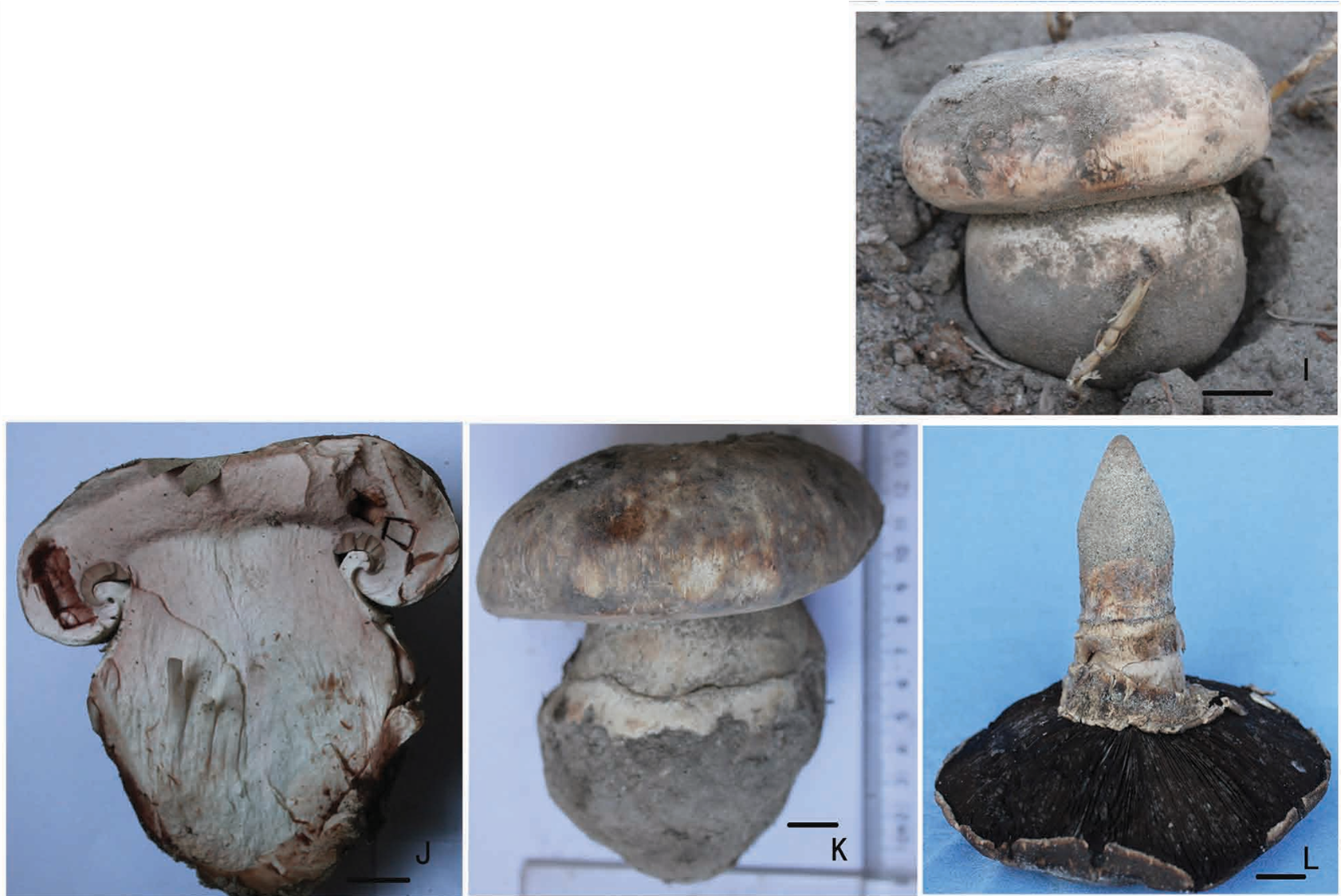
Agaricus sinodeliciosus Z.R. Wang & R.L. Zhao, spec. nov. (Figure 2: I–L; Figure 5)
MycoBank: MB 810516
Typus:—CHINA, Xinjiang Province, Bortala, Ebinur Lake, 10 May 2012, WZR2012 821, collected by Zhuo-Ren Wang (holotypus HMAS!; isotypus SWFC!)
Basidiomata medium to large, growing underground (in sandy soil) and buried, when young, then erumpent, semihypogeous. Pileus 70–120 mm in diameter when mature, and around 50 mm in diameter when young, cushionshaped, then complex, truncate or shallowly depressed at disc, margin involute; surface covered with appressed, fine light brown or buff brown squamules on a dirty white background, reddish-brown when bruised. Lamellae free, crowded, very narrow, reddish-brown, then brown, finally dark brown, with several series of lamellulae. Stipe 80–100 × 70–80 mm when mature, and 60 × 30 mm in young basidiomata, stout, first broadly fusiform with a rounded base, then cylindrical with a tapering base with age. Annulus inferous forming a volviform, peronate, membranous, broad sheath, with a narrow annular ledge in its centre, derived from the universal veil, remnants often remain appressed to stipe surface, yellowish-brown, but sometimes completely falling off, showing the smooth or fibrillose, white stipe surface which becomes reddish-brown when bruised. Context firm, dirty white, reddish-brown on cutting.Macrochemical reactions: KOH negative; Schäffer reaction negative.
Basidiospores very variable in size and shape, 6.4–8.3 (–9) × 4.9–6.4 µm, avX = 7.2 ± 0.6 × 5.7 ± 0.5 µm, Q = 1.2–1.5, avQ = 1.27, n = 20, subsphaerical to broadly ellipsoid, smooth, thick-walled, brown, without apical pore. Basidia very rare, or even absent in a basidiomata, 13–17 × 4–7 µm, clavate, 4-spored, hyaline, with sterigmata up to 2 µm long. Cheilocystidia 20–41 × 6–10 µm, globose, clavate or broadly clavate, often with a long peduncule, hyaline or with yellowish-brown vacuolar pigment. Pleurocystidia similar to the cheilocystidia, some with rudimentary sterigmata at apex. Pileipellis a cutis composed of hyphae 4–16 µm wide, cylindrical, branched, curved, the broader the more constricted at septa, with light brown parietal pigment. Terminal elements abundant, 4–7 µm wide with attenuate apex. Annulus composed of cells 5–10 µm wide, hyaline, cylindrical, or elongate ellipsoid.
Diagnosis:—This species is distinguished by its medium to large semihypogeous basidiomata, light colored pileus, large spores and presence of pleurocystidia.
Habit, habitat and distribution:—solitary or gregarious, in sandy soil of reedy grassland. Only known from China, but probably distributed in Russia.
Etymology:—the epithet “sino” means origin from China; epithet “deliciosus” means this species is edible and tasty.
Other materials examined:—CHINA, Xinjiang Province, Bortala, Ebinur Lake, 2011, WZRxinjiang1, ibidem, 10 May 2012, WZR2012 8210, WZR2012 822, WZR2012 823, WZR2012 824, WZR2012 902, WZR2012 905, WZR2012 906, all collected by Zhuo-Ren Wang. All samples deposited in SWFC! and HMAS!.
Notes:—Agaricus sinodeliciosus belongs to Agaricus [section Bivelares] subsection Hortenses. The most similar species to A. sinodeliciosus is A. subsubensis Kerrigan, but the latter differs in its much smaller basidiospores (6.26.6 × 5.3–5.6 µm) and absence of cheilocystidia and pleurocystidia (Kerrigan et al. 2008). Agaricus balchaschensis Samgina & Nam also has medium to large semihypogeous basidiomata, however, it also differs from A. sinodeliciosus in lacking cheilocystidia and pleurocystidia (Samgina & Nam 1989). There is no available ITS sequence from the type specimen of A. balchaschensis. We contacted the AA herbarium where the type material is deposited and also one of the authors (G.A. Nam) to request type material on loan without success. In GenBank the sequence AM930983 of “Agaricus sp. 1331” deposited by Hildén in 2013 matches perfectly with those of our collections of A. sinodeliciosus. The collection 1331 was identified as A. balchaschiensis without any morphological information by Hildén et al. (2013) in a publication focusing on the cultivation of Agaricus species. Our new species also could have been misidentified as A. gennadii (Chatin & Boud.) P.D. Orton (section Chitonioides) in China because both share similar characters of pileus, stipe, spores and cheilocystidia. However the context discoloration (only pale pink in stipe cortex) in A. gennadii is much less pronounced than in A. sinodeliciosus; both species differ phylogenetically in agreement with their placement in sections Chitonioides and Bivelares respectively.

序列信息

如何下载序列?

分子类型 标本号 Version No. 序列 文献 来源地
DNAWZR2012 821[主模式]KM657906ITS中国 新疆维吾尔自治区 Bortala, Ebinur Lake
DNAWZR2012 822KM657907ITS中国 新疆维吾尔自治区 Bortala, Ebinur Lake
DNAWZR2012 823KM657908ITS中国 新疆维吾尔自治区 Bortala, Ebinur Lake
DNAWZR2012 824KM657909ITS中国 新疆维吾尔自治区 Bortala, Ebinur Lake
DNAWZR2012 8210KM657910ITS中国 新疆维吾尔自治区 Bortala, Ebinur Lake
DNAWZR2012 902KM657911ITS中国 新疆维吾尔自治区 Bortala, Ebinur Lake
DNAWZR2012 905KM657912ITS中国 新疆维吾尔自治区 Bortala, Ebinur Lake
DNAWZR2012 906KM657913ITS中国 新疆维吾尔自治区 Bortala, Ebinur Lake
DNAWZRxinjiang1KM657914ITS中国 新疆维吾尔自治区 Bortala, Ebinur Lake

涉及该物种的相关文献

  1. Towards standardizing taxonomic ranks using divergence times – a case study for reconstruction of the Agaricus taxonomic system.

    ,

    2016. Zhao, R.-L., Zhou, J.-L., Chen, J., Margaritescu, S., Sánchez-Ramírez, S., Hyde, K. D., … Moncalvo, J.-M.. Fungal Diversity, 78(1), 239–292

        https://doi.org/10.1007/s13225-016-0357-x
  2. Microbial communities in the native habitats of Agaricus sinodeliciosus from Xinjiang Province revealed by amplicon sequencing

    ,

    2017. Jiemin Zhou, Xuming Bai, Rui-Lin Zhao. Scientific Reports 7(1)

        https://doi.org/10.1038/s41598-017-16082-1
  3. Edible species of Agaricus (Agaricaceae) from Xinjiang Province (Western China)

    ,

    2015. Zhuo-Ren Wang, Luis A. Parra, Philippe Callac, Jun-Liang Zhou. Phytotaxa 202(3):185-197

        https://doi.org/10.11646/phytotaxa.202.3.2
  4. 内蒙古和东北地区蘑菇属真菌资源及驯化栽培研究

    ,

    2019. 胡日瓦. 吉林农业大学硕士学位论文

       
  5. 野生食用菌“苇菇”的物种多样性及中华美味蘑菇适生区预测

    ,

    2022. 曹槟,林汝楷,刘冬梅,赵瑞琳. 菌物学报 41 (02) : 190-203