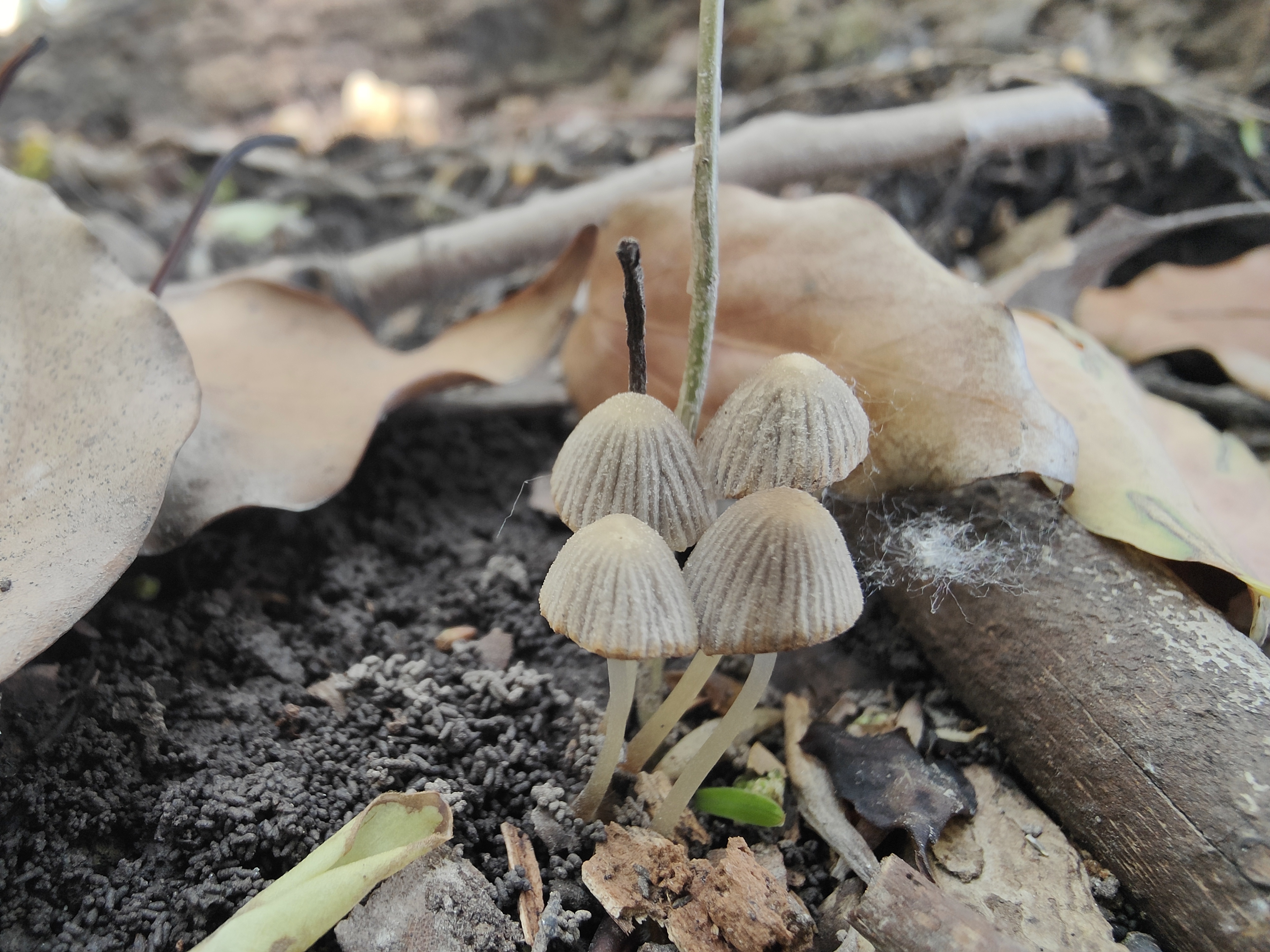
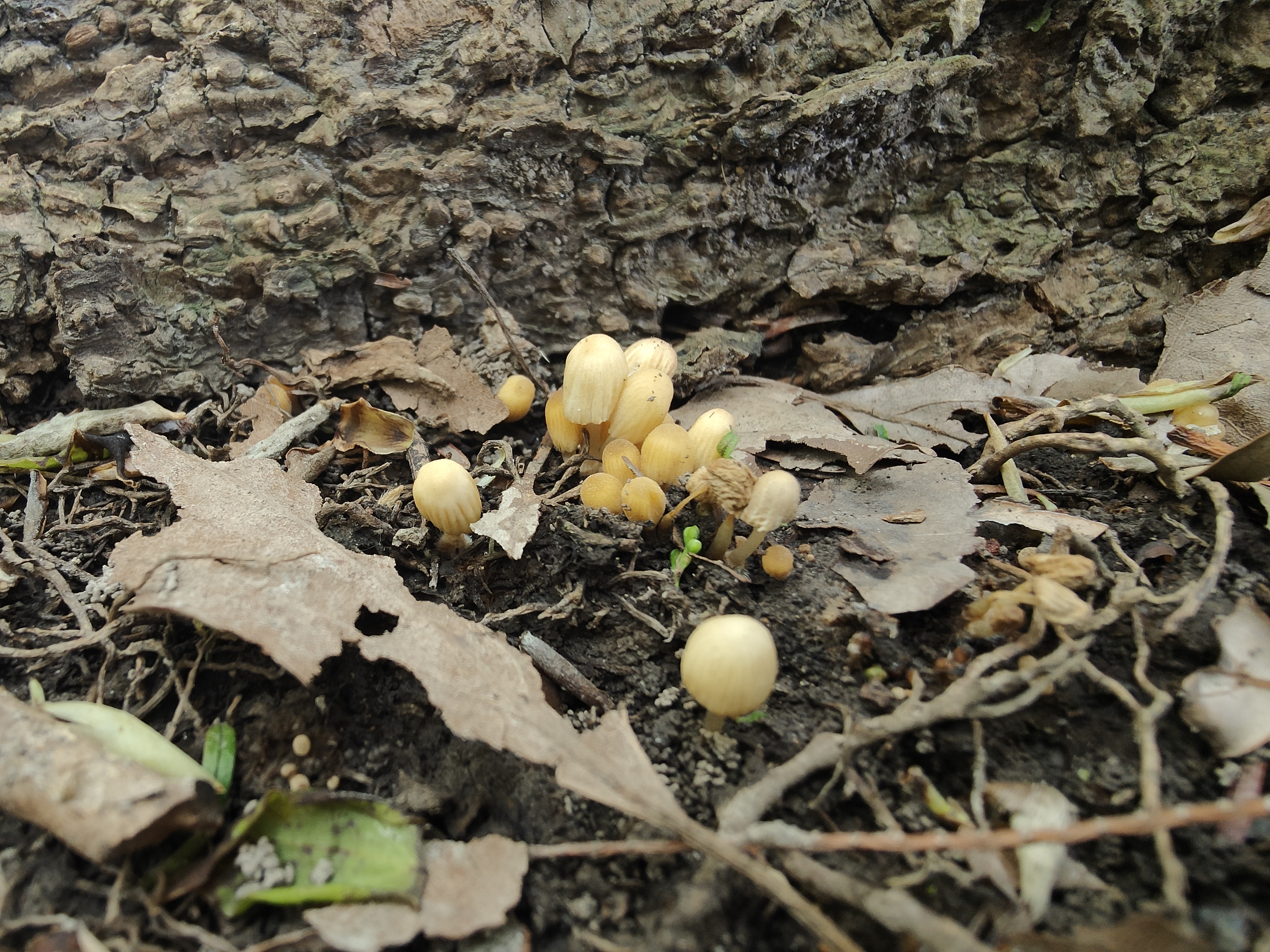
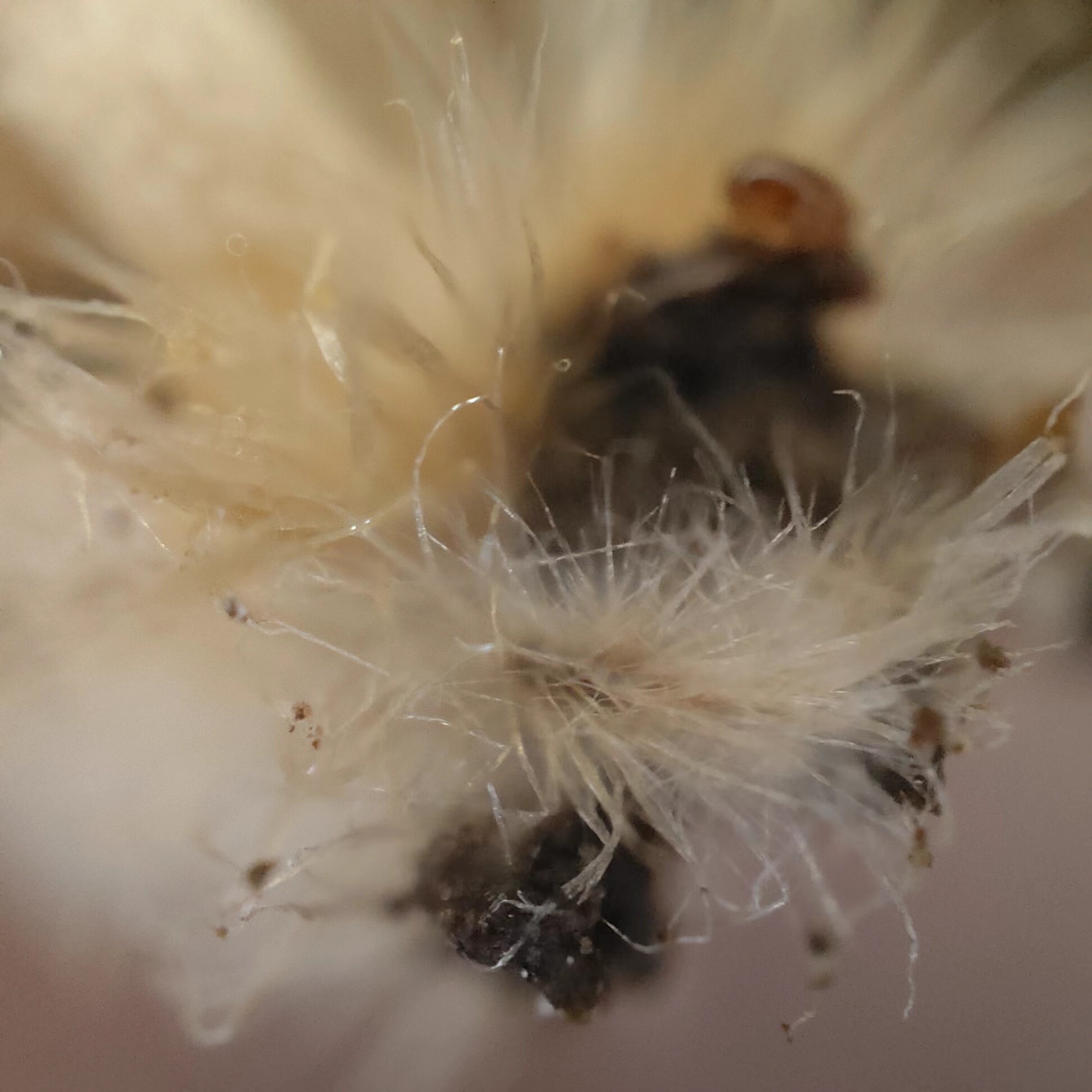
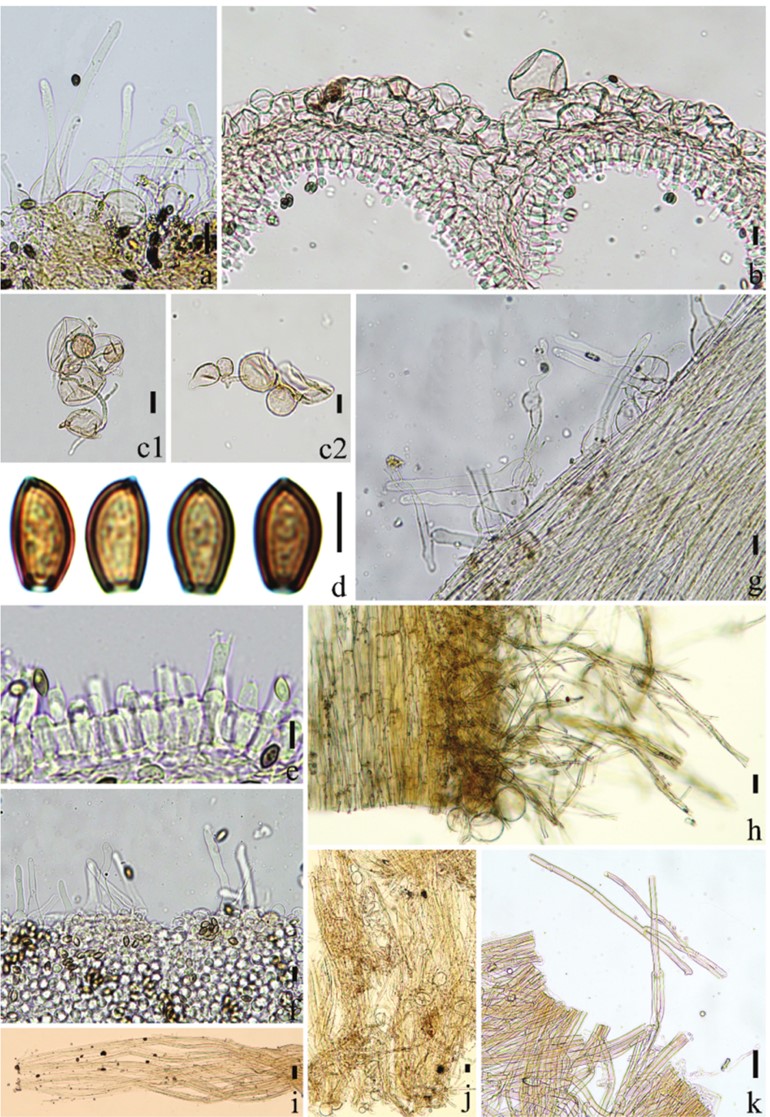
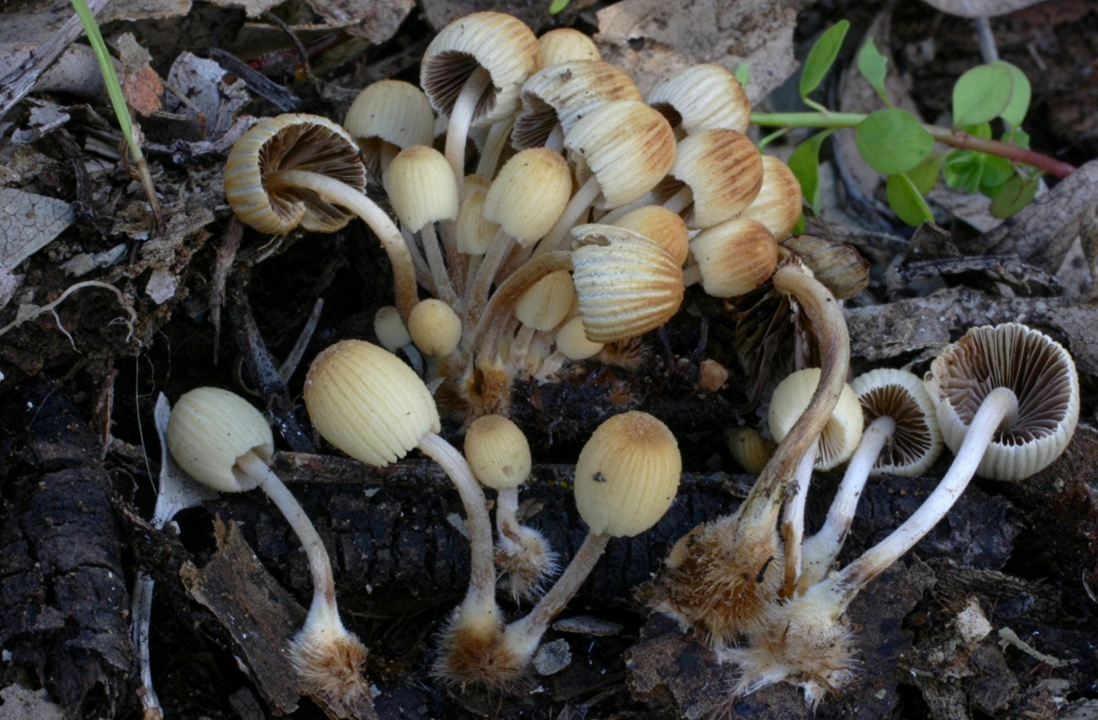
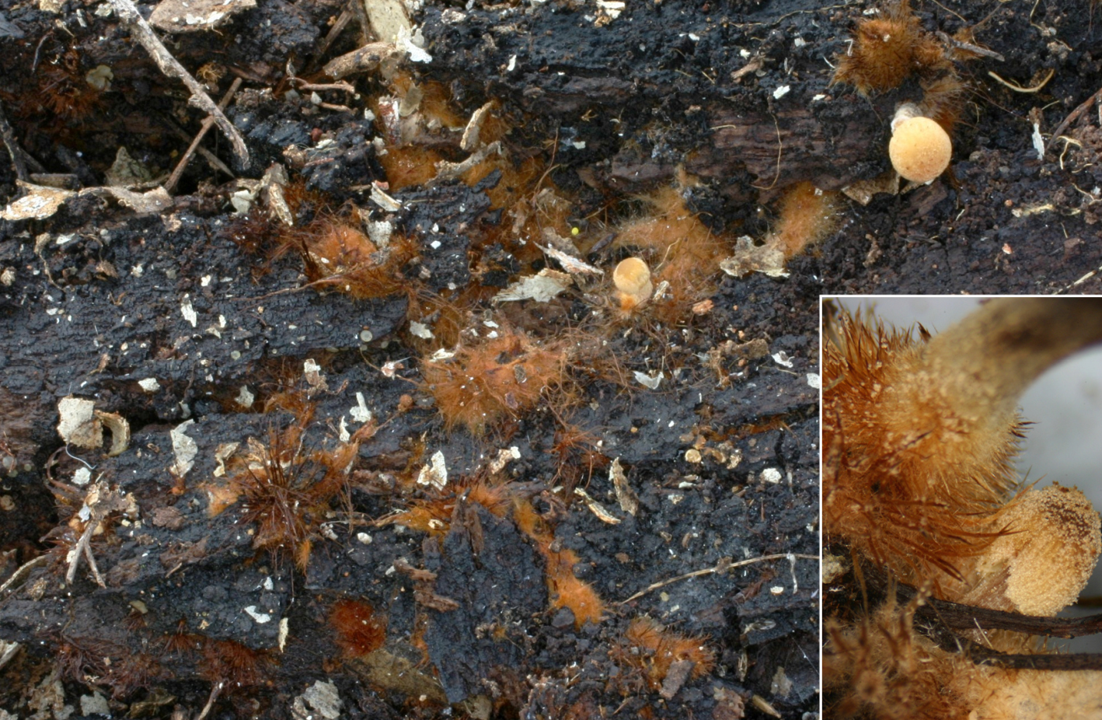
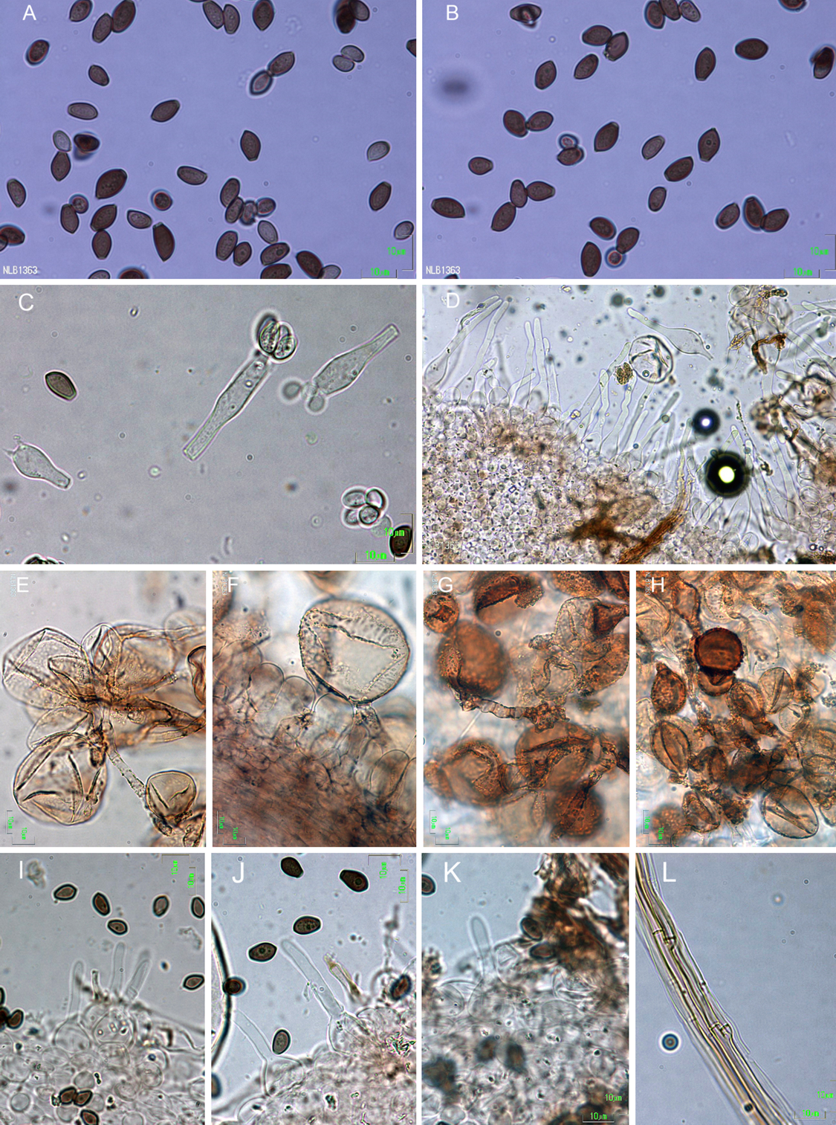
Coprinellus aureodisseminatus T. Bau & L.Y. Zhu, sp. nov, Figures 5–7 Mycobank: MB 849759.
Etymology: The prefix “aureo” refers to the yellow-brown colour of its young basidiomata and veil which is similar to the species in sect. Aureogranulati, while “disseminatus” indicates that the species is morphologically close to C. disseminatus.
Diagnosis: Pileus yellow-brown when young and become whitish when mature with not obvious radial grooves; lamellae undeliquencing at age; stipe attached to a cream to rust-brown ozonium-state; basidiospores ovoid in frontal view, amygdaliform with the acute apex in side view; basidia trimorphological; cheilocystidia lageniform; pileipellis in spher- ocystoderm at ridge part and in paraderm in groove part; elements of the veil at pileus most in subglobose to globose and on stipe mostly consisted of the hyphae-like cell, slightly thick-walled, yellow-brown to dark brown; clamp connection absent. Type: China: Shanghai City: Jiading District, Jiabei Country Park, on mud ground near rotten wood in artificial camphor forest, 9 April 2023, Jia-Ming Cai, HMJAU67119 (ITS: OR436416; LSU: OR436373).
Description: Basidiomata small-sized. Pileus 0.5 − 1.5 cm, first subglobose, ellipsoid or ovoid, obtuse conical when mature, sometimes with a rounded umbo; light yellow-brown (1B5) or deep yellow (4B5) when young covered with white (2A1) to cream (3A2), powdery or scaly veil, then become (sub)white (2A2, 3A2) at the margin and light yellow-brown (1B5) at the centre, finally become grey-white (1B1) at age, only with brown hue at centre and margin, pubescent; the radial grooves not obvious when young, and extended to the top 1/4 of the cap after maturation, without a clear line at the folding part. Context very thin, only present at the centre part, white (1A2) to cream (1A3). Lamellae narrow adnate, L = 18 − 24, I = 0 or 1, 0.1 − 0.2 cm in wide, first white (1A1) to cream (1A3), then brown-grey (5D3), finally blackish (6F4), not deliques- cent at age. Stipe 1.5 − 4.5 × 0.1 − 0.2 cm, white (1A2) to cream (1A3), sometimes with a brown hue at the lower part of the stipe, hollow, crispy, pubescent, without a volva-like margin, often attached to a cream (1A3) to rust-brown (7E8) ozonium-state.
Basidiospores [78, 7, 4] (7.9)9.0 − 9.2(10.1) × (5.2)5.4 − 5.6(6.1) × (4.7)5.3 − 5.4(5.8) μm, Q 1 = 1.49 − 1.83, Q 2 = 1.53 − 1.92, ovoid in frontal view, amygdaliform with acute apex in side view, dark red-brown (7E8) in water and blackish (7F7) in 5% KOH solution; germ pore cen- tral, 1.7 − 2.4 μm in wide. Basidia trimorphologic, 15 − 37 × 5 − 8 μm, short clavate to clavate, usually con- stricted at the middle part, 4-spored, sterigmata 3 − 6 μm in length; each basidium surrounded with 4 − 6 pseudoparaphyses. Cheilocystidia lageniform, 16 − 68 × 10 − 18 μm, with 5 − 7 μm wide, tapering neck, sometimes with 3 − 5 μm, lanceolate or 5 − 8 μm, obtuse or subcapitate apex. Pleurocystidia unseen. Hymenophoral trama regular. Pileipellis in spherocystoderm at ridge part and in paraderm in groove part, consisting of subglobose cells, 18 − 72 × 15 − 67 μm, hyaline to light yellow-brown (5A5), thin- walled to slightly thick-walled; pileocystidia slender lageniform, 63 − 138 × 8 − 23 μm, with 6 − 12 μm wide, tapering neck, sometimes subcapitate apex, hyaline or with brown hue at the base, thin-walled to slightly thick- walled. Caulopellis hyphae 3 − 8 μm wide, hyaline to yellow-brown (6C7), strongly multiple-branched and diverticulate which usually with septa, thin-walled; hyphae of stipe trama 13 − 27 μm wide, hyaline, thin- walled to somewhat thick-walled; caulocystidia lageniform, 25 − 174 × 11 − 13 μm, with 5 − 9 μm wide, erect or bender, tapering neck, usually with capitate apex (sometimes in shape like thanatophidia head), same colour with hyphae of caulopellis. Elements of veil at peilus most in subglobose to globose, 16 − 70 × 16 − 55 μm, occasionally attached with a 2 − 5 μm, short hyphae-like cell; elements of veil on stipe mostly con- sisted of hyphae-like cell, 4 − 6 μm in width, some subglobose to ellipsoid cells also present, 13 − 40 × 12 − 27 μm, slightly thick-walled, yellow-brown to dark brown. Hyphae of ozonium parallel dense arrangement, 3 − 6 μm, slightly thick-walled to thick-walled, cream (1A3) to rust-brown (7E7), darker in 5% KOH solution. Clamp connection absent, but pseudocystidia present, and short side-branches of hyphae near septa which resemble clamp connections are often observed.
Habitat: In groups or caespitose on the bark of the broad-leaved tree or ground of a forest. Usually occurs in late spring to early autumn.
Distribution: Southeast and Southwest China.
Additional specimens examined: China: Zhejiang Province: Lishui City, Qingyuan County, Qingyuan Town, Baishanzu National Park, on rotten wood of broad-leaved tree, 15 August 2015, Tolgor Bau, HMJAU67120 (ITS: OR436414; LSU: OR436374); same location, on moss layer on the trunk of the broad- leaved tree, 25 August 2023, Yong Zhou, HMJAU67119; Yunnan Province: Kunming City, Yeya Lake, on rotten wood of the broad-leaved tree, 7 August 2016, Tolgor Bau and Jun-Qing Yan, HMJAU67121 (ITS: OR436415; LSU: OR436375).
Notes: C. aureodisseminatus displays macroscopic similarities to C. disseminatus when mature, however, the pileus of the latter is initially whitish and exhibits a distinct line or groove when young. Microscopically, C. disseminatus lacks cheilocystidia, and its pileipellis con- sists of spherocystoderm, whether at the ridge or the groove. Additionally, the veil elements are comprised of two types of cells: one type is (sub)globose, hyaline, and thin-walled, while the other type mainly consists of chains of ellipsoid or subglobose, brown or ochre, thick-walled cells. It is worth noting that C. aureodisse- minatus has been discovered in Australia, initially as “C. disseminatus” (Hubregtse 2019), and in Ecuador as endo- phytes. These findings indicate that this species might have a widespread presence in subtropical or tropical areas (unpublished).
参考翻译:
Coprinellus aureodisseminatus T. Bau & L.Y. Zhu
Mycobank编号:MB849759
词源学:前缀aureo指其幼年子实体和菌幕的黄褐色调,近似于金粒组sect.
Aureogranulati物种;disseminatus指其形态上近似于白小鬼伞。
金白小鬼伞的主要特征是菌盖幼年黄褐色,成年后变白色调,有不明显的辐射状沟纹;菌褶不自溶;菌柄连接到奶油色至锈褐色的菌丝束;担孢子正面观卵形,侧面观杏仁形,顶端锐尖;担子三型(
#指担子的长度聚集在三个不连续的区间中——网站作者注#);褶缘囊状体长颈烧瓶形;菌盖皮层凸起部分spherocystoderm型,凹下部分paraderm型;菌盖菌幕细胞多为近球形指球形,菌柄菌幕细胞多菌丝状,略厚壁,黄褐色至深褐色;锁状联合阙如。
模式标本:中国上海嘉定区嘉北郊野公园,生于人工香樟林中,腐木附近的泥土上,2023年4月9日
描述:担子果小型。菌盖0.5-1.5cm宽,幼年近球形,椭圆形或卵形,成熟时钝圆锥形,有时有一个圆润的凸起;幼时为淡黄棕色或深黄色,被白色至乳白色的粉末状或鳞片状菌幕覆盖,随后边缘变为(近)白色,中心变为淡黄棕色,最终老化时变为灰白色,仅中心和边缘带棕色调,有绒毛;幼时径向沟纹不明显,成熟后延伸至菌盖顶部1/4处,折叠部分无明显的折线。菌肉非常薄,仅在中心部分存在,白色至乳白色。菌褶窄直生,L = 18 − 24, I = 0或1,0.1-0.2cm宽,初时白色至乳白色,然后变为棕灰色,最终变为黑色,老化时不自溶。菌柄1.5 − 4.5 × 0.1 − 0.2 cm,白色至乳白色,有时菌柄下部带棕色调,中空,脆骨质,有绒毛,基部无菌托状结构,常附有乳白色至锈棕色的菌丝束。
担孢子 9.0 − 9.2 × 5.4 − 5.6 × 5.3 − 5.4 μm,Q1 = 1.49 − 1.83,Q2 = 1.53 − 1.92,正面观卵形,侧面观杏仁型,顶端尖锐,在水中呈深红棕色,在5% KOH溶液中呈黑色;芽孔中生,宽1.7 − 2.4 μm。担子三型,15 − 37 × 5 − 8 μm,短棒状至棒状,中部收窄,4孢,担子小梗长3 − 6 μm;每个担子周围有4 – 6周细胞。褶缘囊状体长颈烧瓶形,16 − 68 × 10 − 18 μm,颈部宽5 − 7 μm,向上收窄;有时披针形顶端宽3 − 5 μm,或者钝圆至近头状膨大的顶端宽5 − 8 μm。侧生囊状体未见。菌髓规则型。菌盖皮层在凸起部分spherocystoderm型,在凹下部为paraderm型,由近球形细胞组成,18 − 72 × 15 − 67 μm,无色至浅黄棕色,薄壁至略厚壁;盖生囊状体为细长的长颈烧瓶形,63 − 138 × 8 − 23 μm,颈部宽6 − 12 μm,有时顶端略膨大,无色或基部带棕色调,薄壁至略厚壁。菌柄皮层菌丝宽3 − 8 μm,无色至黄棕色,强烈多分枝和分枝状,通常有隔膜,薄壁;菌柄皮层菌丝宽13 − 27 μm,无色,薄壁至略厚壁;柄生囊状体长颈烧瓶形,25 − 174 × 11 − 13 μm,颈部宽5 − 9 μm,直立或弯曲,通常顶端膨大(有时形似蛇头),与菌柄皮层菌丝颜色相同。菌盖菌幕细胞多近球形至球形,16 − 70 × 16 − 55 μm,有时存在2 − 5 μm短菌丝状细胞;菌柄菌幕由菌丝状细胞组成,宽4 − 6 μm,也有一些近球形至椭圆形细胞,13 − 40 × 12 − 27 μm,略厚壁,黄棕色至深棕色。菌丝束菌丝平行密集排列,宽3 − 6 μm,略厚壁至厚壁,奶油色至锈棕色,在5% KOH溶液中颜色加深。无锁状联合,但有假囊状体,并且在隔膜附近常可见类似锁状联合的短菌丝。
生境:群生或簇生于阔叶树木头或林地上,常出现于晚春或早秋。
分布:中国西南和东南地区。
成熟时,金白小鬼伞拥有和白小鬼伞类似的宏观特征,然而后者的菌盖幼年时白色并有明显的沟纹。显微镜下,白小鬼伞缺乏褶缘囊状体,且其菌盖皮层不论在凹陷处还是凸起处均为spherocystoderm型。另外,白小鬼伞菌幕由两种细胞组成,一种是(近)球形透明厚壁细胞,另一种是链状排列的椭圆形至近球形,褐色至黄褐色厚壁细胞。值得注意,金白小鬼伞在澳大利亚也有发现,最初被鉴定为白小鬼伞(Hubregtse 2019);在厄瓜多尔它作为内共生菌被发现。这些表明了金白小鬼伞可能在热带和亚热带地区分布广泛。