71. Coprinus urticicola (B. & Br.) Buller in Trans. Br. mycol. Soc. 5: 485. 1917.
Agaricus urticicola B. & Br. in Ann. Mag. Nat. Hist., ser. 3 (7): 376. 1861; Coprinopsis urticicola (B. & Br.) Redhead, Vilgalys & Moncalvo in Taxon 50: 232. 2001 — Coprinus brassicae Peck in Rep. N.Y. St. Mus. nat. Hist. 43: 64. 1890 — Coprinus melo in J. Favre, Ass. fong. Hauts-Marais: 215. 1948 — Coprinus suburticicola Pilát & Svrˇcek, Ceská Mykol ˇ . 21: 140. 1967.
71a. var. urticicola. – Fig. 73.
SEL. ICON. — Arnolds in Arnolds et al., Overz. Paddest. Nederland: pl. 5C. 1995; Breitenb. & Kränzl., Pilze Schweiz 4: pl. 306. 1995; Cetto, Gr. Pilzf. 5: pl. 1724. 1987.
SEL. DESCR. & FIGS. — Uljé & Noordel. in Persoonia 16: 294, 296, fig. 11. 1997.
VERN. NAME — Witte halminktzwam.
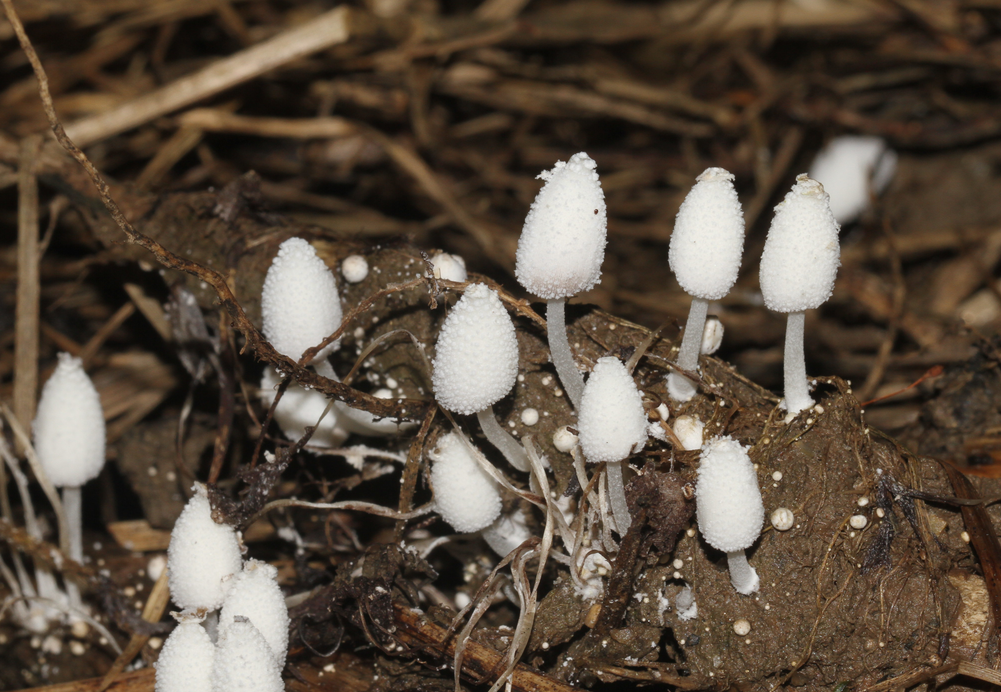
Pileus 3–6(8) × 2–4 mm when still closed, up to 13 mm when expanded, at first (sub)globose, ellipsoid, ovoid or conical, pure white. Veil white, breaking up in small, woolly-hairy scales. Lamellae, L = 35, l = 0–3, crowded, free, first white, then grey to blackish. Stipe up to 30 × 0.5–1 mm, white, greyish white, somewhat floccose above the slightly clavate base.
Spores 5.5–9.0 × 4.5–6.5 µm, Q = 1.10–1.65, av. Q = 1.25–1.45, av. L = 6.0–8.1 µm, av. B = 4.8–6.0 µm, subglobose to ellipsoid and then often somewhat conical to base and rounded at apex, rather pale red-brown; germ pore central, 1.0–1.5 µm wide. Basidia 10–23 × 6–8.5 µm, 4-spored, surrounded by (3)4–6 pseudoparaphyses. Cheilocystidia 30–65 × 10–14 µm, similar to pleurocystidia. Pleurocystidia 40–70 × 10–15 µm, (sub)cylindrical, (narrowly) utriform, oblong, ellipsoid or narrowly conical. Elements of veil thin-walled, diverticulate, 2–8 µm wide; walls slightly to strongly incrusted. Clamp-connections absent.
HABITAT & DISTR. — Solitary or subfasciculate, on grasses and herbs, sometimes on wood; common in the Netherlands. March–Nov. Common in Europe, also recorded from North America.
Coprinus urticicola is a common species in hay-fields with abundant dead grasses and also rather common in Phragmites lands. The species can be recognised by the small, pure white basidiocarps with woolly scales of veil. Microscopically the often conical, ellipsoid or ovoid, pale coloured spores and thin-walled elements of veil are good char acters to identify C. urticicola. The microscopical characters of the types of C. melo and C. suburticicola are similar to those of C. urticicola, and these species are therefore considered synonyms. Since the description of C. brassicae also agrees very well with C. urticicola, this species is also listed among the synonyms.