Micropsalliota tenuipes J. Q. Yan sp. nov. MycoBank: 842897
Etymology: Referring to its slender stipe.
Diagnosis: Differs from M. arginea in having bigger basidiospores (5.3–6.2 × 3.0–3.5 µm). (Figures 2L, 8, 10F)
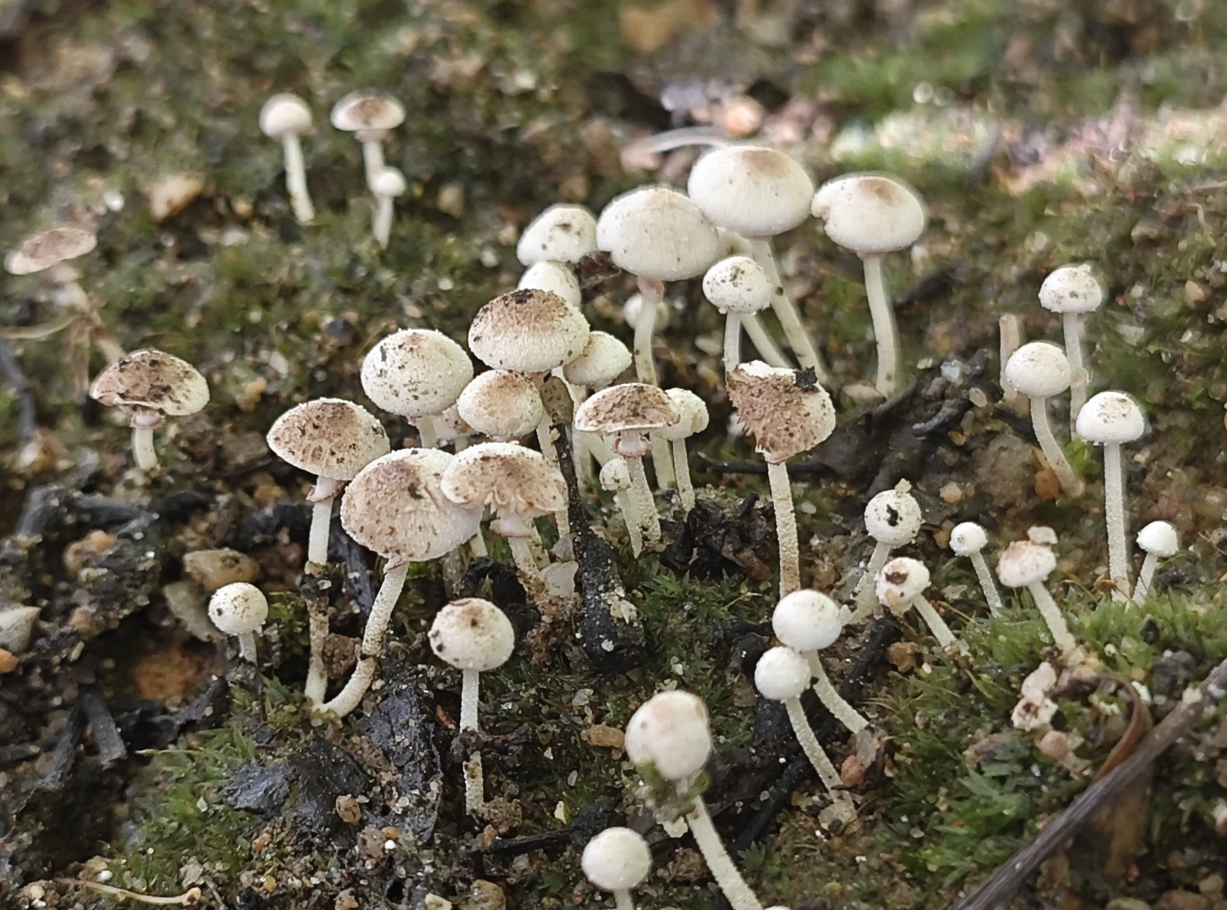
Basidiomata slender (IG = 41–131). Pileus 6.0–12 mm in diameter, dirty white (2A1), brownish orange (6C4–6C5) with age, applanate to plane, surface dry, smooth. Context less than 0.5 mm thick. Lamellae 0.3–0.5 mm broad, free, subdistant, with 2–3 series of lamellulae, dirty white becoming light orange (6A4) to light brown (6C5–6D6) as mature. Stipe 13–23 × 0.3– 0.5 mm, cylindrical, slender, hollow, white with yellowish gray (4B2) tinges, surface with white (1A1) fibrils. Annulus single, membranous, light brown (6C5–6D6), persistent, superior to median.
Basidiospores (5.0) 5.3–6.2 (6.5) × 3.0–3.5µm, av. = 5.8 × 3.3µm, Q = (1.56) 1.61–1.91 (2.07), elongated or few ellipsoid in face view, amygdaliform in profile view, light brown, wall 0.3–0.5µm thick, with or without an apically thickened endosporium, without germ pore, inamyloid. Basidia 9.5–12 × 6.0–7.0µm, clavate, hyaline, 4- or 2- spored. Pleurocystidia absent. Cheilocystidia 14–26 × (6.0) 8.0– 11.5 (12.5) µm, hyaline, claviform or widely utriform, apex broadly obtuse, rare subcapitate, covered by hyaline deposition that dissolves in 5% KOH. Pileipellis a cutis, hyphae 6.0– 15µm in diameter, some constricted at the septa on some hyphae, with hyaline, high refractive inclusions that dissolves in 5% KOH.
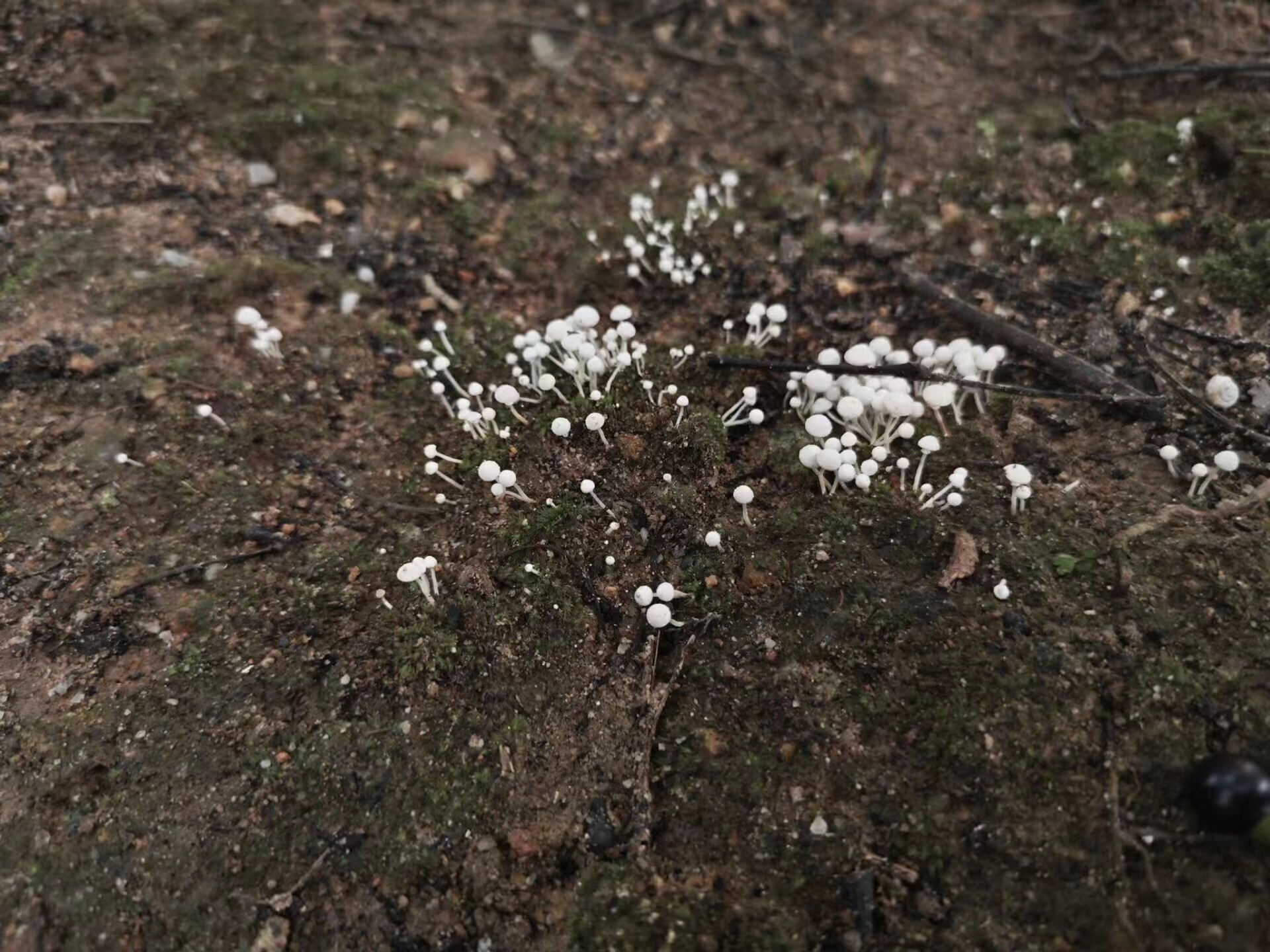
Habit and habitat: Gregarious on ground in forest.
Specimens examined: CHINA. Fujian Province, Sanming Castanopsis fargesii Provincial Nature Reserve, 18 Jun 2020, Jun-Qing Yan, Hui Zeng, Sheng-Nan Wang, HFJAU1536, holotype; Wuyishan National Park, 12 Jun 2021, Jun-Qing Yan, HFJAU3178.
Notes: Micropsalliota tenuipes is characterized by its slender stipe compared to the size of the pileus (6.0–12 mm). Micropsalliota arginea, M. cinnamomeopallida, M. plumeria, and M. pseudoarginea resemble M. tenuipes but have smaller basidiospores (<5.5µm long) (Pegler and Rayner, 1969; Heinemann, 1980, 1988; Heinemann and Leelavathy, 1991; Zhao et al., 2010). In the phylogenetic tree, M. tenuipes groups together with M. albella, but the latter has smaller basidiomata (a pileus 2.0–5.0 mm in diameter) and basidiospores shorter than 5.5µm (He et al., 2020).