白小鬼伞 Coprinellus disseminates (Pers.) J.E. Lange
Coprinellus disseminatus (Pers.) J.E. Lange, Dansk bot. Ark. 9(no. 6): 93 (1938)
≡Agaricus disseminatus Pers., Syn. meth. fung. (Göttingen) 2: 403 (1801)
≡Coprinus disseminatus (Pers.) Gray, Nat. Arr. Brit. Pl. (London) 1: 634 (1821)
≡Pseudocoprinus disseminatus (Pers.) Kühner, Botaniste 20: 156 (1928)
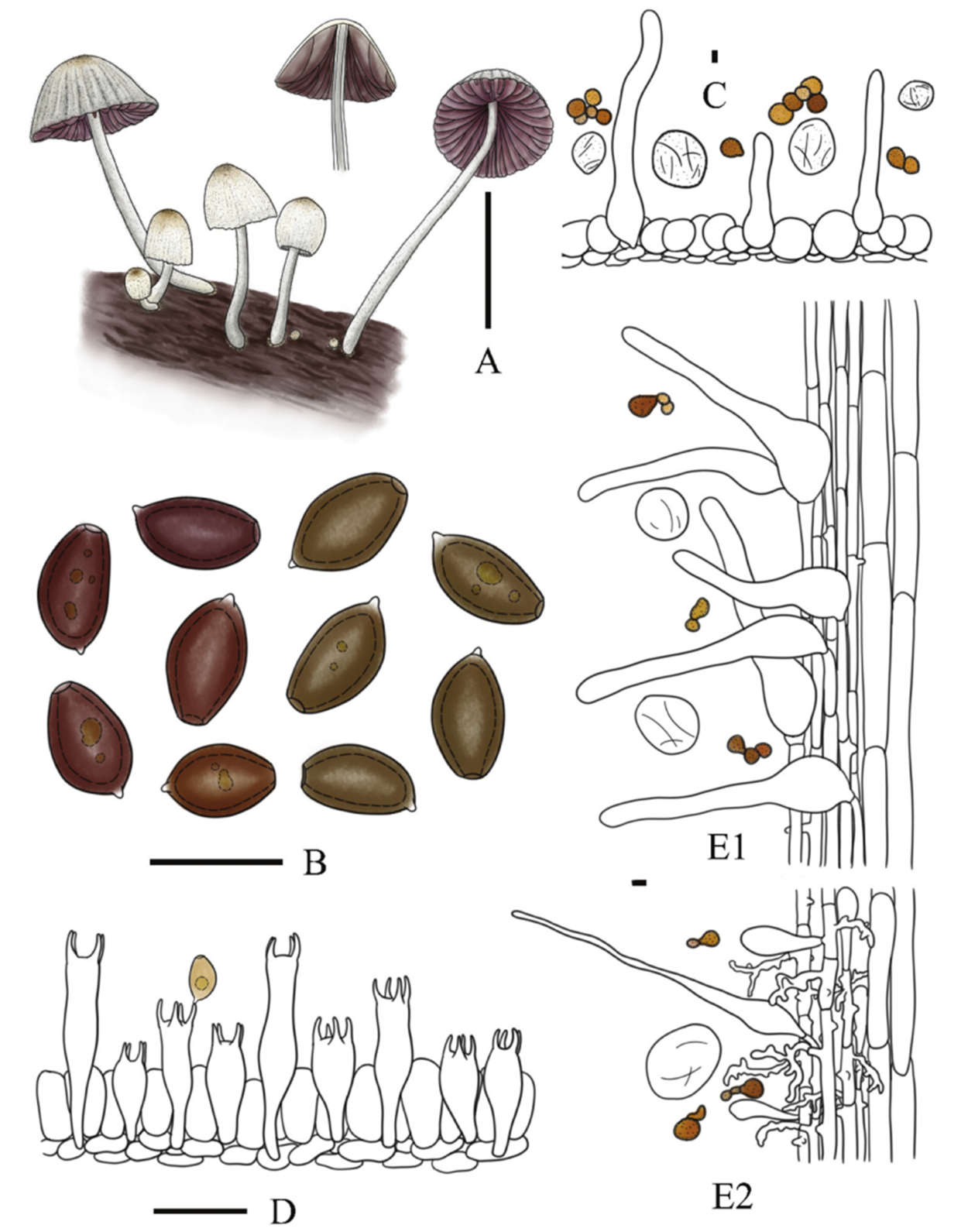
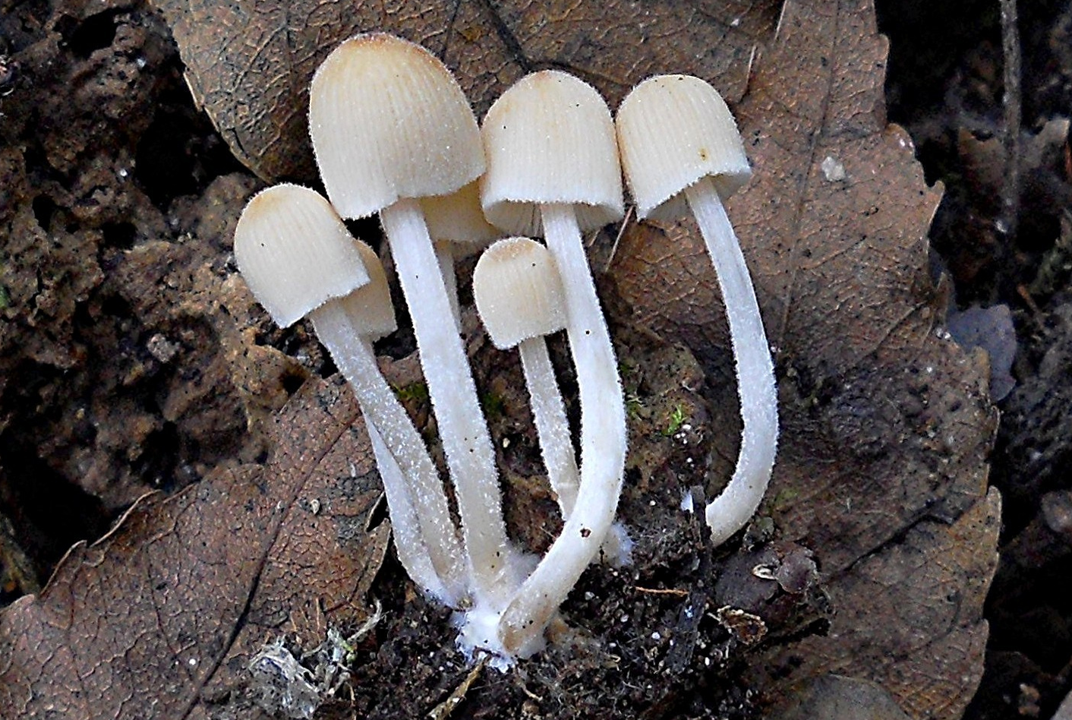
菌盖直径 0.2 - 1.2 cm,高 1.0 - 1.5 cm,钟形至圆锥形。表面具有纤毛,白色颗粒状鳞片,边缘具细条纹,白色渐变至深灰色,顶部颜色稍深。菌肉薄,白色。菌褶较密,不等长,直生,初期白色,后加深至褐色。菌柄长 1.4 - 2.6 cm,粗 0.05 - 0.1 cm,圆柱形,中空,半透明色。表面具有纤毛,基部具白色菌丝。
担孢子 8.1 - 10.0 × 4.9 - 5.4 μm,平均值 9.1 × 5.1 μm, Q = 1.6 - 2.0,Q av = 1.8 ,钟形,光滑,水中呈红褐色,遇 5%KOH 呈橄榄色,芽孔中生,直径 2.4 - 2.7 μm。担子 12 - 22 × 6 - 9 μm,棒形或中部缢缩,具 4 小梗,周具 3 - 5 拟担子,无色。未发现缘生囊状体和侧生囊状体。柄生囊状体长颈瓶形 44 - 188 ×12 - 25 μm(颈长 29 - 157 μm,颈粗 4 - 12 μm)。盖生囊状体长颈瓶形 73 – 152 × 14 - 30 μm(颈长 48 - 129 μm,颈粗 9 - 13 μm)。盖皮菌丝“Hymeniderm”型,近球形,直径 22 - 57 μm。菌幕细胞,多呈近球形,直径 12 - 32 μm,具厚壁和颗粒状附属物,黄褐色。
生境及习性:常群生于腐木或枯枝及周边土壤层,发生在春夏秋季。
世界分布:世界广布(Ujlé & Bas 1991; Uljé 2005; Nagy, et al 2012b; Hussain, et al 2018)。
中国分布:广布(邓叔群 1963; 戴芳澜 1979; 谢支锡, 等 1979; 张树庭 & 卯哓岚1995; 毕志树, 等 1997; 卯晓岚 1998; 王也珍, 等 1999; 周茂新 2007; 李江 2011; 李玉, 等 2015)。
研究标本:内蒙古:通辽市大青沟国家自然保护区,图力古尔,包海鹰,娜琴,黄梅,2018.06.16,HMJAU46427(HM0179),HMJAU46430(HM0182);吉林:长春市净月潭,黄梅,2017.06.25,HMJAU46334(HM0050);2017.07.07,HMJAU46362(HM0087);吉林市蛟河市前进林场,图力古尔,黄梅,2017.06.26,HMJAU46339(HM0055);吉林市蛟河市胜利河林场,图力古尔,黄梅,2017.06.27,HMJAU46345(HM0063),HMJAU46346(HM0064);延边朝鲜族自治州安图县二道白河科学院后山,图力古尔,黄梅,2017.06.29,HMJAU46351(HM0071),HMJAU46352(HM0072);延边朝鲜族自治州安图县二道白河和平林场,图力古尔,黄梅,2017.07.26,HMJAU46376(HM0106);长春市吉林农业大学,黄梅,2017.09.10,HMJAU46400(HM0144);通辽市是晖南抚民镇吊水壶,黄梅,2018.08.20,HMJAU46450(HM0209);浙江:杭州市天目山,图力古尔,娜琴,刘丽娜,刘晓亮,2018.07.05,HMJAU46443(HM0202);广东:韶关市始兴县车八岭国家自然保护区,黄梅,2017.05.07,HMJAU46307(HM0001) , HMJAU46308(HM0002) , HMJAU46309(HM0004) ,HMJAU46311(HM0006),HMJAU46312(HM0008);肇庆市鼎湖山,黄梅,2017.05.10,HMJAU46314(HM0016);广西:崇左市龙州县弄岗国家自然保护区,2017.05.16,黄梅,HMJAU46318(HM0028);2017.05.17,HMJAU46320(HM0032),HMJAU46321(HM0034);海南:白沙县五指山国家级自然保护区,图力古尔,娜琴,刘丽娜,刘晓亮,2018.06.26,HMJAU46439(HM0194)。
讨论:本种群生于腐木上,担子体小,菌盖白色至深灰色,孢子呈近梭形,盖生囊状体长颈瓶形,不具缘生囊状体和侧生囊状体,菌幕细胞呈球形,具厚壁和颗粒状附属物,呈黄褐色。宏观形态十分相似种——C. disseminatisimilis S. Hussain,发现于巴基斯坦,孢子也呈钟形,但具丰富的棒形或囊形缘生囊状体,菌幕细胞呈近球形,光滑,Hussain 进行系统学研究,发现该种与本种亲缘关系也十分近(Hussain, et al 2018);C. pseudodisseminatus T. Bau & M. Huang,发现于中国,孢子呈近椭圆形或豆形,具丰富缘生囊状体,菌幕细胞呈近圆柱形,厚壁,具分支,分子系统学研究发现其与本种亲缘关系较远(Huang & Bau2018);C. hiascens (Fr.) Redhead, Vilgalys & Moncalvo 具囊形或颈瓶形缘生囊状体,长颈形盖生囊状体,孢子呈椭圆形,菌幕细胞多呈圆柱形,厚壁,具分支。Ujlé 根据本种具盖生囊状体等特征,将其归属到 Coprinellus section Setulosi,但与该组其他种区别于其缘生囊状体缺失;但 2012 年,Nagy 通过分子生物学技术展开小鬼伞属真菌分子系统学研究时,发现本种与 section Micacei 的物种聚集成一支,且具有很高支持率(Uljé 2005; Nagy, et al 2012b)。
Coprinellus disseminatus subsp. orientalis T. Bau & L. Y. Zhu subsp. nov, Figures 20–22
Mycobank: MB 849766.
Etymology: “orientalis” indicates that this new subspecies is distributed in northeast Asia.
Diagnosis: Basidiomata tiny-sized; pileus light grey to grey when mature, mostly without brown hue; lamellae relatively sparse (L = 14 − 19); basidia trimorphological; terminal cells of caulopellis at the lower part of stipes mixed with short-branched, long-branched and urtiform or ellipsoid cells; distributed in northeast Asia.
Type: China: Jilin Province: Changchun City, a campus of Jilin Agricultural University, on the base of the living tree of Salix spp., 16 September 2020, Li-Yang Zhu, HMJAU67128 (ITS: OR436409).
Description: Basidiomata tiny-sized. Pileus 0.3 − 0.9 cm, first subglobose, pearl white to pale grey, cover with yellow-brown to dark brown powdery or finely scaly scales; then become ellipsoid or campaniform, white (1A1), cream (3A2) to light yellow-brown (3B3), the colour on the centre of pileus usually darker; obtuse conical when mature, light grey (1B1) to grey, mostly without brown hue; the radial grooves extended to the top, with a clear line at the folding part; pubescent. Context is very thin, only present at the centre part, white (1A1) to cream (3A2). Lamellae narrow adnate, L = 14 − 19, I = 0 − 3, 0.1 cm in wide, first white (1A1) to cream (3A2), then purple-brown (7B2), finally blackish (7F4), mostly non-deliquescent at age except in moist environment. Stipe 1.3 − 3.8 ×
0.1 − 0.15 cm, white (1A2) to cream (3A2), hollow, crispy, pubescent, and with fine tomentum at the middle and lower part of the stipe, without a volva-like margin. Ozonium at the base of the stipe is absent most time.
Basidiospores [60, 6, 5] (6.3) 7.9 − 8.2 (9.0) × (4.4) 4.9 − 5.1 (5.6) × (4.5) 4.8 − 5.0 (5.7) μm, Q 1 = 1.36 − 1.77, Q 2= 1.47 − 1.83, ovoid to long ovoid in frontal view, amygdaliform with the acute apex in side view, obconical at the base and truncate at apex, dark red-brown (6E8) in water and blackish (5E3) in 5% KOH solution; germ pore central to slightly eccentric, 1.0 − 1.9 μm in wide. Basidia trimorphological, 11 − 31 × 4 − 8 μm, short clavate to clavate, 4-spored, sterigmata 3 − 4 μm in length; each basidium surrounded with 4 − 6 pseudoparaphyses. Cheilocystidia and pleurocystidia absent. Hymenophoral trama regular, trama hyphae 2 − 11 μm in wide. Pileipellis spherocystoderm at ridge part and groove part, consisting of subglobose cells, 20 − 57 × 18 − 46 μm, hyaline, thin-walled to slightly thick-walled; pileocystidia clavate to lageniform, 71 − 211 × 8 − 29 μm, with 9 − 16 μm wide, tapering neck, sometimes subcapitate apex, hyaline or with brown hue at base, thin-walled, sometimes slightly thick-walled at base. Caulopellis hyphae 2 − 6 μm wide, hyaline, rare diverticulate at middle and upper part and multiple-branched (16 − 96 μm in length) and diverticulate at lower part, thin-walled; hyphae of stipe trama 10 − 22 μm wide, hyaline, thin-walled to somewhat thick-walled. Caulocystidia long lageniform to clavate, 41 − 180 × 16 − 33 μm, with 6 − 13 μm wide, erect or bender, tapering neck; terminal cells of caulopellis at the lower part of stipes mixed with short-branched, long-branched and urtiform or ellipsoid cells. The veil on pileus and stipes dimorphologic: (1) colourless, subglobose to globose cells, 16 − 49 × 10 − 20 μm, hyaline, thin-walled to slightly thick-walled; (2) chains of light yellow-brown to dark brown, subglobose to ellipsoid cells, 6 − 20 × 6 − 15 μm, thick-walled. Clamp connection absent.
Habitat: In groups or caespitose on the base of the trunk or near living trees or bark of broad-leaved trees. Usually occurs in summer to autumn.
Distribution: North and Northeast China.
Notes: The distribution in Northeast Asia is a significant distinguishing characteristic of this subspecies. The pileus of the original subspecies found in Europe was previously described as pale brown, yellow-brown, or ochre, but the colour of materials we collected usually lacked the yellow-brown hue. Additionally, the basidia of the original subspeciesare relatively larger (16 − 41 μm) than those of the specimens we observed here. The presence of multiple-branched and diverticulate caulopellis hyphae at the lower part of the stipes was not reported in the original subspecies, but we found it to be a relatively stable characteristic in C. disseminatus subsp. orientalis. C. velutipes also process similar structures, while their branches are much longer, measuring up to 336 μm in length.
Furthermore, we identified a unique 54 bp length sequence in the hyper-variable ITS1 domain (5’-TTGCRTGTGCGTAGCRCTGCGTGTTCGCGCRCGTTGCG-TTGCGTACGGGCTC(T)A-3’, site 135 to 190; shown in Table 2) for this subspecies. This sequence could also distinguish this Northeast Asian subspecies from the original subspecies from Europe. The blast result with this sequence (Figure S2) revealed that the most similar sequences were all located in Northeast Asia. Therefore, we consider these fragments as the DNA barcode of this subspecies.
参考翻译:
Coprinellus disseminatus subsp. orientalis T. Bau & L. Y. Zhu subsp. nov,图20–22
Mycobank编号:MB 849766
词源:"orientalis"指该新亚种分布于东北亚地区。
鉴别特征:子实体微小;菌盖成熟时呈浅灰色至灰色,多数不具棕色调;菌褶相对稀疏(L = 14 − 19);担子三型;菌柄下部皮层的末端细胞混合短分枝、长分枝及囊状或椭球形细胞;分布于东北亚地区。
模式标本:中国吉林省长春市吉林农业大学校园内,生于活柳属树木基部,2020年9月16日,Li-Yang Zhu采集,HMJAU67128(ITS:OR436409)。
形态描述:子实体微小。菌盖直径0.3−0.9cm,初期近球形,珍珠白色至浅灰色,被黄褐色至暗褐色粉状或细鳞状鳞片;后期变为椭球形或钟形,呈白色(1A1)、奶油色(3A2)至浅黄褐色(3B3),菌盖中央颜色通常更深;成熟时呈钝圆锥形,浅灰色(1B1)至灰色,多数不具棕色调;放射状沟纹延伸至顶部,折叠处具明显界线;被短绒毛。菌肉极薄,仅存在于菌盖中央区域,白色(1A1)至奶油色(3A2)。菌褶窄直生,L = 14 − 19,I = 0 − 3,宽0.1cm,初期白色(1A1)至奶油色(3A2),继而变为紫褐色(7B2),最终呈黑色(7F4),除潮湿环境外多数不自溶。菌柄1.3−3.8 × 0.1−0.15cm,白色(1A2)至奶油色(3A2),中空,脆质,被短绒毛,中下部具细密绒毛,无菌托状边缘。菌柄基部多数情况下无菌丝束。
担孢子[60, 6, 5] (6.3) 7.9 − 8.2 (9.0) × (4.4) 4.9 − 5.1 (5.6) × (4.5) 4.8 − 5.0 (5.7) μm, Q 1 = 1.36 − 1.77, Q 2= 1.47 − 1.83,正面观卵圆形至长卵圆形,侧面观杏仁形且顶端锐尖,基部倒圆锥形,顶端平截,水中呈暗红褐色(6E8),5% KOH溶液中呈黑色(5E3);芽孔中生至略偏生,宽1.0−1.9 μm。担子三型,11−31 × 4−8 μm,短棒状至棒状,4孢梗,小梗长3−4 μm;每个担子周围具4−6个周细胞。无褶缘和侧生囊状体。菌髓规则型,菌髓菌丝宽2−11 μm。菌盖皮层在脊部与沟部均为spherocystoderm型(单层细胞),由近球形细胞组成(20−57 × 18−46 μm),透明,薄壁至稍厚壁;盖生囊状体棒状至瓶状(71−211 × 8−29 μm),颈部渐细(宽9−16 μm),顶端有时近头状膨大,透明或基部具棕色调,薄壁,基部有时稍厚壁。菌柄皮层菌丝宽2−6 μm,透明,中上部罕见分枝,下部多分枝(长16−96 μm)且具分歧,薄壁;柄髓菌丝宽10−22 μm,透明,薄壁至稍厚壁。柄生囊状体长瓶状至棒状(41−180 × 16−33 μm),具直立或弯曲的渐细颈(宽6−13 μm);柄下部柄皮层的末端细胞混合短分枝、长分枝及尿囊状或椭球形细胞。菌盖与菌柄的菌幕结构二型:(1)无色近球形至球形细胞(16−49 × 10−20 μm),透明,薄壁至稍厚壁;(2)浅黄褐色至暗褐色的链状近球形至椭球形细胞(6−20 × 6−15 μm),厚壁。无锁状联合。
生境:夏秋季群生或簇生于阔叶树树干基部、活立木周边或树皮上。
分布:中国华北与东北地区。
备注:分布于东北亚是本亚种的重要鉴别特征。欧洲原亚种的菌盖曾被描述为浅褐色、黄褐色或赭色,但本次采集标本通常缺乏黄褐色调。此外原亚种担子(16−41 μm)较本标本更大。原亚种未报道柄下部具多分枝分歧的柄皮层菌丝,但本研究发现该特征在C. disseminatus subsp. orientalis中相对稳定。绒柄小鬼伞C. velutipes虽具类似结构,但其分枝更长(可达336 μm)。
此外,我们在该亚种的高变ITS1区段(5’-TTGCRTGTGCGTAGCRCTGCGTGTTCGCGCRCGTTGCG-TTGCGTACGGGCTC(T)A-3’,位点135至190;见表2)鉴定出一段54 bp的特异性序列。该序列可有效区分东北亚亚种与欧洲原亚种。基于此序列的Blast结果(图S2)显示最高相似度的序列均位于东北亚。因此我们将该片段视为本亚种的DNA条形码。