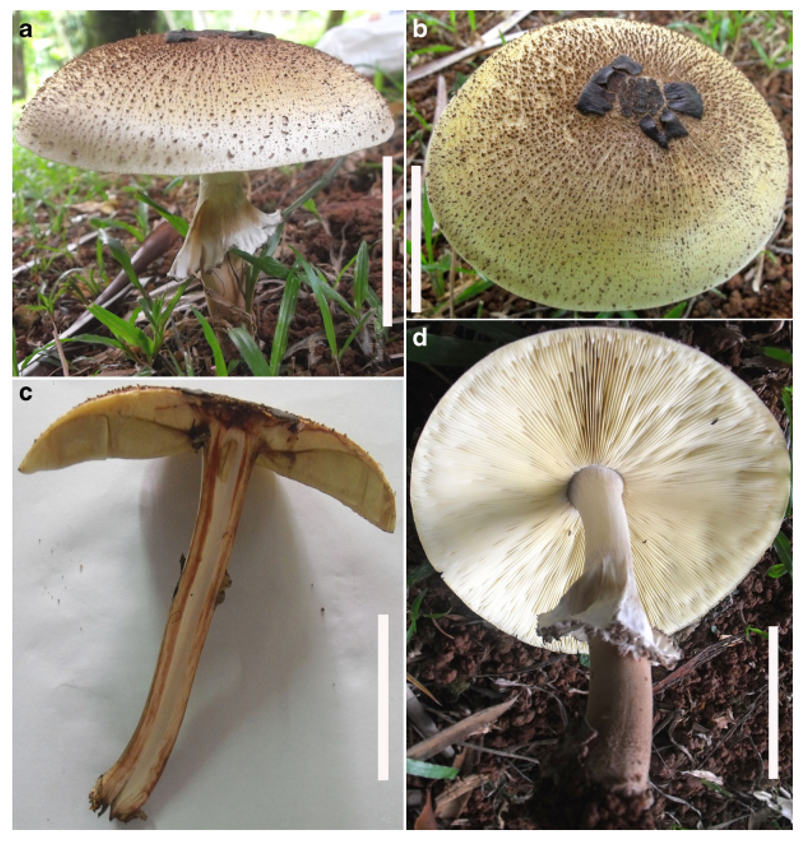
绿褶托菇 图17 图版I-1
Clarkeinda trachodes (Berk.) Singer, Lilloa 22: 413,1951.
Agaricus trachodes Berk., Hooker Lond. Journ. Bot.6: 487,1847.
Agaricus pedilius Berk& Broome, Journ. Linn. Soc., Bot. 14: 32, 1873. Agaricus poderes Berk. & Broome, loc. cit.: 32, 1873.
Chitonia pedilia(Berk. & Broome) Sacc., Syl. Fung. 5: 992,1887. Chitonia poderes (Berk. & Broome) Sacc., loc. cit: 992, 1887.
Clarkeinda pedilia (Berk. & Broome) Kuntze, Rev. Gen.P1.2: 848,1891. Clarkeinda poderes (Berk. & Broome) Kuntze, loc. cit.: 48,1891.
Chitoniella poderes(Berk.&Broome) Henn., Engl. & Prantl. Nat. Pflanzenfam.1,1**:240,1897.
Chitoniella trachodes (Berk.) Petch,Ann. Roy. Bot. Gard., Peradeniya 4: 396,1910.
担子果大型,肉质。菌盖直径 8~15cm,初略呈钟形,后渐平展,白色至污白色;菌盖表面被褐色至巧克力色的鳞片,中央的鳞片常保持完整,呈一大块状,周围的鳞片则在生长过程中撕裂成块状、反卷的小鳞片,鳞片向边缘渐小和渐稀疏;菌褶离生,较密,不等长,初期白色,后转为浅黄绿色,成熟时褐绿色至绿褐色。菌柄中生,长10~14 cm,直径1~2 cm,近圆柱形,内部中空,基部稍膨大;菌环上位,膜质;菌托膜质,白色。菌肉近白色,伤先变橘红色至红色,最后呈褐色。孢子印橄榄绿色。
担子 18~20x6.5~7μm,棒状,薄壁,无色,透明,具4孢梗,基部无锁状联合担孢子 6~7.5x4~5um[Q=(1.33)1.40~1.63,Q=1.49±0.08],侧面观杏仁形至近卵形,背腹观近卵形,顶端具平截芽孔,壁厚,光滑,褐黄色,在 3%KOH 溶液中呈褐黄色至褐色,类糊精质,内壁遇甲酚蓝变红或反应不明显。褶缘囊状体(15)20~45(55)x(10)15~20(28)um,宽棒状,透明,无色,薄壁。侧生囊状体阙如。菌盖中央鳞片由毛状排列的细胞组成,多具黄褐色至深褐色胞内色素。担子果各部位皆无锁状联合。
生境;夏秋生于路边或林中地上。
世界分布:亚洲热带地区(马来西亚、孟加拉国、斯里兰卡、泰国、印度和印度尼西亚),在我国见于云南南部。
模式产地:斯里兰卡。
研究标本:云南:勐腊,勐仑,中国科学院西双版纳热带植物园公路边土坡上,海拔570m,1988年8月12日,杨祝良382(HKAS 22120);勐腊,勐仑,西双版纳国家级自然保护区,海拔860m,1989年10月22日,杨祝良773(HKAS 22121);潞西,江东,1979年7月31日,郑文康79802(HKAS 4852)。
讨论:绿褶托菇Cl.trachodes 的主要特点是菌盖中央具一巧克力色的大块状鳞片,菌柄中上部有菌环,基部具一膜质的菌托,菌肉伤变色,孢子较小、橄榄绿色。有人曾报道意大利有绿褶托菇分布(Lavorato&Contu,2002),经过对该文引证标本的研究,发现该标本的孢子呈椭圆形、顶端不平截,该标本应为蘑菇属(Agaricus)之一种(Hosen &Ge,2011)。
Clarkeinda Kuntze
The genus Clarkeinda Kuntze belongs to the family Agaricaceae, and was circumscribed by Kuntze (1891). According to the Dictionary of the Fungi the widespread genus contains five species and Index Fungorum lists 14 records (Kirk et al. 2008; Clements 1909; Index Fungorum 2016). Species in this genus, especially Clarkeinda trachodes, are only distributed in south and southeast Asia (Yang 1991; Kuntze 1891; Hosen and Ge 2011).
319. Clarkeinda trachodes (Berk.) Singer, Lilloa 22: 413, 1951. Facesoffungi number: FoF 01844, Figs. 96, 97, and 98
Description: Basidiomes medium to large, fleshy. Pileus 120 mm in diam., hemisphaerical when young, and becoming convex to applanate at maturity; pellicle on the cap brown to coffee or chocolate brown, thin when young and thick when mature, and brown to grayish brown at maturity; the whole surface except the pellicle area covered with grayish brown to vinaceous brown squamules, with numerous, small, loosely floccose, brown squamules; context up to 8–9 mm thick in the center of the pileus, white, instantly turning reddish with expo sure. Lamellae free and distant from the stipe, white to dirty white when young, turning to olive brown when mature, becoming reddish brown after bruised, crowded with lamellulae, entire margin, concolorous. Stipe 140 × 45 mm, central, subcylindrical, fistulose in mature specimens; surface dirty white to white at the apex, light brown to brown towards the base, glabrous above the annulus, lower half densely covered with minute, brown, furfuraceous squamules. Annulus present on the upper part of the stipe but not the top, up to 20 mm, thick, membranous and remaining up to maturity, adaxial part glabrous with fine longi tudinal striate but abaxial part rough with squamules. Volva presents, grayish, dirty white to white, membranous, usually closely appressed to stipe and eventually inconspicuous. Basidiospore deposit not obtained. Basidia 17–28 × 5.5–9μm, mostly clavate to subclavate, thin-walled, tetrasporic, but seldom 1-, 2- or 3-spored, bearing four short sterigmata, hyaline, smooth, lacking incrustations, clamp connections absent. Basidioles narrowly clavate to clavate. Hymenophoral trama interwoven, hyphae cylindrical to slightly inflated, up to 14μm wide, thin-walled, hyaline, and without clamp connections. Basidiospores (Fig. 98b) (5–)5.5–6 (–7) × (3.5–)3.9–4(–4.5) μm, mean Q = 1.4–1.5, ovoid, occasionally broadly ellipsoid to ellipsoid, glabrous, thick-walled, apiculus eccentric, apex or ger minating pore prominent and truncate with slightly depressed, olive brown to dark, umber brown in deposit, dextrinoid in Melzer’s solution, not metachromatic in Cresyl blue. Cheilocystidia 25–33 × 10.5–15.5μm, abundant, scattered to more or less crowded, narrowly clavate, clavate to broadly cla vate, obpyriform, hyaline, thin-walled, smooth, lacking incrus tations, sometimes with long pedicel and narrow. Pleurocystidia absent. Pileipellis consisting of short branching chains of 4–7 cells, slightly interwoven, terminal cells 12–23 × 8–14.5μm, dull brown vacuolar pigment inside the cells in glycerin, water and 5 % KOH solutions, thin-walled, clavate, cylindrical, obpyriform to fusiform or spindle-shaped in rare cases, occa sionally branching with lateral cells that are mostly clavate, basal cells nearly subglobose to clavate or cylindrical.
Habit, habitat, distribution: The basidiomes of C. trachodes normally fruit as isolated individuals or in groups of two in disturbed habitats and at forest edges. Our collection was collected on grassland in Royal Botanic Gardens, Peradeniya, Sri Lanka. It is also known from China, India, Indonesia, Bangladesh and Malaysia.
Material examined: Sri Lanka. Central Province: Peradeniya, Royal Botanic Gardens, 7°15′35.03″N 80°36′ 4.07″E, elev. 590 m, 15 July 2009, Samantha C. Karunarathna (MFLU 10–0139, reference specimen desig nated here)
Notes: Clarkeinda trachodes is distinguished by its large basidiome size, prominent chocolate or coffee brown to dark brown pellicle on the pileus disc surface, presence of an an nulus, olive brown to umber brown spore deposit, slightly thick-walled basidiospores with a truncate apex, and a context that changes from white to reddish brown when exposed. Since Berkeley (1847) first described the species from Sri Lanka, it has been reported from south and Southeast Asia by Petch and Bisby (1950, as Chitoniella), Leelavathy et al. (1981), and Pegler (1985, 1986). Yang (1991) has also reported it from the tropical region of Yunnan, China. This is the first report with the molecular phylogenetic confirmation after Berkeley (1847) first described this from Sri Lanka. We therefore designate it as a reference specimen.