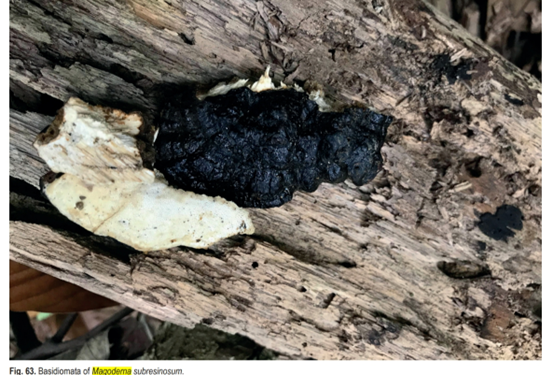
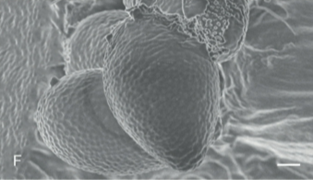
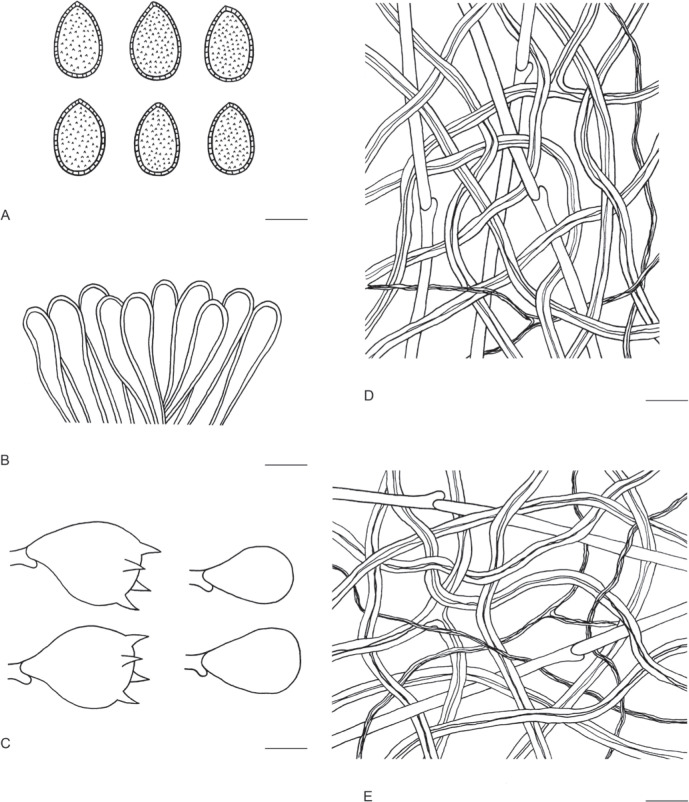
Basidiomata annual, sessile, woody hard. Pilei solitary, flabelliform, up to 12 cm diam and 3 cm thick. Pileal surface coal black, slightly shiny, glabrous, sticky, with obvious concentric furrows and strong radial wrinkles; margin subacute to obtuse, entire, incurved when dry. Pore surface pale greyish brown when dry; pores circular to angular, 4–5 per mm; dissepiments distinctly thick, entire. Context cream to pale wood brown, without dark melanoid lines, woody hard and fibrous, up to 1.3 cm thick. Tubes pale yellowish brown, up to 1.6 cm long. Hyphal system trimitic; generative hyphae with clamp connections, all hyphae IKI –, CB +; tissues slightly darkening in KOH. Generative hyphae in context colourless, thin-walled, 2–4 μm diam; skeletal hyphae in context colourless, sub-solid, arboriform and flexuous, 2–6 μm diam; binding hyphae in context colourless, thick-walled, branched and flexuous, up to 1 μm diam. Generative hyphae in tubes colourless, thin-walled, 2–3 μm diam; skeletal hyphae in tubes colourless, sub-solid, arboriform and flexuous, 2–4 μm diam; binding hyphae in tubes colourless, thick-walled, branched and flexuous, up to 1 μm diam. Pileipellis composed of clamped generative hyphae, thick-walled, apical cells clavate, inflated, dark brown, about 20– 35 × 5–9 μm, anticlinal, forming a regular palisade. Cystidia and cystidioles absent. Basidia barrel-shaped, colourless, thin-walled, 20–25 × 18–20 μm; basidioles in shape like the basidia, colourless, thin-walled, 18–20 × 11–15 μm. Basidiospores ellipsoid to ovoid, non-truncated, pale yellow, IKI –, CB +, double-walled with slightly thick walls, exospore wall faintly verrucose, endospore wall with dense spinules, (14.7–)14.9–17.3(–18) × (9.6–)9.8–11.3(–11.8) μm, L = 15.88 μm, W = 10.52 μm, Q = 1.51 (n = 60/2).
Notes: Magoderna subresinosum is widely distributed in tropical and subtropical areas of Asia and Africa (Steyaert 1972). The taxonomic status of M. subresinosum was controversial for a long time. Humphrey (1938) regarded it as Ganoderma subresinosum due to the ganodermoid basidiomata. Corner (1983) suggested it should be placed in Amauroderma based on a similar hyphal system and similar basidiospores. However, it can be distinguished by a slightly shiny and sticky coal black pileal surface, pale and fibrous context, ellipsoid to ovoid and non-truncated basidiospores with faintly verrucose exospore wall and dense spinules on the endospore wall.