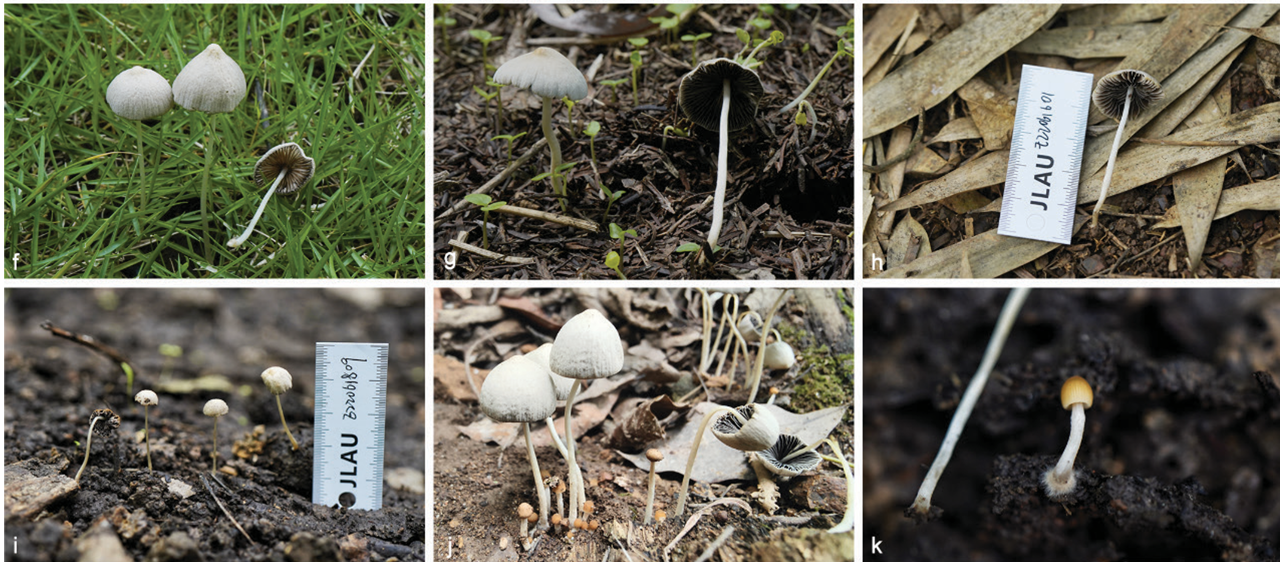
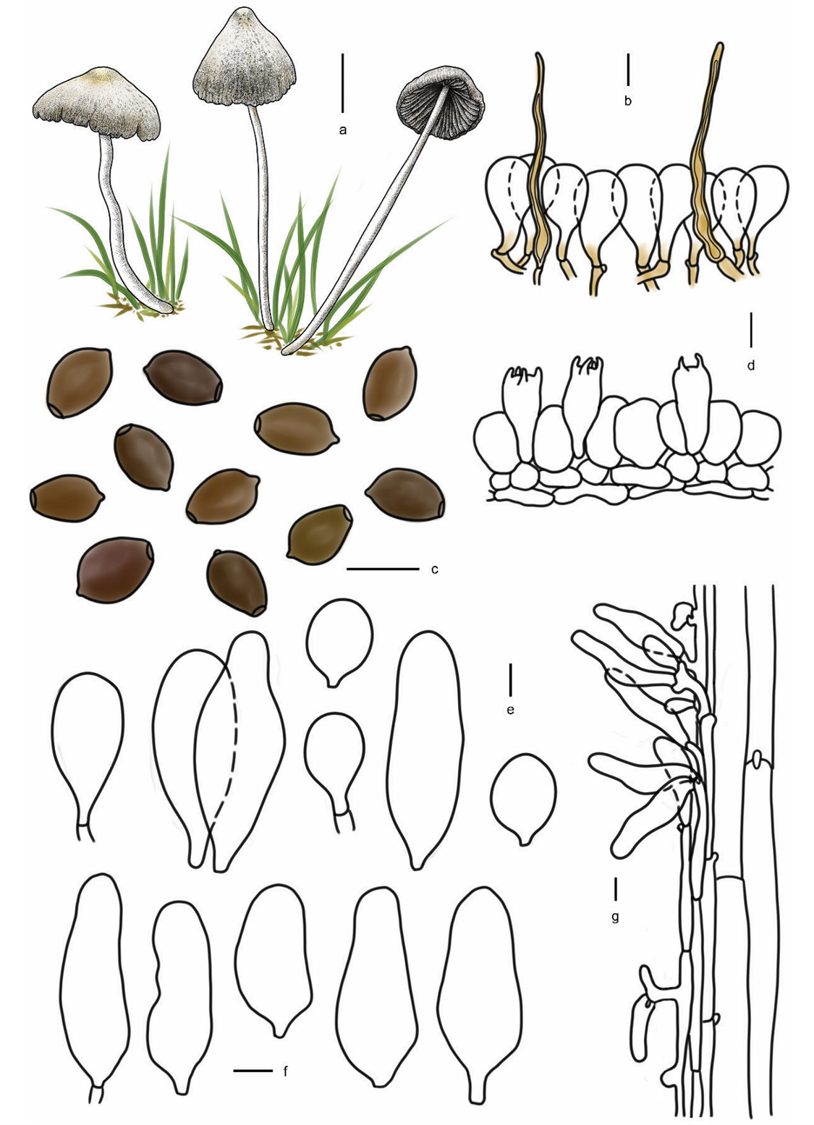
Parasola crispa T. Bau, L.Y. Zhu & W.F. Lin, sp. nov. MycoBank No: MB468520 Figs 6f–k, 7
Etymology. The specific epithet refers to the obscure sulcate-striate pileus of this species.
Diagnosis. Basidiocarps psathyrelloid; pileus conico-convex to paraboloid when mature, sometimes with obvious papilla, lacteous to pale brown-gray, somewhat yellow-brown at center, surface subglabrous to uneven, mainly with obscure sulcate-striate up to 1/3 to 1/2 part from margin to center; lamellae adnate; stipes glabrous with clavate base; basidiospores 10.3–10.7 × 7.3–7.6 × 6.4–7.0 μm, ellipsoid or ovoid in front view and ellipsoid to oblong in side view, germ pore central or slightly eccentric, 1.8–3.3 μm wide; basidia monomor phics, with relatively long sterigma which is up to 8 μm; sclerocystidia present; caulocystidia present, mostly sublageniform or subcylindrical.
Type. CHINA • Zhejiang Province, Hangzhou City, Zijingang Campus of Zhe jiang University, 30°29'73"N, 120°08'70"E, 51 m a.s.l., on soil mixed with rotten grass in grassland, July 5th 2021, T. Bau, W. F. Lin and L. Y. Zhu, Z21070513 (holotype HMJAU60339).
Description. Basidiocarps small, psathyrelloid, not collapsing. Pileus 6–7 × 6–8 mm at young stage, 10–18 mm when mature, at first conical, finally coni co-convex to paraboloid and never flattened, sometimes with obvious papilla; dry; sordid yellow to light cinnamon when young, lacteous to pale brown-gray, some what yellow-brown at center when age; surface subglabrous to uneven, some times with obscure sulcate-striate up to 1/3 to 1/2 part from margin to center. Context thin, white to pale gray, odor and taste not distinctive. Lamellae crowded, adnate, 1–3 mm in wide, L = 32–39, I = 1 or 3, initially pale gray then become brown gray with somewhat olivaceous hue and finally purple gray or dark gray when mature, more pale at margin; not deliquescent. Stipe 31–74 × 1–2 mm, cy lindrical, hollow, equal or attenuate towards the apex, white to sordid yellow, gla brous, clavate and without white hairs at base of stipes. Spore print not recording.
Basidiospores [49, 4, 3] (9.3–)10.3–10.7(–11.4) × (6.6–)7.3–7.6(–8.2) × (5.8–)6.4–7.0(–7.2) μm (10.5 × 7.4 × 6.7 μm in average), Q1 = 1.29–1.51, Q2 = 1.46–1.80, av. Q1 = 1.41, av. Q2 = 1.58; ellipsoid or ovoid in front view and ellipsoid to oblong in side view, with apical papilla, with conical base and trun cate apex, smooth, dark yellow-brown to almost black; inamyloid; germ pore central or slightly eccentric, 1.8–3.3 μm wide. Basidia monomorphics, 20–37 × 8–13 μm, with relatively long sterigma which up to 8 μm, clavate, hyaline, 4- or 2-spored, surrounded with 4–6 pseudoparaphyses; subhymenium composed of subglobose, ellipsoid, oblong or cylindrical elements, 8–20 × 6–16 μm. Chei locystidia abundant, 26–76 × 15–28 μm, subglobose, utriform, ellipsoid or sub lageniform, smooth, colorless, thin-walled. Pleurocystidia relatively rare, when present, 41–79 × 11–32 μm, broad utriform, sublageniform or (sub)cylindrical. Lamella trama regular, 3–12 μm wide, hyaline, colorless, thin-walled. Pileipellis a hymeniderm mainly made up of sphaeropedunculate cells with inconspic uous short pedicels, 20–43 × 14–21 μm, hyaline, with brown hue at base in most cases, mixed with sclerocystidia; sclerocystidia 28–159 × 4–6 μm, yel low-brown, thick-walled; pileus trama hyphae densely interwoven, thin-walled, hyaline, dark yellow to yellow-brown, 4–6 μm wide. Caulopellis hyphae parallel, 4–9 μm wide, hyaline, thin-walled, slightly diverticulate; hyphae of stipe trama 9–21 μm wide, colorless, thin-walled; caulocystidia present at upper part of stipe, 30–53 × 11–16 μm, mostly in cylindrical or broad lageniform, 16–21 × 11–16 μm, sometimes subglobose to ellipsoid, hyaline, thin-walled. Clamp connection abundant, pseudoclamp also present.
Ecology. Solitary, subfasciculate, or in small groups, grow in lawns and other grassy places, at base of dead trump of broadleaf trees or humus layer of bam boo forest. Fruiting during June to August. Currently only known from East and Central China.
Other specimens examined. CHINA • Zhejiang Province, Hangzhou City, Zijingang Campus of Zhejiang University, 30°29'90"N, 120°08'61"E, 51 m a.s.l., July 5th 2021, T. Bau, W. F. Lin and L. Y. Zhu, HMJAU60340 (Z21070507); CHINA • Shanghai Municipality, Songjiang District, Tianma Mountain, 31°07'48"N, 121°15'39"E, 82 m a.s.l., June 29th 2021, J. M. Cai, HMJAU67660 (CJM62901); • August 28th 2022, J. M. Cai, HMJAU60341 (SHPC); CHINA • Anhui Province, Chizhou City, Shitai County, bamboo forest opposite Shitai Environmental Pro tection Agency, 30°12'43"N, 117°29'29"E, 55 m a.s.l., June 16th 2022, L. Y. Zhu, H. B. Song, and H. Cheng, HMJAU64093 (Z22061601); CHINA • Anhui Province, Hefei City, Feixi County, Zipeng Mountain National Forest Park, 31°43'45"N, 117°00'51"E, 55 m a.s.l., July 22nd 2022, H. Cheng, HMJAU64095 (C22072201); CHINA • Hubei Province, Wuhan City, Wuhan Botanical Garden of Chinese Academy of Science, 30°32'56"N, 114°25'07"E, 366 m a.s.l., June 18th 2022, L. Y. Zhu, H. B. Song, and H. Cheng, HMJAU64096 (Z22061809).
Notes. There are three known psathyrelloid species in Parasola, namely Parasola cinnamomescens, Parasola conopilea, and Parasola Psathyrelloides, and the fourth is the new species Parasola crispa. Different from Parasola cris pa, these three species have brown or orange-brown pileus and longer sclero cystidia (in Parasola conopilea 100–300 μm, in Parasola psathyrelloid up to 700 μm and in Parasola cinnamomescens 140–395 μm). Additionally, Parasola conopilea has larger basidiospores (in average 14.2 × 7.4 μm) and caulocystid ia at top of stipe and its pileus often have metal gloss and sometimes slightly sticky when young from our observation (HMJAU60365, HMJAU60342). Com pared with Parasola crispa, Parasola psathyrelloides has finely sulcate-striate up to the center which resembles species in sect. Parasola (Ganga and Man imohan 2019). Differing from Parasola crispa, Parasola cinnamomescens pro cesses specialized pileipellis elements that resemble pileocystidia (Khan et al. 2023). Notably, the caulocystidia located at the upper of stipes also serve as a diagnostic feature to distinguish species within this section. Based on our observation, the caulocystidia in Parasola conopilea are predominantly (sub) lageniform or subglobose in shape and relatively large size, averaging 44 × 15 μm (as showed in Fig. 25a–c). Interestingly, Parasola crispa appears to oc cupy a transitional position between Parasola conopilea and Parasola psathyrel loid, as indicated by the degree of smoothness of their pileus. The detailed comparisons of the aforementioned Parasola species are presented in Table 2. In addition to species within sect. Conopileae, Parasola crispa is often mac roscopically confused with Psathyrella amarescens Arnolds and Psathyrella corrugis (Pers.:Fr.) Konr. & Maubl due to their shared similar morphological fea tures, such as conical, lacteous to pale brown-gray pileus with slight folding and slender stipes. However, stipes of these two Psathyrella species are covered with small, white, evanescent fibrils, particularly when young, and these two species possess fusiform cheilocystidia and pleurocystidia (Yan 2018; Friebes and Melzer 2009). However, these features are absent in Parasola crispa.
参考翻译:
皱盖近地伞Parasola crispa
词源:种加词指该物种菌盖具不明显的辐射状沟纹。
鉴定特征:子实体为小脆柄菇型;菌盖成熟时圆锥凸形至抛物面形,有时具明显乳突,乳白色至浅棕灰色,中心略带黄褐色,表面近光滑至不平整,主要从边缘至中心1/3至1/2区域具不明显的辐射状沟纹;菌褶贴生;菌柄光滑,基部棒状;担孢子10.3–10.7 × 7.3–7.6 × 6.4–7.0 μm,正面观椭圆形或卵形,侧面观椭圆形至长椭圆形,芽孔居中或稍偏,宽1.8–3.3 μm;担子单型,具相对较长的担子小梗,可达8 μm;存在厚壁囊状体;存在柄生囊状体,多为近瓶状或近圆柱形。
形态描述:子实体小型,小脆柄菇型,不液化。菌盖幼时6–7 × 6–8 mm,成熟时10–18 mm,初始圆锥形,最终为圆锥凸形至抛物面形,从不平展,有时具明显乳突;干燥;幼时污黄色至浅肉桂色,老熟时乳白色至浅棕灰色,中心略带黄褐色;表面近光滑至不平整,有时具不明显的辐射状沟纹,从边缘延伸至中心达1/3至1/2区域。菌肉薄,白色至浅灰色,气味和味道不显著。菌褶稠密,贴生,宽1–3 mm,L = 32–39,I = 1或3,初为浅灰色,后变为棕灰色略带橄榄色调,成熟时最终呈紫灰色或深灰色,边缘颜色较浅;不液化。菌柄31–74 × 1–2 mm,圆柱形,中空,等粗或向顶渐细,白色至污黄色,光滑,基部棒状,无菌柄基部白色绒毛。未记录孢子印。
担孢子 [49, 4, 3] (9.3–)10.3–10.7(–11.4) × (6.6–)7.3–7.6(–8.2) × (5.8–)6.4–7.0(–7.2) μm(平均10.5 × 7.4 × 6.7 μm),Q1 = 1.29–1.51,Q2 = 1.46–1.80,平均Q1 = 1.41,平均Q2 = 1.58;正面观椭圆形或卵形,侧面观椭圆形至长椭圆形,具顶生乳突,基部圆锥形,顶端平截,光滑,暗黄褐色至近黑色;非淀粉质;芽孔居中或稍偏,宽1.8–3.3 μm。担子单型,20–37 × 8–13 μm,具相对较长的担子小梗,可达8 μm,棒状,透明,产4孢或2孢,周围有4–6个侧丝状假隔丝;子实下层由近球形、椭圆形、长形或圆柱形细胞组成,8–20 × 6–16 μm。缘生囊状体丰富,26–76 × 15–28 μm,近球形、囊状、椭圆形或近瓶状,光滑,无色,薄壁。侧生囊状体相对少见,存在时41–79 × 11–32 μm,宽囊状、近瓶状或(近)圆柱形。菌褶菌髓规则,宽3–12 μm,透明,无色,薄壁。菌盖皮层为皮层状组织,主要由具不明显短柄的球茎状细胞组成,20–43 × 14–21 μm,透明,多数基部带褐色色调,混有厚壁囊状体;厚壁囊状体 28–159 × 4–6 μm,黄褐色,厚壁;菌盖菌髓菌丝紧密交织,薄壁,透明,暗黄色至黄褐色,宽4–6 μm。柄生皮层菌丝平行排列,宽4–9 μm,透明,薄壁,略具分枝;菌柄菌髓菌丝宽9–21 μm,无色,薄壁;柄生囊状体存在于菌柄上部,30–53 × 11–16 μm,多为圆柱形或宽瓶状,16–21 × 11–16 μm,有时近球形至椭圆形,透明,薄壁。锁状联合丰富,亦存在假锁状联合。
生态习性:单生、近簇生或小群生,生长于草坪及其他草丛地、阔叶树枯干基部或竹林腐殖层中。子实体发生于六月至八月。目前仅知分布于中国东部与中部。
备注:在Parasola属中,已知有三个小脆柄菇型物种,即Parasola cinnamomescens、Parasola conopilea和Parasola psathyrelloides,第四种便是新物种Parasola crispa。与Parasola crispa不同,这三个物种具有棕色或橙棕色的菌盖,且厚壁囊状体更长(Parasola conopilea中为100–300 μm,Parasola psathyrelloides中可达700 μm,Parasola cinnamomescens中为140–395 μm)。此外,根据我们的观察(HMJAU60365,HMJAU60342),Parasola conopilea具有更大的担孢子(平均14.2 × 7.4 μm)、菌柄顶部存在柄生囊状体,且其菌盖常具金属光泽,幼时有时微粘。与Parasola crispa相比,Parasola psathyrelloides具有延伸至中心的细微辐射状沟纹,这使其类似于Parasola组内的物种(Ganga and Manimohan 2019)。与Parasola crispa不同,Parasola cinnamomescens具有特化的菌盖皮层细胞,类似于盖生囊状体(Khan et al. 2023)。值得注意的是,位于菌柄上部的柄生囊状体也是区分本组内物种的一个鉴定特征。根据我们的观察,Parasola conopilea的柄生囊状体主要为(近)瓶状或近球形,尺寸相对较大,平均为44 × 15 μm(如图25a–c所示)。有趣的是,根据菌盖的平滑程度,Parasola crispa似乎占据着Parasola conopilea和Parasola psathyrelloides之间的过渡位置。上述Parasola物种的详细比较见表2。
除了Conopileae组内的物种外,Parasola crispa在宏观上常与Psathyrella amarescens Arnolds和Psathyrella corrugis (Pers.:Fr.) Konr. & Maubl.混淆,因为它们共享相似的形态特征,例如圆锥形、乳白色至浅棕灰色且具轻微褶皱的菌盖以及细长的菌柄。然而,这两个Psathyrella属物种的菌柄(尤其是幼时)覆盖有细小、白色、易消失的纤毛,并且具有梭形的缘生囊状体和侧生囊状体(Yan 2018;Friebes and Melzer 2009)。而这些特征在Parasola crispa中并不存在。