返回搜索
Logo Pic

长白山囊小伞

Cystolepiota changbaishanensis


T. Bau and X. Y. Zhou 2024

基本信息 General Info.

  • 通用中文名Chinese name:长白山囊小伞
  • 拉丁学名Scientific name:Cystolepiota changbaishanensis T. Bau and X. Y. Zhou 2024
  • 科Family:疣孢环柄菇科Verrucosporaceae
  • 属Genus:囊小伞属Cystolepiota
  • 分布Distribution:中国
  • 有分布的省区Provinces:吉林省(文献记载)
    查看具体分布情况
  • 生态Ecology:单生,散生或群生于混交针叶林的地表土壤或落叶层上。
  • 营养类型Nutrition Type:腐生Saprotrophic: 分解死亡生物体或有机物获取养分
  • 置信指标Confidence:★★★

物种介绍

DefaultPicture

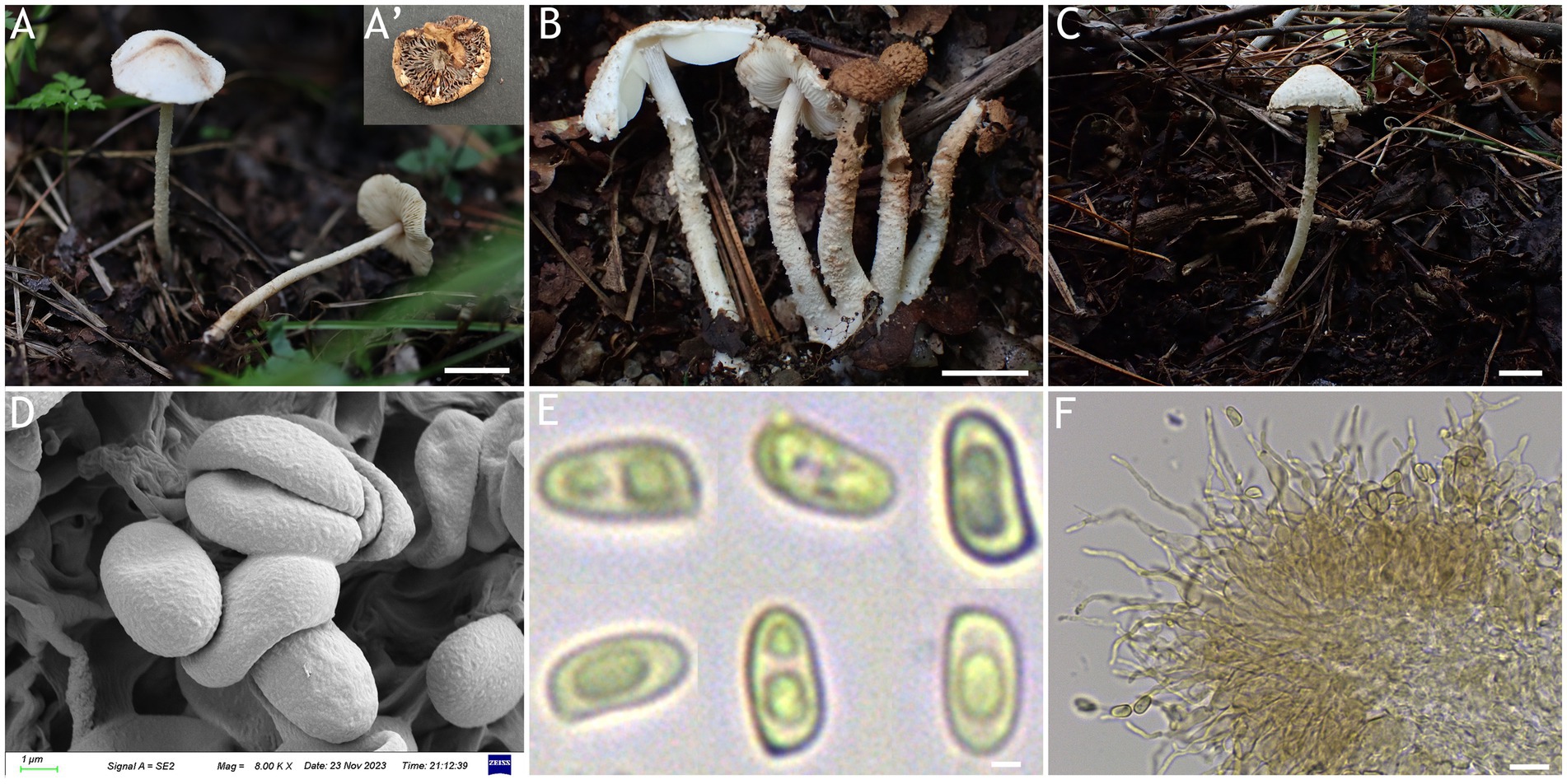
A-C:担子果,A':干标本,D:扫描电镜下孢子,E:光镜下孢子,F:褶缘囊状体。A,D-F:HMJAU68224(主模式),B:HMJAU68223,C:HMJAU68222。比例尺:A-C=1cm,D-E=1μm,F=10μm
来源文献:Four new species of Cystolepiota (Agaricaceae, Agaricales) from northeastern China

长白山囊小伞是2024年发现于长白山上针叶林的一个物种。其主要特征是:菌盖污白色至奶油色,被粉末状、颗粒状或近锥形的鳞片,鳞片奶油色,灰橙色至褐色;菌褶离生,白色至奶油色;菌褶和菌肉干燥后变灰橙色至褐色;担孢子长椭圆形至圆柱形,在扫描电镜下可见模糊的小疣突;显微镜下褶缘囊状体烧瓶形至长烧瓶形,无侧生囊状体。
该物种和哈氏囊小伞C. hetieri近缘。

相似物种

形态上,它和瓶囊囊小伞C. fumosifolia、锥鳞囊小伞C. pyramidosquamulosa和描述于老挝的C. pyramidalis形态上相似,菌盖和菌柄都拥有近锥形鳞片。但瓶囊囊小伞菌柄有褐色斑点,存在侧生囊状体;锥鳞囊小伞菌褶偏黄白色,干燥后不变色,无褶缘和侧生囊状体;C. pyramidalis菌盖橙白色至淡橙色,菌褶淡黄色且触碰或成熟后变橙褐色,担孢子介于椭圆形和卵形。

物种描述

文献中物种描述

  • 以下描述摘自相关参考文献,由文字识别而来,请以原文为准。
  • 部分文献可能存在描述过时、描述错误或者描述片面等情况,仅供参考。
  • 外文描述的参考翻译系网站管理者的个人翻译,详请参见原文。

描述 1 来源:Four new species of Cystolepiota (Agaricaceae, Agaricales) from northeastern China

类型:原白(物种发表时的原始描述)

3.2.1 Cystolepiota changbaishanensis T. Bau and X. Y. Zhou, sp. nov.
MycoBank number: MB 851389 (Figures 3, 4).
Diagnosis: The identifying features of C. changbaishanensis are that the pileus is dirty white to cream, with pulverulent, granulose or subpyramidal squamules, cream, greyish orange, light brown, brown; pileus and pileus context becoming greyish orange to brown after drying; lamellae white to cream, turn grayish orange to light brown when drying; basidiospores obscure small warts visible under SEM; and cheilocystidia lageniform to broadly lageniform.
Etymology: The species epithet “changbaishanensis” is derived from the name of the mountain where the material was collected.
Type: China, Jilin Province, Jiaohe City, Qianjin forest farm, July 23, 2022, coll. T. Bau and H. B. Song (HMJAU68224), Holotype!
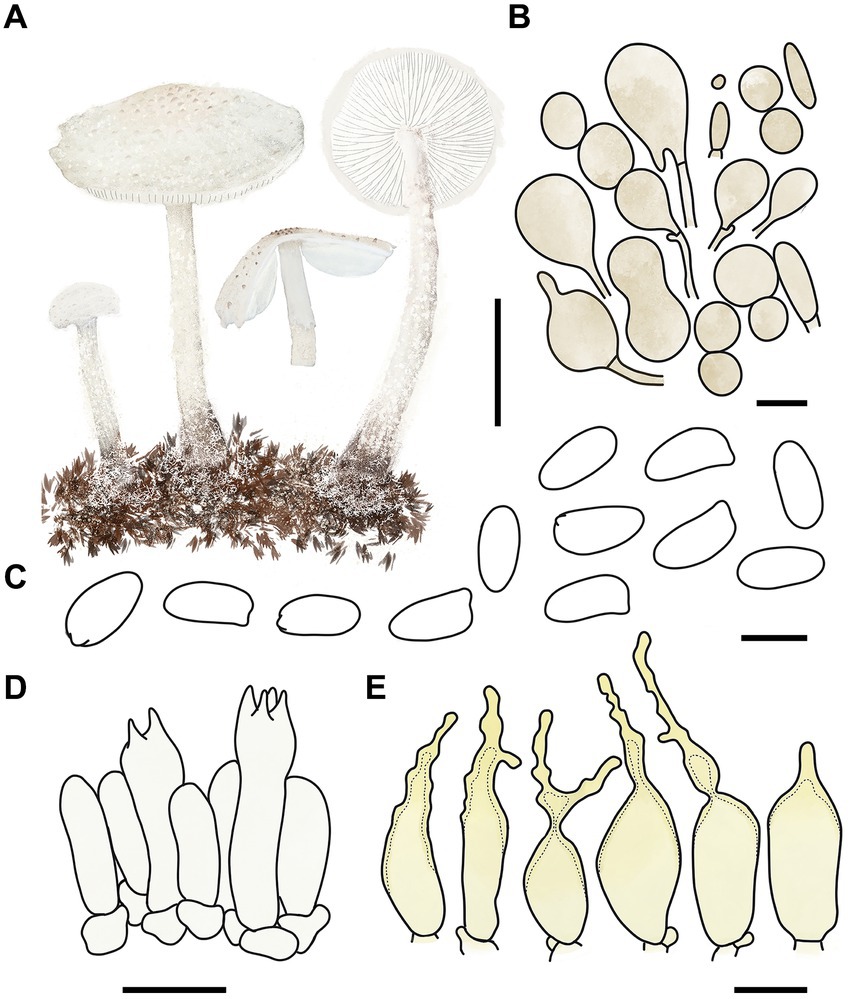
Description: Basidiomata small. Pileus 0.8–2.2 cm, hemispherical when young, expanding to plano-convex or applanate, slightly subumbonate with age, dirty white to cream; with pulverulent, granulose or subpyramidal squamules, dirty white to cream, greyish orange (6B2–B8), light brown (7D5–D8), brown (7E5–E8); pileus context whitish, pileus and pileus context becoming greyish orange (6B5–B7) to brown (7E6–E8) after drying. Lamellae free, white to cream, crowded, up to 0.4 cm broad, with 1–3 tiers of lamellulae, turning grayish orange (6B2–B8) to light brown (6D2–D8) when drying. Stipe 3.2–6.2 × 0.1–0.5 cm, subcylindrical, occasionally downward thickened; white to cream on the upper portion, subsmooth, with granulose squamules from the annular area downwards, concolorous with pileus, fragile and fugacious. Annulus white, fugacious. Odor and taste not recorded (Figures 3A–C, 4A).
Basidiospores [150,5,5] 4.6–6.0 (−6.4) × 2.1–3.0 (−3.4) μm, Q = 1.63–2.54, Qv = 2.08, long ellipsoid to cylindrical, hyaline, slightly thick-walled, smooth-walled under the LM, small warts visible under SEM, inamyloid, non-dextrinoid, metachromatic in cresyl blue, cyanophilous. Basidia13–20 × 4–7 μm, clavate, 4-spored, sometimes 2-spored, greyish yellow (4C4–C6). Lamellar trama regular, greyish yellow (4C3–C7). Cheilocystidia 32–56 × 6–12 μm, lageniform to broadly lageniform, greyish yellow (4C4–C7) to golden yellow (1B4–B8), with a long cylindrical-tortuous apex, slightly thick-walled. Pleurocystidia absent. Pileus and stipe covering an irregular epithelium composed of globose, subglobose, spheropedunculate, 10–21 μm in diam., usually 2–5 cells in a string, brownish orange (5C2–C5). Clamp connections present in all structures (Figures 3D–F, 4B–E).
Habitat: Solitary, scattered or clustered on dead leaves and soil of mixed coniferous forests.
Distribution: Found only in Jilin Province, northwestern China.
Additional specimens examined: China, Jilin Province, Helong City, Xianfeng National Forest Park, August 22, 2021, coll. T. Bau and X. Wang (HMJAU68221); Jiaohe City, Qianjin forest farm, July 23, 2022, coll. T. Bau, L. Y. Zhu, W. N. Hou and H. B. Song, (HMJAU68228, HMJAU68229, HMJAU68230); Dunhua City, State forest farm, July 27, 2022, coll. T. Bau and W. N. Hou (HMJAU68225); Baishan City, Jingyu National White Bear Reserve, July 29, 2022, coll. T. Bau and L. Y. Zhu (HMJAU682310); Tonghua City, Baijifeng National Forest Park, July 8, 2023, coll. T. Bau, Q. R. Liu, Z. Q. Cheng, M. Liu and J. L. Wei (HMJAU68226, HMJAU68227, HMJAU68232, HMJAU68222, HMJAU68223).
Notes: Macromorphologically, this species is similar to C. fumosifolia, C. pyramidalis and C. pyramidosquamulosa, because all of them present subpyramidal squamules on the pileus and stipe surface. But the lamellae of Cystolepiota fumosifolia usually have brown spots, and it has pleurocystidia (Vellinga, 2006). Cystolepiota pyramidalis has orange white to pale orange pileus, pale yellow lamellae, which turn brownish orange when touched or mature, and ellipsoid-ovoid basidiospores (Sysouphanthong et al., 2022). The lamellae of Cystolepiota pyramidosquamulosa are yellowish white, do not change color after drying, and do not have cystidia (Qu et al., 2023).
In the phylogenetic trees (Figures 1, 2), Cystolepiota changbaishanensis and C. hetieri are sister clades, but the lamellae of the latter's basidiomata did not change color after drying and exhibited pleurocystidia.

序列信息

如何下载序列?

分子类型 标本号 Version No. 序列 文献 来源地
DNAHMJAU 68224[主模式]OR947166.1ITS中国 吉林省 Jiaohe City, Qianjin forest farm
DNAHMJAU 68224[主模式]OR947177.1LSU中国 吉林省 Jiaohe City, Qianjin forest farm
DNAHMJAU 68224[主模式]PP465907.1tef1中国 吉林省 Jiaohe City, Qianjin forest farm
DNAHMJAU 68221OR947168.1ITS中国 吉林省 Helong City, Xianfeng National Forest Park
DNAHMJAU 68221OR947179.1LSU中国 吉林省 Helong City, Xianfeng National Forest Park
DNAHMJAU 68228OR947171.1ITS中国 吉林省 Jiaohe City, Qianjin forest farm
DNAHMJAU 68229OR947172.1ITS中国 吉林省 Jiaohe City, Qianjin forest farm
DNAHMJAU 68230OR947173.1ITS中国 吉林省 Jiaohe City, Qianjin forest farm
DNAHMJAU 68225OR947167.1ITS中国 吉林省 Dunhua City, State forest farm
DNAHMJAU 68225OR947178.1LSU中国 吉林省 Dunhua City, State forest farm
DNAHMJAU 68225PP465908.1tef1中国 吉林省 Dunhua City, State forest farm
DNAHMJAU 68231OR947174.1ITS中国 吉林省 Baishan City, Jingyu National White Bear Reserve
DNAHMJAU 68226OR947169.1ITS中国 吉林省 Tonghua City, Baijifeng National Forest Park
DNAHMJAU 68227OR947170.1ITS中国 吉林省 Tonghua City, Baijifeng National Forest Park
DNAHMJAU 68222OR947164.1ITS中国 吉林省 Tonghua City, Baijifeng National Forest Park
DNAHMJAU 68222PP465921.1rpb2中国 吉林省 Tonghua City, Baijifeng National Forest Park
DNAHMJAU 68222PP465905.1tef1中国 吉林省 Tonghua City, Baijifeng National Forest Park
DNAHMJAU 68223OR947165.1ITS中国 吉林省 Tonghua City, Baijifeng National Forest Park
DNAHMJAU 68223OR947176.1LSU中国 吉林省 Tonghua City, Baijifeng National Forest Park
DNAHMJAU 68223PP465906.1tef1中国 吉林省 Tonghua City, Baijifeng National Forest Park
DNAHKAS 78850MN810142ITS中国
DNAHKAS 78850MN810103LSU中国
DNAHKAS 78850MN820978rpb2中国
DNAHKAS 78850MN820918tef1中国

涉及该物种的相关文献

  1. New species of Echinoderma and Lepiota (Agaricaceae) from China

    ,

    2020. Ya-Jun Hou, Zai-Wei Ge. Phytotaxa 447(4): 221-236

        https://doi.org/10.11646/phytotaxa.447.4.1
  2. Four new species of Cystolepiota (Agaricaceae, Agaricales) from northeastern China

    ,

    2024. Xian-Yan Zhou & Tolgor Bau. Front. Microbiol. 15

        https://doi.org/10.3389/fmicb.2024.1358612